It’s set to be another exciting event: on Friday 6 November, from 6 pm, the City of Erfurt, together with other partners, is hosting the smartest night of the year, and of course the University of Erfurt will be taking part too. Once again, as part…
The Federal Ministry of Health is providing 1.2 million euros in funding for a new research project in the field of healthcare at the University of Erfurt. Under the title "Delays in the Diagnosis of Endometriosis: Socio-psychological Determinants of…
The University of Erfurt is once again supporting one of its female researchers with a so-called Zia Fellowship. Following last year’s successful launch, when Dr Suzanne Foxley was accepted into ZEIT-publishing house’s fellowship programme, Dr Eva…
Cornelia Betsch, Professor of Health Communication and Director of the Institute for Planetary Health Behaviour at the University of Erfurt, is to be honoured with the Franz-Emanuel-Weinert Prize by the German Psychological Society (DGPs). In doing…
From 7 to 10 September 2026, psychologists from academia and professional practice will gather in Luxembourg for the DGPs Congress. A number of early-career researchers from the Institute for Planetary Health Behaviour (IPB) will also be presenting…
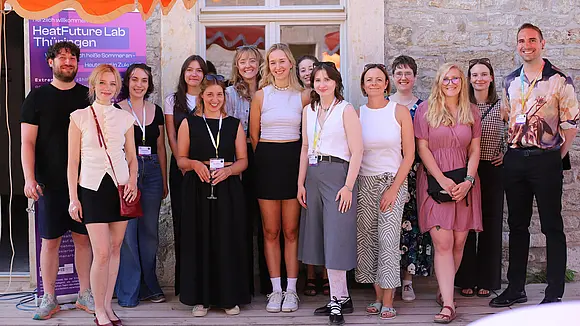
What will the medicine of the future look like in terms of dealing with rising temperatures? The HeatFuture Lab invited members of the public to explore the consequences of hot summers and to contribute their own ideas. Around 1,100 visitors took the…
What will a hot summer feel like in the future? And how can cities, healthcare and we ourselves cope better with heat? Questions like these are the focus of the HeatFuture Lab Thuringia, which the Institute for Planetary Health Behaviour at the…
Extreme heat is becoming an ever-greater threat to public health in Europe – the continent is warming at almost twice the global average rate. An international research team led by the Institute for Planetary Health Behaviour at the University of…
The Institute for Planetary Health Behaviour (IPB) is once again supporting two innovative interdisciplinary research projects in the field of Planetary Health Behaviour through its annual internal project funding scheme.
Rising temperatures, urbanisation and artificial light at night are altering the living conditions of mosquitoes in Europe – with potential consequences for the spread of pathogens such as the West Nile virus. A new network project by the One Health…