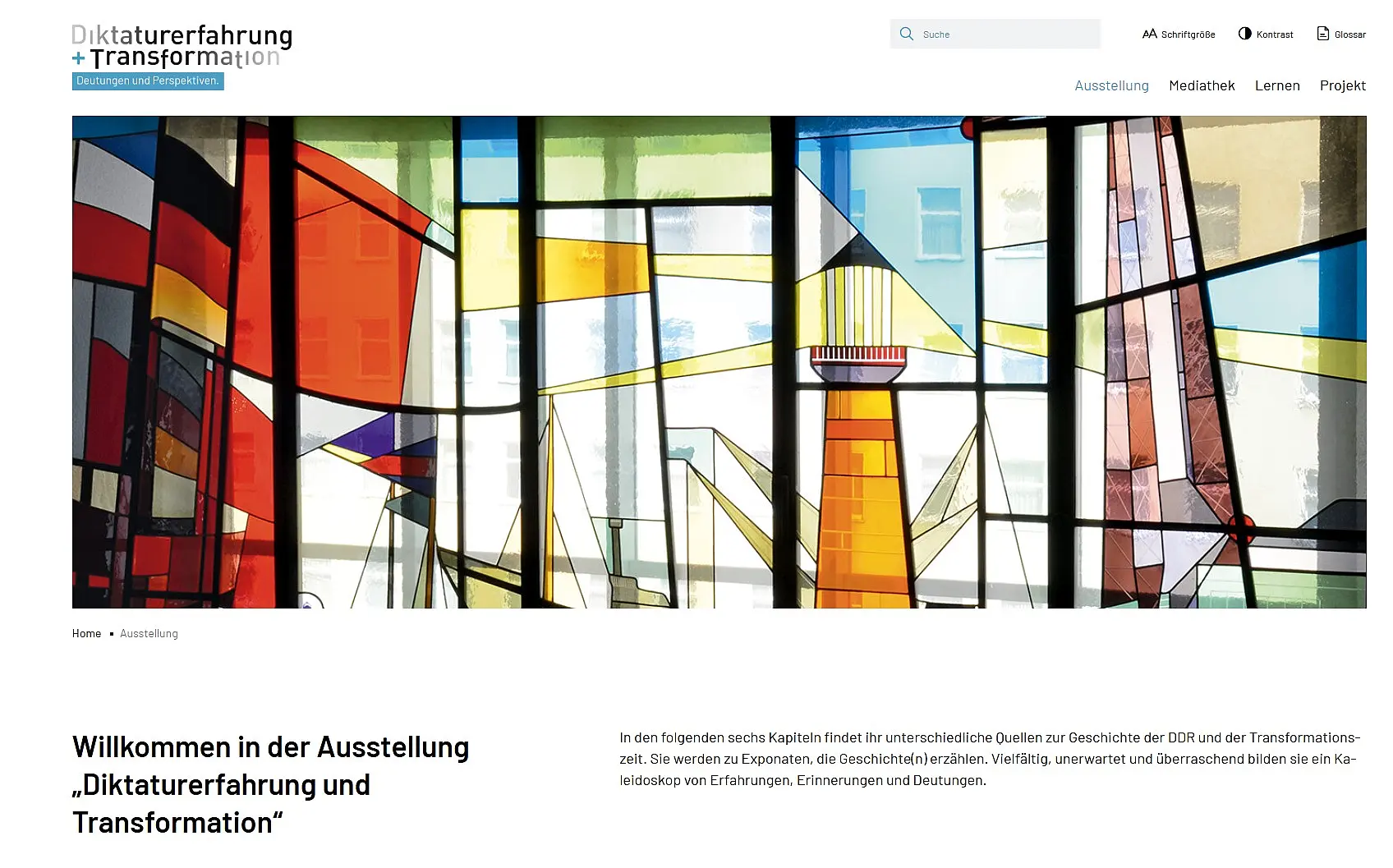
It is aimed at anyone who wants to take a critical, differentiated and multi-perspective look at the history of the GDR and the transformation period and presents a selection of key sources and materials from this period. The exhibition also presents the research results of the network in a thematically structured way; a media library also offers the opportunity to access the digital copies provided as sources and to enable a critical examination of the sources.
The research network "Dictatorship Experience and Transformation", which was funded by the Federal Ministry of Education and Research until the end of September 2025, is an interdisciplinary cooperation of history didactics, historians, art historians, literary scholars, social scientists, theologians and film scholars. The aim of their research was to write a history of the experiences of the late GDR and the transformation period that gives space to a broad spectrum of experiences, including contradictory ones, and thus helps to overcome dichotomous perspectives. The starting point was the assumption that not only individual and collective experiences during the GDR itself, but also the profound experiences of upheaval since 1990 characterise the memory of the GDR. This results in the conflict of remembrance that characterises the current controversial debates. The year 1989 was therefore deliberately placed at the centre of the four-decade period under investigation.
The ten subprojects of the network were grouped into two main areas: Projects in the area of experience and memory dealt with individual and group-specific experiences during the period under investigation, from which today's memories and value judgements are fed. Projects in the area of representation and judgement formation investigated different forms of engagement with the GDR and the transformation period. One of the principles of the network is to combine historical research and social dialogue. The digital platform that has now been published was also created against this background. In addition to the thematically structured presentation of the DuT research results, a media library offers the opportunity to access and view the digitised material as sources. The combination of thematic content access and source-based page indexing means that the platform can be used both independently for in-depth research and in school lessons.
The diverse materials (written sources, photographs, literary texts, interviews, films, works of art) are clustered, contextualised and didactically prepared on the platform according to topic and media methodology. Arts, cultural, literary and film studies, historical and social science perspectives and didactic approaches are consistently brought together in order to illuminate the findings to date from multiple perspectives and in a multidimensional way. "Dictatorship experience" and "transformation" are thus filled with content and made individually tangible through case studies and sources.
The digitised material for the project was created in an independent digital collection at the Thuringian University and State Library (ThULB), where it can be viewed as a closed source collection and can also be found via other digital libraries.
![[Translate to English:] facebook icon](/fileadmin/SocialMediaIcons/iconfinder_06-facebook_white.svg)

![[Translate to English:] instagram icon](/fileadmin/SocialMediaIcons/iconfinder_38-instagram_white.svg)
![[Translate to English:] YouTube icon](/fileadmin/SocialMediaIcons/iconfinder_18-youtube_white.svg)
![[Translate to English:] xing icon](/fileadmin/SocialMediaIcons/iconfinder_xing_white.svg)
