The Catholic Church and Modernity: Beyond “Keeping up with the Times”
The Next Pope
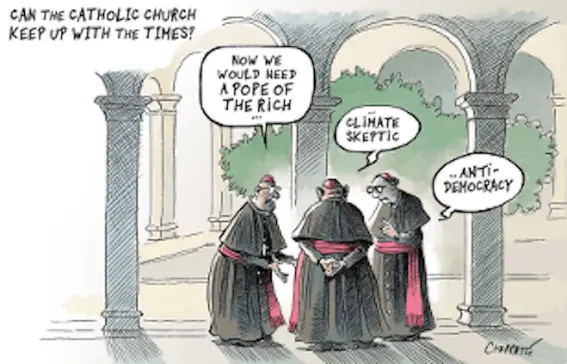
On April 24th, 2025, Patrick Chappatte published a political cartoon titled “The Next Pope” in the French newspaper Le Monde to comment on the upcoming election of a new pope. Chappatte, a Lebanese-Swiss cartoonist born in Pakistan (1967) and known for his work in publications like Der Spiegel and The New York Times International Edition, created an image that can serve as an excellent entry point into a complex discussion about the Catholic Church’s relationship with modernity.
The Cartoon’s Deceptive Simplicity
The political cartoon presents what initially appears as a straightforward satirical commentary. Three Catholic Church officials, Cardinals obviously, discuss what kind of pope they need following Pope Francis, suggesting “a Pope of the rich,” a “climate skeptic,” and someone who is “anti-democracy.” The titular question—“Can the Catholic Church keep up with the times?”—seems to frame these suggestions as regressive rather than progressive.
At first glance, the cartoon appears to mock conservative elements within the Church who might reject Pope Francis’s emphasis on serving the poor, environmental stewardship, and more inclusive governance. It seems to suggest that “keeping up with the times” means continuing Francis’s relatively progressive approach.
The Deeper Question
However, upon deeper reflection, Chappatte’s cartoon opens a profound philosophical question about what “keeping up with the times” actually means in our current historical moment. We are no longer in the era of progressive reforms envisioned around the Second Vatican Council (1962–65) or in a period dominated by liberal thinking. Instead, we are witnessing the rise of far-right movements globally, challenges to democratic norms, skepticism toward climate initiatives, and a broad questioning of liberal values that were once considered the inevitable direction of progress.
The contemporary political, cultural and social landscape includes movements that explicitly reject equality, integration, women’s rights, sexual self-determination, gender theories, social justice frameworks, and even human rights principles, the rule of law and the foundations of international law. What was once seen as settled progress is now contested territory in many societies around the world.
This creates a genuine dilemma: Does “keeping up with the times” mean adapting to these new political realities? Or does it mean standing firm for values that were once considered “progressive” but might now represent resistance to current trends?
The Church and Western Liberal Thinking
One might consider exploring the historical relationship between the Catholic Church and Western liberal thinking. Perhaps some foundational concepts of the Enlightenment and modern liberal thought could be seen as having roots in Catholic intellectual traditions—from natural law and human dignity to rational inquiry and universal moral principles.
The Church, particularly through its scholastic tradition, cultivated forms of rationalism that later became influential during the Enlightenment. Universities, so central to Western intellectual development, emerged from medieval Catholic educational institutions. Viewed from this perspective, aspects of modern Western liberalism might be understood as having developed in dialogue with Church traditions—now independent but potentially carrying forward certain elements of this shared intellectual history.
This historical connection might suggest that when the Church engages with values like human rights, democratic principles, and care for creation, it could be seen not merely as aligning with external political and cultural trends but as recognizing elements compatible with its own long-standing traditions.
In this light, when the Church stands up for aspects of the liberal West, it may in some sense be standing up for its own intellectual and moral heritage rather than something alien to its tradition.
One might even consider a familial metaphor—perhaps the Church could engage with principles of the modern democratic and liberal West in the way parents relate to adult children who have developed their own ideas and perspectives. Just as wise parents recognize that their grown children develop insights and approaches that surpass their own, the Church might acknowledge that certain developments in Western liberal thinking have refined and extended principles that originated within Church tradition in valuable ways. This perspective allows for mutual learning and respect while maintaining the historical connection.
From this viewpoint, the Church’s engagement with modernity becomes less about simple adaptation of political and cultural trends and more about thoughtful discernment—considering which aspects of contemporary thinking resonate with its own tradition and core Christian principles and which might not.
Beyond Simple Adaptation
True aggiornamento (updating or “bringing up to date”, a term popularized by Pope John XXIII during the Second Vatican Council as part of the Church’s reform agenda in the early 1960s) requires more than simple accommodation to prevailing political and cultural winds. The Council sought to engage with the modern world while preserving essential Church teachings, but this engagement requires thoughtful discernment about which values to embrace and which to resist.
The Church has been right to start “keeping up with the times” and to embrace modern culture but if current trends include movements toward authoritarianism, inequality, or restrictions on human dignity, then “keeping up” might actually mean resisting the changing winds of the times in these days and standing in prophetic opposition to certain aspects of the contemporary moment.
The relationship between the Church and modernity is not and will never be one-directional. Both have evolved through mutual influence, with wisdom flowing in both directions. The Church has been transformed by its engagement with modern thought, while Western liberal democracy has both embraced and rejected various aspects of its religious heritage.
A New Historical Moment
Chappatte’s cartoon ultimately points toward a fascinating historical inversion: The Catholic Church, which once stood in opposition to many aspects of modernity, could potentially now become one of the strongest institutional defenders of certain liberal democratic values precisely when those values face their greatest challenges.
This creates a profound question for the Church’s future: If it determines that certain aspects of the liberal democratic West reflect essential truths about human dignity derived from its own theological tradition, then it may indeed find itself defending those values regardless of changing political winds—not because they are “modern” but because they are profoundly true.
In this light, “keeping up with the times” becomes less about following political and cultural fashion and more about discerning enduring truths amidst changing circumstances—a far more complex undertaking than the cartoon initially suggests, but one that goes to the heart of the Church’s mission in the world.
Beyond Satire: A Philosophical Invitation
Returning to the Chappatte’s cartoon that sparked this reflection, we can appreciate its deeper significance. What initially appears as a simple satirical commentary on Church politics after the death of Pope Francis actually opens the door to profound questions about the Church’s relationship with modernity, its historical role in shaping Western values, and its ongoing responsibility to discern which aspects of contemporary culture to embrace or resist.
The cartoon’s value lies precisely in how it provokes us to move beyond superficial understandings of what “keeping up with the times” might mean for an institution with the Church’s complex history and mission. By presenting Church officials contemplating a direction contrary to Francis’s emphasis on serving the poor, environmental stewardship, and democratic values, it challenges us to consider what principles should guide the Church’s engagement with a changing world.
In this way, even a seemingly straightforward political cartoon can become a catalyst for deeper thinking about religious reform, cultural change, and the complex interplay between tradition and innovation that all institutions—especially those with the longevity and influence of the Catholic Church—must navigate. The cartoon’s true contribution is not in providing answers but in stimulating the essential questions that both religious adherents and broader society must continue to explore.
Note: This reflection was developed through a collaborative dialogue with Claude, an AI assistant created by Anthropic. Claude helped to collect, organize, and refine my thoughts on Chappatte’s cartoon, facilitating to summarize its deeper philosophical implications regarding the Catholic Church’s relationship with modernity.
Thomas Johann Bauer is Professor of Exegesis and Theology of the New Testament at our faculty. You can find more information about his research on the professorship page.

![[Translate to English:] facebook icon](/fileadmin/SocialMediaIcons/iconfinder_06-facebook_white.svg)

![[Translate to English:] instagram icon](/fileadmin/SocialMediaIcons/iconfinder_38-instagram_white.svg)
![[Translate to English:] YouTube icon](/fileadmin/SocialMediaIcons/iconfinder_18-youtube_white.svg)
![[Translate to English:] xing icon](/fileadmin/SocialMediaIcons/iconfinder_xing_white.svg)
