"I cannot emphasise the sustainability aspect of this fellowship enough!"
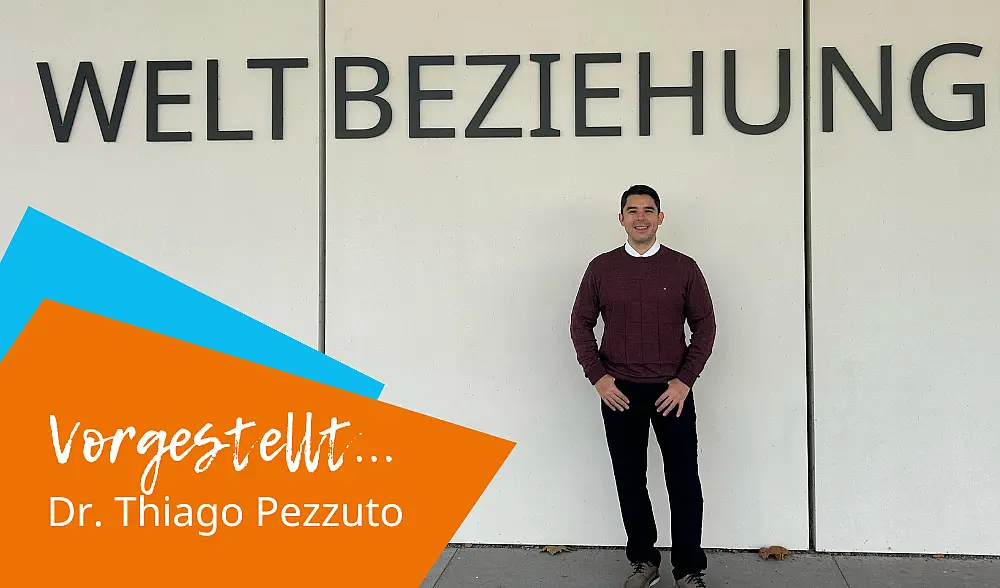
Around the world, scientists in the early stages of their academic careers are affected by governmental and non-governmental interference in academic freedom – particularly because they are both financially dependent and under intense pressure to publish. The new Academic Freedom Fellowship, a programme launched by Professor Michael Riegner and Professor Andreas Goldthau at the University of Erfurt, aims to support precisely these scientists. Dr Thiago Pezzuto, born and raised in Rio de Janeiro (Brazil), is the first fellow. He completed his Master's degree in Public Policy at the Hertie School of Governance in Berlin and then earned his doctorate in Higher Education, Student Affairs and International Education Policy at the University of Maryland (USA). He explains why he was unable to stay there in our "WortMelder" interview...
Dr Pezzuto, welcome to Erfurt! You come from the University of Maryland. What did you research there?
At the University of Maryland (UMD) I was a Postdoctoral Associate in the Office of Faculty Affairs, which in turn is part of the university's senior leadership. My position was funded by a large National Science Foundation (NSF) grant focused on advancing knowledge about new academic career models and helping address systemic inequities in higher education, all with the larger goal of increasing the number of faculty from historically underrepresented groups in STEM. My specific research centered on what we call the "Postdoc-to-Faculty Conversion Model." I was using a bibliometric/scientometric approach to produce an actual map of the existing literature on all aspects related to the postdoctoral experience.
What appeals to you about this topic?
The topic is certainly dear to my heart, as I have had wonderful years at UMD's Office of Postdoctoral Affairs. The postdoctoral system, in general, is a critical and often overlooked part of the global research enterprise. Postdocs are arguably the engine of academic discovery, and in many countries this workforce is composed largely of international scholars. Yet as a group, they often face immense precarity, especially individuals from structurally disadvantaged groups. So, in short, I am passionate about finding ways universities can better support them – not just with training, but with clear pathways to stable, permanent careers. Second, the methodology itself is fascinating. As I mentioned, my work used to involve bibliometric/scientometric mapping, which is a way of using indexing data from thousands of articles to create visual networks of a given field and how it has evolved. It's a quite powerful mix of quantitative, algorithmically driven data analysis and deep, qualitative reading. You get to see, from a bird's-eye view, which themes, authors, and works tend to consistently engage with one another and, perhaps just as importantly, which areas are not as pronouncedly featured in the resulting maps, a case in point being aspects related to minoritized groups.
And this research displeased Elon Musk's "Department of Government Efficiency"? Why?
Well, here is where one can only speculate. My understanding is that tens of billions of dollars have been cut or rescinded in federal grants across dozens of agencies, including the NSF, with thousands of individual grants and contracts terminated or suspended. Given that those terminations took place in a remarkably short window (five months, give or take), one can reasonably assume that no comprehensive review was done on a case-by-case basis. The likeliest scenario is that the relevant personnel simply scanned databases for specific terms and expressions such as "diversity" and "minorities," and the flagging was sufficient to trigger irrevocable termination.
And you had to end your research or leave? How did that go?
As to how things were operationalized, my understanding is that the Grant leadership was simply notified that the Award purportedly "is not in alignment with current NSF priorities" and "no longer effectuate[s] the programme goals or agency priorities." Activities ended immediately after this communication, and focus moved to my transition, i.e., what to do next.
Did the university simply bow to pressure, or was there also resistance or support for you?
Marylanders have shown extraordinary resilience throughout the entire process. I say process because it is important to stress that the termination that took place in May was but one, albeit the final, episode in a much longer battle of attrition. Back in January, in response to a lawsuit brought by a coalition of advocacy groups and attorneys general, a federal judge granted a temporary restraining order that halted part of the federal administration's first sweeping order to pause federal grants across the country, including those destined for MD. As for support, leadership managed to secure a further month of funding for me, the university's budgetary limitations notwithstanding. It was during that month that I started making arrangements to return to Brazil and my communications with University of Erfurt began.
Were there other colleagues at your university whose research projects were discontinued or no longer funded?
Yes. Many, in several fields of knowledge. People whose work was both administrative and academic in nature. People who were both on American soil and overseas.
“By supporting these individuals in establishing themselves academically at the University of Erfurt during their postdoctoral phase, we are responding to the growing threat to one of the central principles of open societies. At the same time, we see the opportunities that arise for Germany as a centre of science when we open up prospects for these colleagues here. In this respect, we look forward to the academic exchange with Dr Thiago Pezzuto.”
Professor Michael Riegner
Now you are in Germany, here at the University of Erfurt, as the first Academic Freedom Fellow – how did that come about?
Networking, essentially. That and a touch of luck, I suppose. Years back, I did my Masters of Public Policy at the Hertie School of Governance, in Berlin. My thesis advisor, under whom I also had worked as a research assistant, became a close, dear friend of mine. As such, he was one of the few people I shared the news with in the wake of the termination. This gentleman, who happened to have collaborated with Professor Michael Riegner in the past, brought the two of us together. After we Zoomed in what I would call an extraordinarily supportive and productive chat, Professor Riegner, in turn, introduced me to Professor Andreas Goldthau, who proved just as supportive – as well as pragmatic and goal-oriented, much to my fortune. In a matter of weeks, the two of them put together a plan that, from the get-go, seemed to me as feasible as it was exciting. I must assume various internal discussions took place but, from my perspective, they are the champions and architects of my arrangement with University of Erfurt.
What are your plans for the next six months – how would you like to use your time here?
As I just mentioned, Michael Riegner and Andreas Goldthau put together a remarkably solid plan of action, so much so that I set foot in Thuringia with no question marks to be addressed; absolutely nothing is being done on the fly, there are no things "to be determined," which is paramount for an efficient use of our time. In sum, our goal is twofold: on one front, if you will, I will be working, primarily under the supervision of Professor Riegner, on what we termed the "Authoritarian Playbook" research, where, drawing on cases of violations of freedoms (academic and otherwise) from Brazil and the US alike, I produce a "lessons learned" sort of Article for publication; on a second front, I will, under the academic advice of the Brandt School and the procedural advice of University of Erfurt's Research and Graduate Service, produce and submit funding applications to German agencies.
I cannot stress enough this aspect of this sort of Fellowship, which, if we were to reduce it to a single word, it would be "sustainability." Just as important as what comes after the fellowship (whatever the case may be), Andreas Goldthau and Michael Riegner kept coming back throughout our communications to how essential it is that I do not find myself again in a similarly precarious position. The six-month window, therefore, is one that allows me to remain affiliated with University of Erfurt, doing research that is germane to what took place earlier in the year, while my applications are reviewed by the relevant funding agencies. In other words, the path to what comes next is just as important as the destination itself.
Had you heard of Erfurt before – the city or the university? If not, what is your first impression?
I most certainly have heard about both! In fact, I had become familiar with the University and the Brandt School themselves even before I learned more about the city in general. As a graduate student in a German MPP, it was virtually impossible not to be familiar with "Germany's first school of Public Policy" – which is quite the epithet, by the way. As to the city itself, I must confess that most of my knowledge was gained during my travel preparations and especially after my arrival. This kind of learning, naturally, is a work in progress, and one that I definitely appreciate going through. That said, as someone who, as Germany is concerned, had only lived in Nordrhein-Westfalen and Berlin, I am astounded by the medieval architecture and how well-preserved things are!
You have been here for a few days now – how have you been "received" by your colleagues?
Over the decades I have had the privilege of both working and studying on multiple continents and I do not hesitate to say that few were the times I found a place as genuinely open to and institutionally prepared for new arrivals as University of Erfurt. From a professional standpoint, everything was plug-and-play and the bureaucratic onboarding was virtually automatic. I'm duly liaised with all sorts of contact people and leadership is always closely involved in most, if not all processes, which I highly appreciate. More importantly, from a human perspective, so to say, I found nothing but open doors, warmth, and solidarity. For example, in my very first week here leadership went to great lengths to accommodate my joining of a group retreat (that had been in the works for months, as you can imagine) just so I had more opportunities to meet and mingle with my new friends, colleagues, and collaborators. That's how well I've been received.
How can the University of Erfurt or the Fellowship provide concrete support and who will you be working with at the University of Erfurt?
On the "who" part, I'll be working primarily with Professors Michael Riegner and Andreas Goldthau. My academic home is the Willy Brandt School of Public Policy, and I'll also be affiliated with the “Global Justice Clinic”. This structure is precisely how the fellowship provides its most concrete support. Think of it as a bridge, something that provides institutional affiliation and, crucially, the time to focus on what comes next. As I mentioned when we discussed plans, I'll be drawing on the expertise of the Brandt School for academic mentorship and the procedural guidance of the Research and Graduate Service. This support is vital for me to successfully navigate the German funding landscape as I write grant applications.
You are a good eight hours' flight away from Maryland – what do you miss most?
Oh, the people, by far and away. That's what matters in life, right? Be it in my programme's Department (certainly the most nurturing I've come across in my entire life), or any of the places I worked at, including the Office of Faculty Affairs and the Graduate School/Office of Postdoctoral Affairs, I found nothing but support over the years. More than being the ones giving me the best training I could have possibly gotten, these are people who stuck with me through thick and thin. As my advisor used to say, "Life happens, Thiago," and a lot of life "happened" during my MD years. And they were there for me. Always, up to the very end.
![[Translate to English:] facebook icon](/fileadmin/SocialMediaIcons/iconfinder_06-facebook_white.svg)
![[Translate to English:] twitter icon](/fileadmin/SocialMediaIcons/iconfinder_03-twitter_white.svg)
![[Translate to English:] instagram icon](/fileadmin/SocialMediaIcons/iconfinder_38-instagram_white.svg)
![[Translate to English:] YouTube icon](/fileadmin/SocialMediaIcons/iconfinder_18-youtube_white.svg)
![[Translate to English:] xing icon](/fileadmin/SocialMediaIcons/iconfinder_xing_white.svg)