Commitment Award 2026: How science is turned into social enterprise in practice!
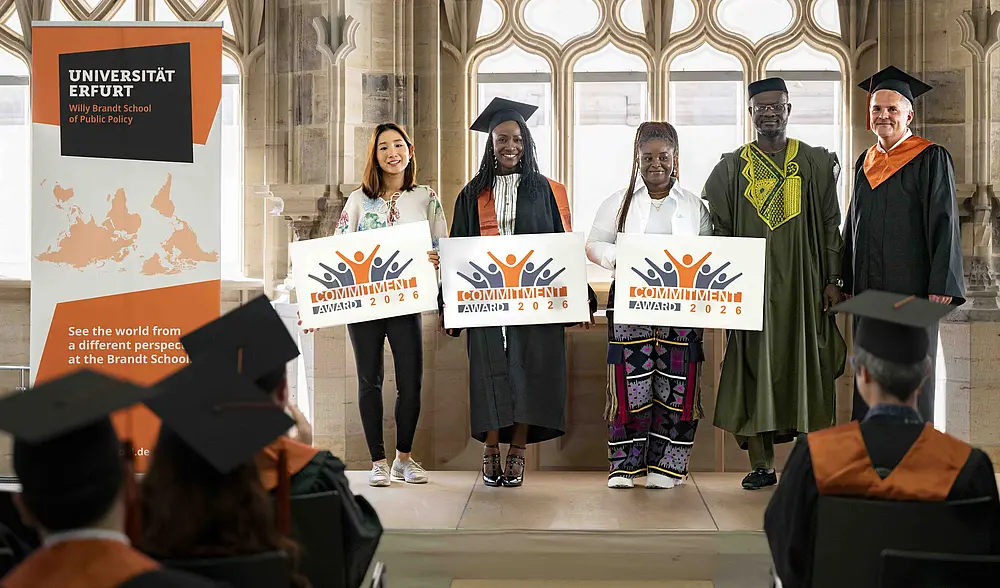
The Commitment Award, presented by the Willy Brandt School of Public Policy in collaboration with the Engagementpreis Foundation, demonstrates that studying at the University of Erfurt can have an impact on society and bring about change – this year as part of the Farewell Ceremony, at which the Brandt School bid farewell to its graduates of the 2024–26 cohort at the Collegium Maius.
The aim of the prize is to provide start-up funding for sustainable ideas and social projects, as the winners each receive prize money of 1,000 euros as “start-up capital” to implement their project. At the same time, students at the Brandt School can use their initiatives to demonstrate what they have learnt during their Master’s programme. The expert jury examines the entries closely: How much of a public benefit does the project offer? How much potential does the project have, and how sustainable is it? Will the prize money be used responsibly and effectively? How likely is it that the project will actually be implemented?
Markus Pins from the Engagementpreis Foundation – the award’s initiator and a long-standing university lecturer in public sector ethics – has now presented the awards and introduced the winning projects: “Algae cultivation, solar energy and emissions reduction are the three themes of this year’s Commitment Award. All three winning projects are sustainable, high-growth and innovative. And as such, they are prime examples of the application of scientific theory to social enterprise practice.”
And these are the 2026 winners:
Clean Cookstoves for Improved Well-being (Nigeria)
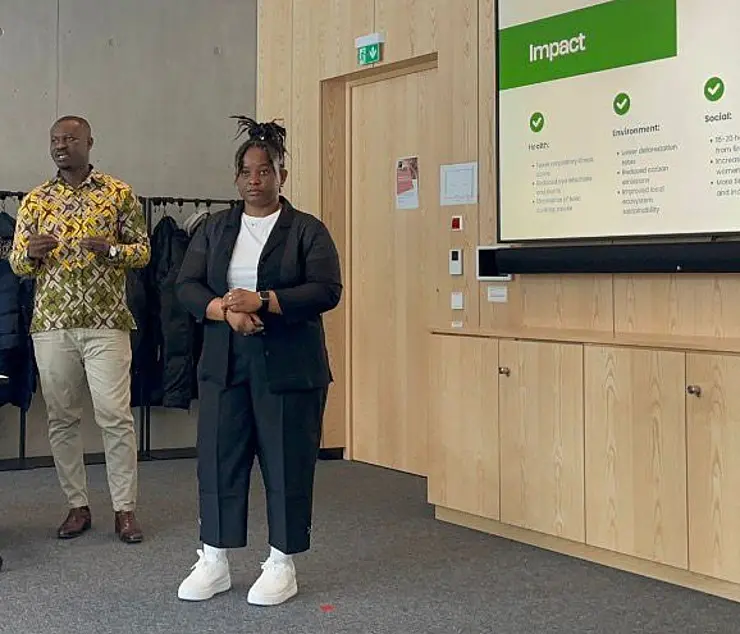
Through their project “Clean Cookstoves for Enhanced Well-being”, Nnenna Ebem and Bernard Osei-Frimpong are pursuing a clear vision: healthier living conditions, reduced environmental impact and more sustainable energy for underserved communities in Nigeria. At the heart of the project are 50 clean cookstoves, which are not simply distributed but firmly integrated into people’s daily lives through practical training and accompanying awareness campaigns. The project is complemented by an innovative pellet fuel kiosk that transforms agricultural waste into valuable fuel – a circular economy model that is both sustainable and scalable. In close partnership with PowerStove NG, this project is being developed to be firmly rooted in Abia State and to bring about tangible health and environmental improvements for the local population.
KELP Forward: Scaling up sustainable seaweed livelihoods in Tawi-Tawi
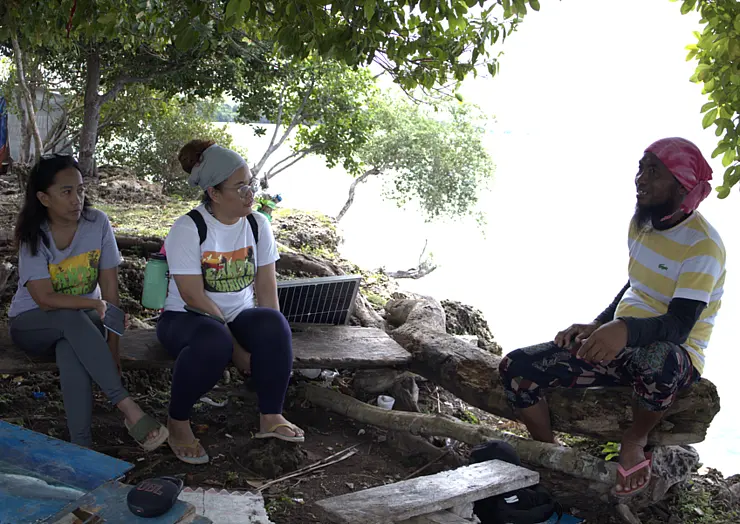
Through “KELP Forward”, Bea Pielago is supporting seaweed farmers in the Philippine province of Tawi-Tawi – right where their livelihood begins: at the source. Together with local partners ABS-CBN Foundation Inc. and Mindanao State University – Tawi-Tawi College of Technology and Oceanography, cultivation centres are being established where sustainable farming methods are taught and seed quality, cultivation techniques and post-harvest processes are specifically improved. The result: higher yields, more stable incomes and a more resilient, sustainable seaweed value chain – a win-win for both the farmers and the region as a whole.
Kijiji Yeetu Solar Empowerment Project (KYSEP)

Michelle V. Aluoch is bringing light to the local economy of Ugunja, Siaya, Kenya, through the “Kijiji Yeetu Solar Empowerment Project” (KYSEP). Her approach: clean, affordable solar energy for small businesses in rural communities – delivered in close collaboration with the Kijiji Yeetu Community Network. As a community-based initiative, KYSEP builds on existing structures and operates precisely where it makes a difference: by supplying local businesses with solar power, energy costs are significantly reduced, jobs are created, and environmentally friendly growth is promoted. With the start-up capital from the Commitment Award, a pilot installation can now be implemented and a community solar fund established – a model that truly sets an example for other regions.
We congratulate all the winners!
About the Commitment Award
Since 2012, the “Engagementpreis” Foundation and the Willy Brandt School of Public Policy have been organising the Commitment Award in close cooperation. It offers students at the Brandt School and people whose ideas they support the opportunity to apply what they have learnt during their studies and to launch new social initiatives here in Erfurt and around the world.
The projects are pitched in the spring of each year to an independent panel of experts as part of the Brandt School’s Social Innovation Lab, headed by Professor Heike Grimm. The three winning projects are selected on the basis of their charitable nature, effectiveness, and potential for success and sustainability. The prizes include start-up capital of 1,000 euros each, mentoring and networking opportunities.
![[Translate to English:] facebook icon](/fileadmin/SocialMediaIcons/iconfinder_06-facebook_white.svg)

![[Translate to English:] instagram icon](/fileadmin/SocialMediaIcons/iconfinder_38-instagram_white.svg)
![[Translate to English:] YouTube icon](/fileadmin/SocialMediaIcons/iconfinder_18-youtube_white.svg)
![[Translate to English:] xing icon](/fileadmin/SocialMediaIcons/iconfinder_xing_white.svg)
