

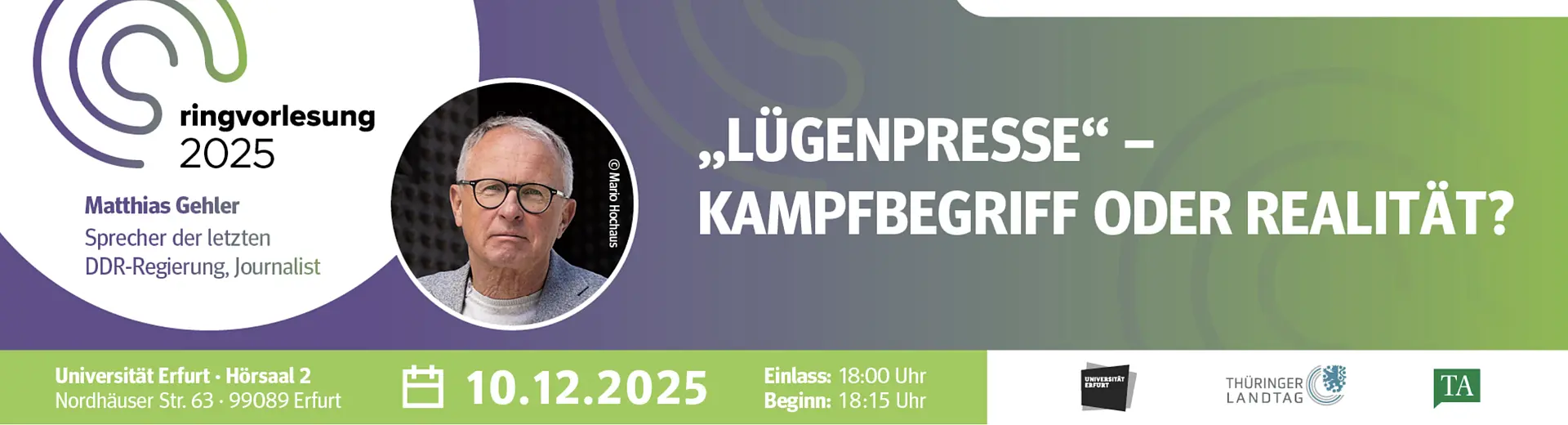
What is the significance of the accusation of the “Lügenpresse” (lying press) – and how does it change the public debate about media, politics and trust? In his lecture, journalist Matthias Gehler explores the question of how communication between the state, media and society has been organised in different political systems and what traces these developments have left to this day.
Based on his experiences as a speaker for the last GDR government, as a broadcaster and long-time observer of media discourse, he examines how information spaces are created, who shapes them and what responsibility journalists bear. Gehler shows that media credibility is not a static state, but a constant struggle for transparency, categorisation and critical distance.
Between state propaganda in the GDR, the upheavals of reunification and the digital public spheres of the present, he unfolds how language, narratives and media logic are changing – and how easily terms such as "lying press" can become political weapons.
"The media need freedom – and responsibility," emphasises Gehler, pointing out that independent reporting is only possible where journalists stand up to pressure, manipulation and populist simplifications. His lecture combines personal memory, professional expertise and analytical acuity to create an invitation to reconsider the role of the media as a democratic foundation – and to defend the value of free information in social dialogue.
The event begins at 6.15 pm, admission is from 6 pm. All interested parties are cordially invited. Admission is free, but registration is requested at www.thueringer-allgemeine.de/ringvorlesung is requested.
(text: Thüringer Allgemeine)
![[Translate to English:] Icon Instagram](/fileadmin/SocialMediaIcons/iconfinder_38-instagram_white.svg)
![[Translate to English:] Icon Facebook](/fileadmin/SocialMediaIcons/iconfinder_06-facebook_white.svg)
![[Translate to English:] Icon Twitter](/fileadmin/SocialMediaIcons/iconfinder_03-twitter_white.svg)


![[Translate to English:] YouTube icon](/fileadmin/SocialMediaIcons/iconfinder_18-youtube_white.svg)
![[Translate to English:] xing icon](/fileadmin/SocialMediaIcons/iconfinder_xing_white.svg)
