
Climate Connect connects
Climate Connect brings together two experts from different scientific fields. Climate research meets psychology or communication science, medicine meets cognitive science or educational science, health research meets political science, implementation research meets sociology. Both speakers have different expertise and experiences and will present their research on climate-friendly behaviour in a pointed manner. The audience is invited to participate in the current state of research on planetary health behaviour and to jointly provide visionary impulses in science, politics and society.
Climate Connect is aimed at anyone interested in scientific exchange and solutions for more health promotion and climate protection. Become part of the "missing link"!
Upcoming dates
16.01.2026: Climate action in court
In the next Climate Connect dialogue we welcome John Peters, lawyer at Lawyers Günther Partnership in Hamburg, one of the most renowned law firms in the field of environmental, planning and climate protection law. He advises civil society organisations, affected parties and municipal actors on strategic climate action and the legal framework for effective climate protection.
In conversation with Professor Cornelia Betsch (Institute for Planetary Health Behaviour), we shed light on how environmental lawsuits workwhich challenges and dynamics they entail and what role role strategic climate lawsuits play in political change and social debates. play. Among other things, the IPB's ongoing research on future litigation provides an opportunity for this.
John Peters, a lawyer at Rechtsanwälte Günther Partnerschaft in Hamburg, advises on environmental, planning and climate protection law. He is committed to legal frameworks that promote climate protection in concrete terms.
Previous dates & videos
19.09.2025: Verstehen. Warnen. Schützen. – Frühwarnsysteme und Schutzverhalten bei Hitze
The Institute for Planetary Health Behaviour at the University of Erfurt invites you to the next event in the ‘Climate Connect’ series. Guests include Professor Dr. Markus Reichstein (Director at the Max Planck Institute for Biogeochemistry in Jena) and Dr. Dominik Daube (scientist at the Institute for Planetary Health Behaviour).
This Climate Connect event will focus on dealing with extreme heat. The guest speaker will be Professor Dr. Markus Reichstein, Director at the Max Planck Institute for Biogeochemistry in Jena. He develops AI-supported early warning systems that identify the risks of heat waves at an early stage based on climate data, soil moisture and changes in vegetation. In conversation with Dr Dominik Daube from the Institute for Planetary Health Behaviour, they discuss how AI-supported warning systems and research into heat protection behaviour can work together. Dominik Daube researches how people react to heat – and what role behaviour, communication and social factors play in effective protection. The aim of the event is to think about early warning and protective behaviour together.
speakers
- Professor Markus Reichstein | Director at the Max Planck Institute for Biogeochemistry in Jena /// Focus areas: Climate extremes and their impact on ecosystems and societies, application of artificial intelligence/machine learning to spatiotemporal dynamics and early warning systems
- Dr Dominik Daube | Researcher at the Institute for Planetary Health Behaviour /// Focus areas: evidence-based health communication, climate-healthy behaviour, research communication
Moderation
- Guido Mehlkop, Institute for Planetary Health Behaviour, Universität Erfurt
Unfortunately, for technical reasons, no recording of this edition of Climate Connect is available.
20.06.2025: Politik mit der Kettensäge - Welche Auswirkungen hat die Trump-Administration in den USA auf den weltweiten Klimaschutz?
14.03.2025: How does it feel to talk to Mother Earth on the phone? And what if Mad Men were to market climate action?
14.02.2025: Election special - More citizen participation for a stronger democracy?
06.12.2024: Utopias against fear? What we can learn from Star Trek for our future
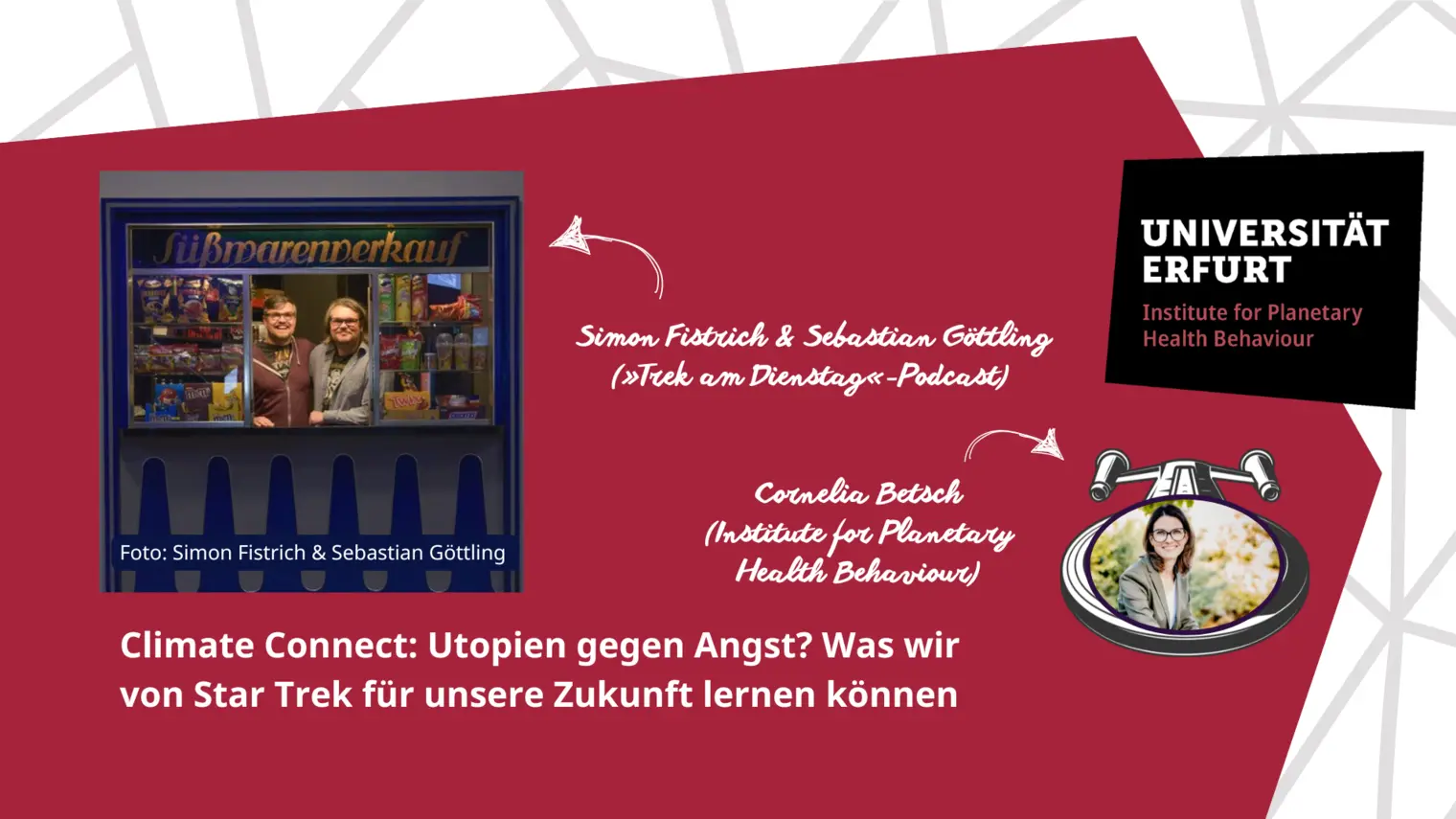
Please note: Once you watch the video, data will be transmitted to Youtube/Google. For more information, see Google Privacy.
18.10.2024: Climate education and education for sustainable development: what skills are required and what contribution can schools make?
07.06.2024: How local journalism could increase the willingness to act against the climate crisis
15.03.2024: Limits of evidence - How can good research communication prevent false conclusions and overgeneralisations?
08.12.2023: Technological openness in the climate crisis: a driver or brake on transformation?
01.09.2023: Behavioural science-based agenda setting at the climate and health nexus
All previous episodes of our lecture series on planetary health behaviour can be found under "Previous dates" and on YouTube.



![[Translate to English:] facebook icon](/fileadmin/SocialMediaIcons/iconfinder_06-facebook_white.svg)

![[Translate to English:] YouTube icon](/fileadmin/SocialMediaIcons/iconfinder_18-youtube_white.svg)
![[Translate to English:] xing icon](/fileadmin/SocialMediaIcons/iconfinder_xing_white.svg)