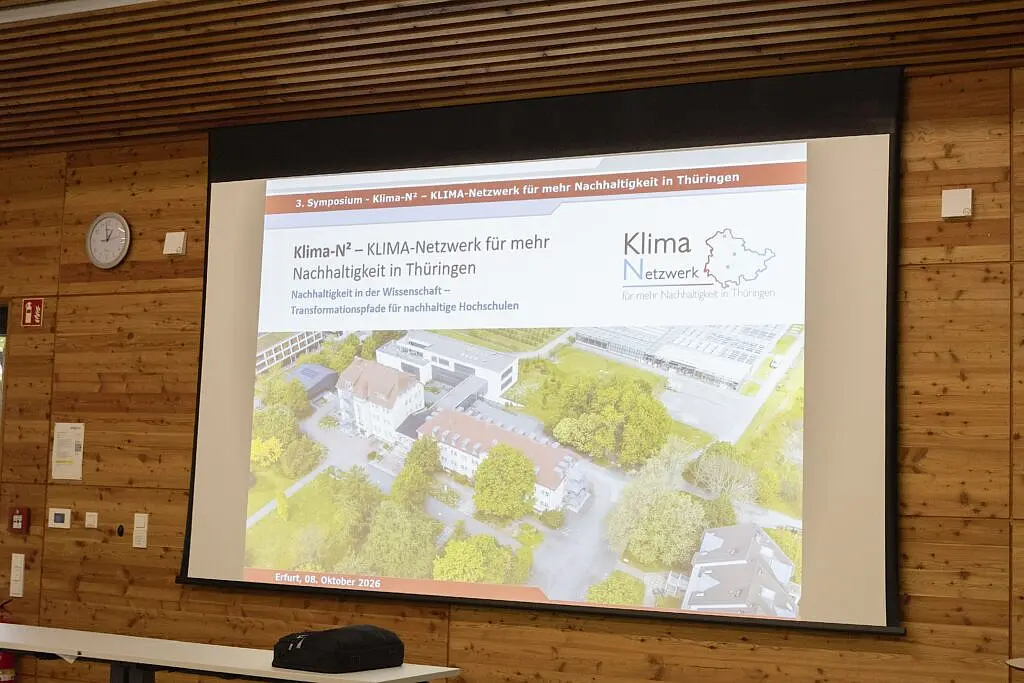
Following a welcome address by Prof. Dr. Björn Machalett and an introduction by the moderator, M. Eng. Kora Schumann (research associate, Klima-N), the first session focused on insights from networks in Thuringia. It opened with a keynote by Dr. Karsten Gäbler (Friedrich Schiller University Jena), entitled "Vernetzt für den Wandel: Das Thüringer Hochschulnetzwerk Nachhaltigkeit". Drawing on his experience with the Thüringer Hochschulnetzwerk Nachhaltigkeit (THN-N), he explored what networking means in the context of higher education. He pointed out that although sustainability has become part of university mission statements and task forces, its implementation in everyday practice and its funding often remain challenging. Effective networking therefore requires professionalisation, the active balancing of different expectations and the development of strong, lasting relationships. His message was clear: obstacles should not be a reason to lose heart.
Markus Wolf and Dipl.-Ing. Christoph Greiner-Petter then demonstrated how a network can develop into a permanent structure. The WIR!-Bündnis Holz-21-regio brings together universities, non-university research institutions in the construction sector, businesses, local authorities and policymakers across the entire value chain, from forest conversion to recycling. With funding from the BMFTR's "WIR!" programme, the Kompetenzzentrum Holzbau und nachwachsende Rohstoffe (KHoR) is being established in Suhl-Nord as a permanent knowledge transfer structure. The example of Bündnis Holz-21-regio illustrates how cooperation between research and practice can drive regional transformation processes.
In the second session, the Klima-N project partners presented their findings and achievements. Erfurt University of Applied Sciences (Prof. Dr. Björn Machalett) focused on campus biodiversity, including the creation of a natural garden, an inter-university lecture series and sustainable mobility concepts. The project also gained an international dimension through Green Trans Edu. Going forward, the aim is to embed institutional practices and transfer the results to additional stakeholders through the THN-N. The University of Erfurt (apl. Prof. Dr. Bettina Hollstein) piloted and evaluated service learning in teaching, introduced a sustainability certificate and established links with new partners, including the BBNE project (Berufliche Bildung für nachhaltige Entwicklung). During the symposium, Holz-21-regio was identified as a potential additional partner for the project at the University of Erfurt. At Ilmenau University of Technology (Prof. Dr. Jens Wolling), a university-wide Taskgroup Nachhaltigkeit and a Green Office were established. The latter is intended to develop into a sustainability forum. Sustainability issues were also incorporated into the university's overall strategic development. Prof. Wolling emphasised the importance of goals, supporters and pathways. His message was that it is important to be patient and impatient at the same time, to push things forward and not give up. Representing Nordhausen University of Applied Sciences, Sabine Köhler presented the institution's work on behalf of Dr. Pascal Leibbrandt. As part of the project, the university analysed its resource flows and implemented practical initiatives such as a Solar Island. A Campus Sustainability Guide and a Sustainability Advisory Board were also established.
Dr. Daria Meyr, R&D Officer at Anhalt University of Applied Sciences, provided insights into another network with her keynote "Brücken bauen für die Transformation". She reported on the network "Nachhaltigkeit in der Wirtschaft in Mitteldeutschland". Based on the Quadruple Helix model, innovation emerges from the interaction between academia, business, public administration and civil society. The network currently comprises 68 partners. She identified trust, a shared language, clear objectives and time to build relationships as key success factors. Bottom-up approaches also enable partners to take the initiative in shaping issues that they consider particularly urgent.
The symposium concluded with a panel discussion on the factors that make partnerships successful. The panellists were apl. Prof. Dr. Bettina Hollstein (University of Erfurt), Dr. Daria Meyr (Anhalt University of Applied Sciences), Dr. Mira Rochyadi-Reetz (Ilmenau University of Technology) and Markus Wolf (Bündnis Holz-21-regio). They agreed that clear leadership by a core team should be combined with opportunities for discussion and participation, and that partners should be approached as equals and offered opportunities for meaningful involvement. The panel identified mutual trust and personal relationships as the essential foundations for long-term cooperation.
The symposium highlighted one key message: sustainability cannot be achieved at universities in isolation. Networks provide structure, mutual support and greater resilience when facing conflicts and resource constraints. For the Klima-N project, the symposium marks the beginning of further networking activities. Exchange between the project partners will continue, alongside cooperation with the Thüringer Hochschulnetzwerk Nachhaltigkeit, Anhalt University of Applied Sciences and non-university partners such as Holz-21-regio.