
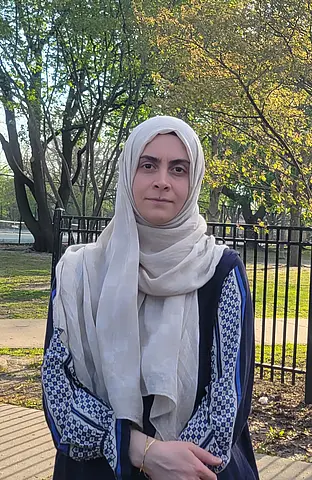
Rukıyye Hacifettahoğlu Güleçyüz
rukiyye.guelecyuez@uni-erfurt.deDoctoral candidate in the ERC project ‘(De)Colonising Sharia?’ (Max Weber Centre for Advanced Cultural and Social Studies)
Contact
Office hours
by appointment
Visiting address
Max Weber Centre for Advanced Cultural and Social Studies
C19 – research building "Weltbeziehungen"
Max-Weber-Allee 3
99089 Erfurt
Mailing address
Universität Erfurt
Max Weber Centre for Advanced Cultural and Social Studies
Postfach 90 02 21
99105 Erfurt
Personal Information
Rukıyye is a doctoral researcher at the Max-Weber-Kolleg whose interdisciplinary background spans data analytics, Islamic legal history, and sociological inquiry. She holds graduate degrees in Measurement and Data Analytics from Anadolu University (2024) and in Islamic Law from Istanbul 29 Mayıs University (2020), where she produced a critical edition and analysis of Nişāncızāde’s Nūr al-ʿAyn fī Iṣlāḥ Jāmiʿ al-Fuṣūlayn, contributing to the preservation and interpretation of Ottoman legal scholarship. She also earned undergraduate degrees in Sociology from Anadolu University (2018) and Islamic and Religious Sciences from Istanbul 29 Mayıs University (2016), graduating as Salutatorian and completing a year-long Arabic Preparatory Program. Her academic experience includes a study-abroad term at Petra University in Jordan, where she focused on Classical and Modern Arabic. In addition to her doctoral work, she is pursuing further training in Information and Document Management at Istanbul University. As part of the Decolonizing Sharia project since winter 2025, Rukıyye contributes to rethinking Islamic legal traditions through critical and decolonial perspectives.
Research Project
Beginning in the nineteenth century, modernization movements rooted in positivist colonial ideologies began to challenge the centrality of Islamic law, resulting in significant shifts in its authority and application. Although the Ottoman Empire never fell under direct European colonial rule, it experienced a form of intellectual colonization. Reformers initiated concerted efforts to align Ottoman legal practice with European traditions — both to address contemporary challenges and to assert the Empire’s position on the world stage. These efforts culminated in the establishment of the Republic of Turkey.
My research focuses on tracing the continuity, change, and rupture in the application of Islamic law over time, specifically in the context of two significant historical periods: the 19th-century modernization efforts of the Ottoman Empire and the 20th-century radical secularization of the Turkish Republic. By examining significant legal reforms and court cases, the study investigates the legal transformation from the Ottoman Empire to the Republic of Turkey, and explores how these changes altered legal practice. It also explores how legal actors and institutions managed the tension between inherited Islamic legal traditions and imported European norms during a critical period of legal change.
Publications
- Hacifettahoğlu Güleçyüz, R. (2025). Yazma Eser Çağında Kütüphaneler. Bilgi Ve Belge Araştırmaları, 23, 58-61. https://doi.org/10.26650/bba.2025.23.1642597
- Hacifettahoğlu Güleçyüz, R., & Bezirci, P. (2024). Güncel Kütüphane Hizmetleri Bağlamında Halk Kütüphanelerinin Özel Gereksinimli Bireylere Etkileri: Harold Washington Kütüphane Merkezi Örneği / The Effects of Public Libraries on Individuals and Groups with Special Needs in the Context of Current Library Services: The Case of Harold Washington Library Center. In P. Bezirci & I. Sert (Eds.), Cumhuri̇yet’i̇n 100. Yılında Bilgi ve Belge Yönetimi Teknolojisinde Güncel Yaklaşımlar (pp. 251–279). Istanbul: Istanbul University Press. https://iupress.istanbul.edu.tr/tr/book/cumhuriyetin-100-yilinda-bilgi-ve-belge-yonetimi-teknolojisinde-guncel-yaklasimlar/chapter/guncel-kutuphane-hizmetleri-baglaminda-halk-kutuphanelerinin-ozel-gereksinimli-bireylere-etkileri-harold-washington-kutuphane-merkezi-ornegi
- Hacifettahoğlu Güleçyüz, R. (2024). Osmanlı Saray Kütüphanesi ve Kataloğu / Ottoman Palace Library and Its Inventory [Review of Treasures of Knowledge: An Inventory of the Ottoman Palace Library (1502/3-1503/4) by Necipoğlu, G., Kafadar, C., H. Fleischer, C.]. Bilgi ve Belge Araştırmaları Dergisi, 22, 57-59. DOI :10.26650/bba.2024.22.1564554
- Hacifettahoğlu-Güleçyüz, R. (2020). Nişancızâde'nin Nûru'l-'Ayn adlı eserinin tahkik ve tahlili (1-6. fasıllar) / Critical Edition and Analysis of Nişāncızāde’s Nūr al-ʿAyn (chapters 1-6). (Publication no: 620331) [Master's thesis, Istanbul 29 Mayıs University]. YÖK Ulusal Tez Merkezi. https://tez.yok.gov.tr/UlusalTezMerkezi/TezGoster?key=Eb5EkakJlp3olBdo_wNEGeocLyztWxf_Z2ClNf3zPmk9ia-saWS4BXp8xCVyI2qC

![[Translate to English:] facebook icon](/fileadmin/SocialMediaIcons/iconfinder_06-facebook_white.svg)

![[Translate to English:] instagram icon](/fileadmin/SocialMediaIcons/iconfinder_38-instagram_white.svg)
![[Translate to English:] YouTube icon](/fileadmin/SocialMediaIcons/iconfinder_18-youtube_white.svg)
![[Translate to English:] xing icon](/fileadmin/SocialMediaIcons/iconfinder_xing_white.svg)
