
Gotha Research on Modern Times
In 2013, the content of the Gotha Research Centre was expanded to include a second focus on the cultures of knowledge of the 19th and 20th centuries. Focused on researching the more recent Gotha collections, in particular the extraordinary Gotha Perthes Collection, investments were made in an explorative research program. This was also done wanting to reach a scientifically interested public, for example within the framework of the annual Gotha Map Weeks organized jointly with the Gotha Research Library. National and international conferences and workshops as well as the work with excellent scholarship holders, early-stage researchers and senior fellows present on site constitute the attractiveness of Gotha research in modern times. In addition to the first doctoral projects, new ways of dealing with the diverse materials stored in the Gotha Perthes Collection, which extend far beyond the exceptional map holdings, were tested in broader cooperation and joint projects. These came primarily from the in-house publishing archive and the associated library. All these activities were connected with the concern to develop approaches of a transdisciplinary, global-historically informed collection and knowledge research, which is closely linked to innovative research questions and perspectives from the historical sciences, the history of science, literature and media studies, as well as from political and religious studies.
Only recently, this department of the Research Centre has become independent as the Centre for Transcultural Studies / Perthes Collection and holds the status of an academic institution of the University of Erfurt. This was done in close cooperation with colleagues from the Faculty of Philosophy and other faculties, who are now participating in the future structure as founding members. The spectrum of research activities has thus expanded once again, and the transdisciplinary orientation has been strengthened.
The Centre for Transcultural Studies, already excellently networked in the national and international research landscape, sees itself as a platform for inter- and transdisciplinary studies on the genesis of today's global world. The research, as well as the always research-oriented teaching, is focussing on the more recent Gotha collection contexts since the end of the 18th century and continues to pay special attention to the outstanding holdings of the Perthes Collection. In doing so, the topics of the Centre for Transcultural Studies open up paths hitherto hardly trodden by research: with a history of knowledge that explicitly turns to media and visual studies, with studies on the genesis and dislocations of the (post-)colonial world, or with work on the multi-layered genealogies of the Anthropocene. At the center of work of the newly founded Centre for Transcultural Studies is the contouring and profiling of a relationally oriented, transcultural knowledge research as well as a history of knowledge of the global, which – starting from Gotha – wants to fathom the much-cited relations between globality and locality and thereby includes (post-)colonial contexts and conditional structures. In this way, the Research College pursues the goal of significantly increasing the radiance of Gotha as a location for collections and research in an area that has been rather neglected to date. In doing so, it also explicitly focuses on current and simultaneously relevant topics of today, which are likely to be of interest to a broader audience.
The proposal is that Gotha's research on the modern era will initially concentrate on four areas within the Friedenstein-Gotha network, which admittedly does not exclude additional focal points to be developed:
Expeditions – Knowledge in the Field
Field research, i.e., knowledge practices in the so-called "field," are much discussed in historical knowledge research in connection with the assumption that the processes of knowledge genesis take place differently here than in the laboratory or at the scholar's desk. While for a long time the debate was determined by the assumption of an autonomy or even epistemic wildness and authenticity of the field, recently the interplay linking the knowledge generated in the field with the knowledge of the so-called parlor scholars has become of interest. Accordingly, questions of credibility, authority, but also the associated negotiation procedures as well as claims to power and validity move to the center. All this requires a methodically reflected cultural and social history of knowledge that is to be conceived in an open disciplinary manner and explicitly includes the competences of the area histories.
The Gotha holdings of recent times offer outstanding prerequisites for this complex of questions: The Gotha Perthes Collection as well as other special collections of the research library and the Friedenstein Castle Foundation hold extensive collections of material “from the field”, some of which are collections of objects, others sketches and field diaries with sometimes extensive collections of data and notes. The corresponding written material, especially letters, is also extensive, which suggests a discussion of approaches to self-testimony research. In addition, there are materials documenting the reorganization of the knowledge collected in the field and its further processing, which in turn show the heterogeneous, contingent assemblages that were to be used for the "maps in the making".
For projects in progress in this area to date, see, for example, "Cartographic Sources and Territorial Transformations of Ethiopia since the Late 18th Century (ETHIOMAP)" and Ethiomap: Exploring Modern Maps of the Horn of Africa,18th-20th centuries.
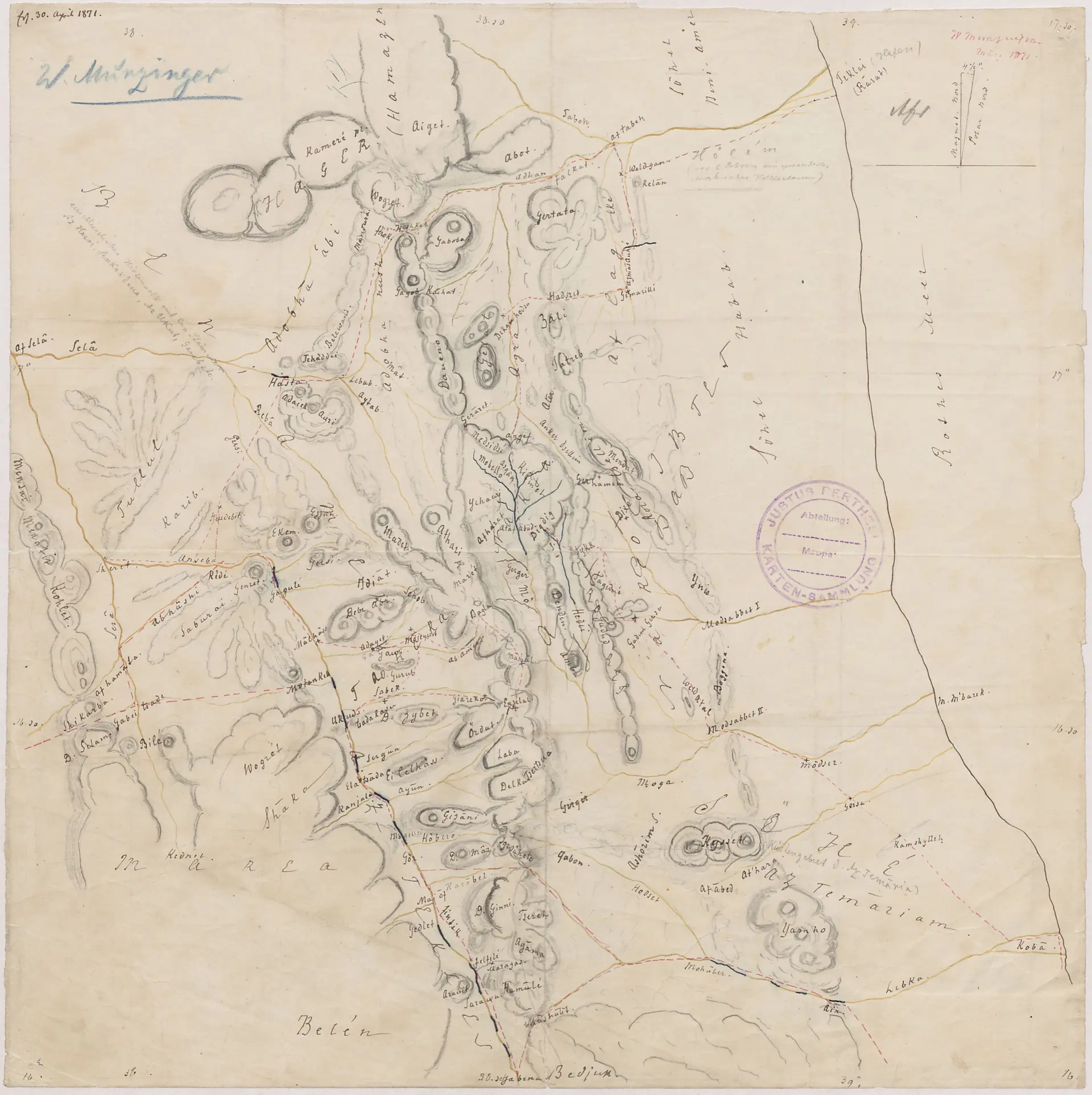
Picture: Draft map by Werner Munzinger for the exploration of the territories of the Habab & Beni-Amer peoples January-October 1871, together with an overview of the present knowledge of the North Abyssinian borderlands Bogos, Mensa, Marea © SPK 547-111827566, Gotha Perthes Collection / Gotha Research Library.
Maps – Nature – Science: Genealogies of an Elective Affinity
A second focus of work is linked to the goal of re-reading the cultures of knowledge of the 19th and 20th centuries, also with a view to the cultures of natural research. This area explicitly ties in with the content-related work of the Gotha Collection and Research Network, but at the same time specifies it with a focus on "maps". Decisive further impulses came from the BMBF-funded joint research project "Karten-Meere" (Mapping the Oceans), which has taken as its starting point the astonishing finding that the Gotha "cartographies of the seas" inscribe themselves in the genealogies of the contemporary emerging oceanography. The decisive factor here was also the attempt to scientifically profile oceanography for a broader audience with the help of the epistemic instrument of the map. This movement can also be traced for other natural sciences that became more and more differentiated in the 19th century, which also resorted to the epistemic instrument of the map: These include meteorology, botany, geology, and mineralogy, as well as other subfields that today can claim less scientific status for themselves, such as race studies or anthropogeography. To be sure, all of these sciences were in part of considerable importance to the colonial project. Distribution maps were omnipresent - and not least with regard to the manifold attempts to scientify the colonial.
The "scientific age" was thus also an age of cartography, which was primarily reflected in the Gotha Perthes Collection in the extensive holdings on the physical atlas. The first and second editions, published in the 1840s and early 1850s, and overseen by Alexander von Humboldt and Heinrich Berghaus, already offer a wealth of material, followed by the comprehensive third edition, which sought to document the current state of the natural sciences in the early 1890s.
See also: BMBF joint project "Karten-Meere. Für eine Geschichte der Globalisierung vom Wasser aus".
For further reading, some finds from the Map Seas blog: Wolfgang Struck, »Justus Perthes’ erste Karte« and Petra Weigel, Eine Insel der Meeresforschung in Gotha , and as a continuing PhD project: The Scientific Age in the Province - Researching, Collecting and Presenting as Sociable Practices around 1900.
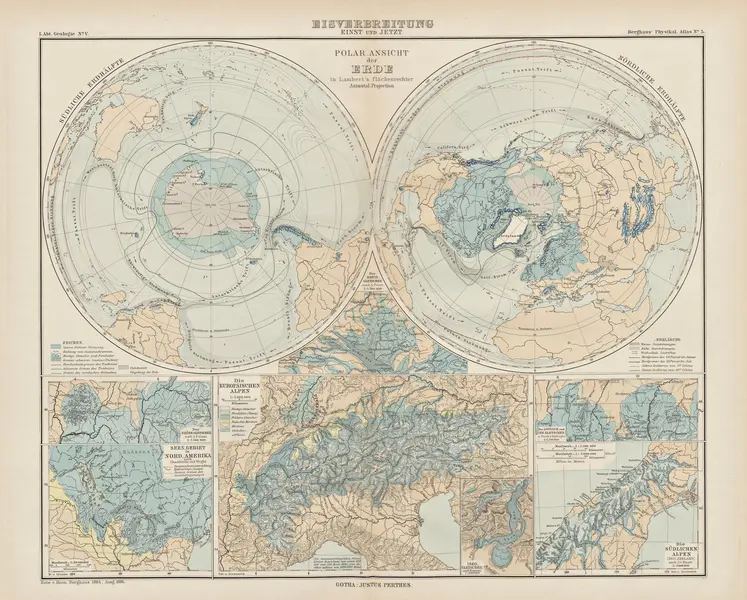
Image: ice distribution, past and present. Polar view of the Earth in Lambert's flat right azimuthal projection, in: Berghaus' Physikalischer Atlas, No. 5, Gotha 1892.
Collecting Knowledge: For a Transdisciplinary Collection Research
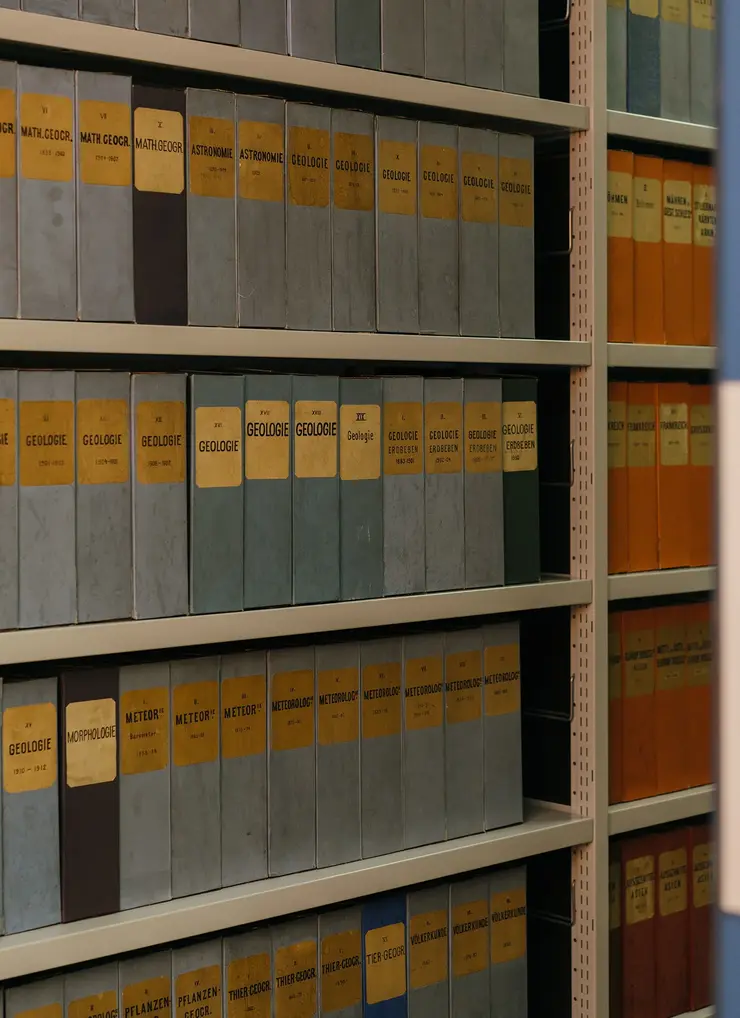
Understanding the residential city of Gotha as a place of collecting and knowledge since the late 18th century is a third important starting point for the work of the Centre for Transcultural Studies / Perthes Collection, which we are intensively pursuing together with employees of the Faculty of Philosophy. One concern is to further raise the profile of this perspective within the Gotha research landscape. After all, the library, the palace, the museum, and the archives with their associated magazines and depots, as well as in particular the legacy of the publishing house Justus Perthes and its successors, contain a great wealth and variety of collections: Listed in inventories, catalogs and lists, packed in folders, boxes, cartons, or standing unpacked on the shelf or hanging loosely in their own fixtures, all of these collection items and the local and global knowledge gathered in them can be explored in the most diverse ways. Firmly integrated, as a bindingly assembled sequence of maps, atlases can be understood as collections of their own type – indeed, on closer inspection, even the individual map is an accumulation of knowledge, which emphasizes the special features of collecting together with the procedures of arranging and sorting out, and which is thus worth exploring.
See also: Research Group "Cultural Techniques of Collecting".
Selling Knowledge: Publishing History and Other Knowledge Economies
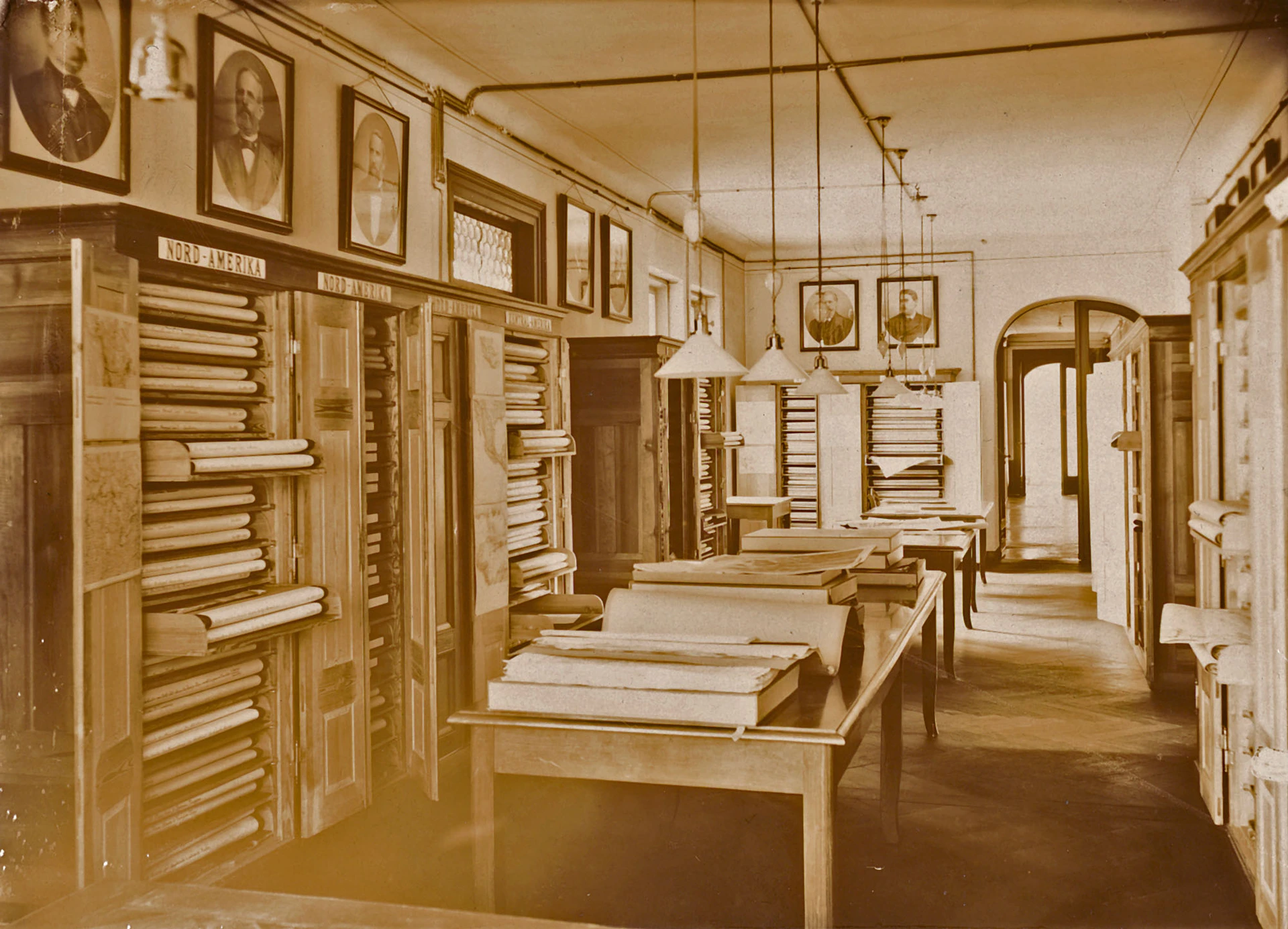
The Centre for Transcultural Studies / Perthes Collection is establishing a research unit for the history of publishing. This will expand research on the Gotha Perthes Collection with a special focus on the three publishing companies whose traditions the collection unites. In regular meetings, the research unit brings together scholars of image, arts, and books, as well as scholars from the fields of geography, history, and the history of science. Recent research has focused primarily on the early days and the heyday of publishing development in the 19th century, when the Gotha publishing house rose to become a globally active company under the name "Justus Perthes Geographische Anstalt Gotha". In the future, the history of the publishing house during the upheavals of the 20th century will also be the focus, i.e. the time of the "VEB Hermann Haack Geographisch-Kartographische Anstalt Gotha" as well as the "Geographische Verlagsanstalt Justus Perthes Darmstadt" founded in 1953 in the Federal Republic of Germany.
Picture: Ancestral Hall of the Perthes Publishing House © Perthes Collection / Gotha Research Library.
![[Translate to English:] facebook icon](/fileadmin/SocialMediaIcons/iconfinder_06-facebook_white.svg)

![[Translate to English:] instagram icon](/fileadmin/SocialMediaIcons/iconfinder_38-instagram_white.svg)
![[Translate to English:] YouTube icon](/fileadmin/SocialMediaIcons/iconfinder_18-youtube_white.svg)
![[Translate to English:] xing icon](/fileadmin/SocialMediaIcons/iconfinder_xing_white.svg)
