
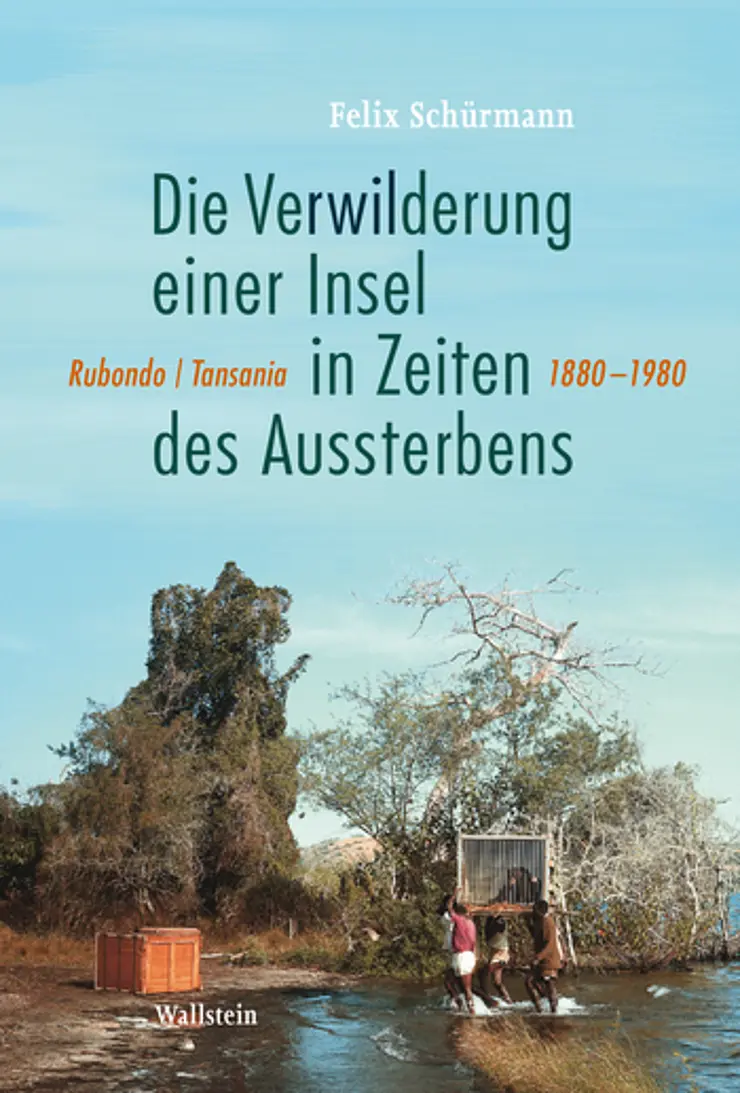
Schürmann, Felix, Die Verwilderung einer Insel in Zeiten des Aussterbens. Rubondo (Tansania), 1880–1980, Göttingen 2026.
An island of supposedly untouched nature in the midst of an ecological disaster zone: Whilst Lake Victoria is widely regarded as a cautionary tale of the destruction of biodiversity caused by the introduction of invasive species, the island of Rubondo is reputed to be one of the last remaining pockets of intact flora and fauna in Africa. Yet the species composition on the Tanzanian island has also been altered by the introduction of formerly non-native species. Rhinos and giraffes, chimpanzees and colobus monkeys, elephants and antelopes – during the period of upheaval following decolonisation, conservationists brought around one hundred large mammals to Rubondo from 1963 onwards, with the aim of transforming the island into a modern-day ‘Noah’s Ark’ for the endangered fauna of East Africa. To make way for this planned reintroduction of wild animals, the people living there – the Nyarubondo – were forced to leave the island. For the first time, Felix Schürmann tells the story of Africa’s oldest and largest nature reserve island and situates these events within the current debates on mass species extinction and the possibility of decolonising nature. He shows how, even during German rule, humans intervened in Rubondo’s biodiversity and, under colonial conditions, altered the living conditions of many species.
“Die Verwilderung einer Insel in Zeiten des Aussterbens” was published by Wallstein-Verlag in August 2026.

Werner, Anja, Deaf German Missionary Berta Foster (1939–2018) and Deaf Education in West Africa. A Woman in the Background, London 2026.
In 1960, 21-year-old Berta Zuther left her life in West Berlin behind to join African American missionary Andrew Foster in Ghana, thus embarking on a journey that would span three continents and result in the establishment of schools for the deaf across Africa. Berta and Andrew were both deaf themselves. They got married in Nigeria in 1961 and devoted their lives to building educational opportunities for deaf Africans - founding 32 schools, churches, and community centers in 13 African countries between 1957 and 2009.
This volume places Berta Foster at the center of interest, a woman who has remained largely invisible in existing accounts of her husband’s pioneering educational mission. While Andrew Foster has been celebrated as an icon in Black and Deaf American history, Berta's crucial contributions as administrator and driving force not just behind their German support network have been overlooked. Drawing on private family archives, including hundreds of personal letters, and interviews with family members as well as former students and colleagues from deaf communities in Ghana and Nigeria, this book explores how deafness, gender, and race intersected in the lives of a Christian couple working across cultural boundaries during the Cold War era.
“Deaf German Missionary Berta Foster (1939–2018) and Deaf Education in West Africa” was published by Routledge in July 2026.
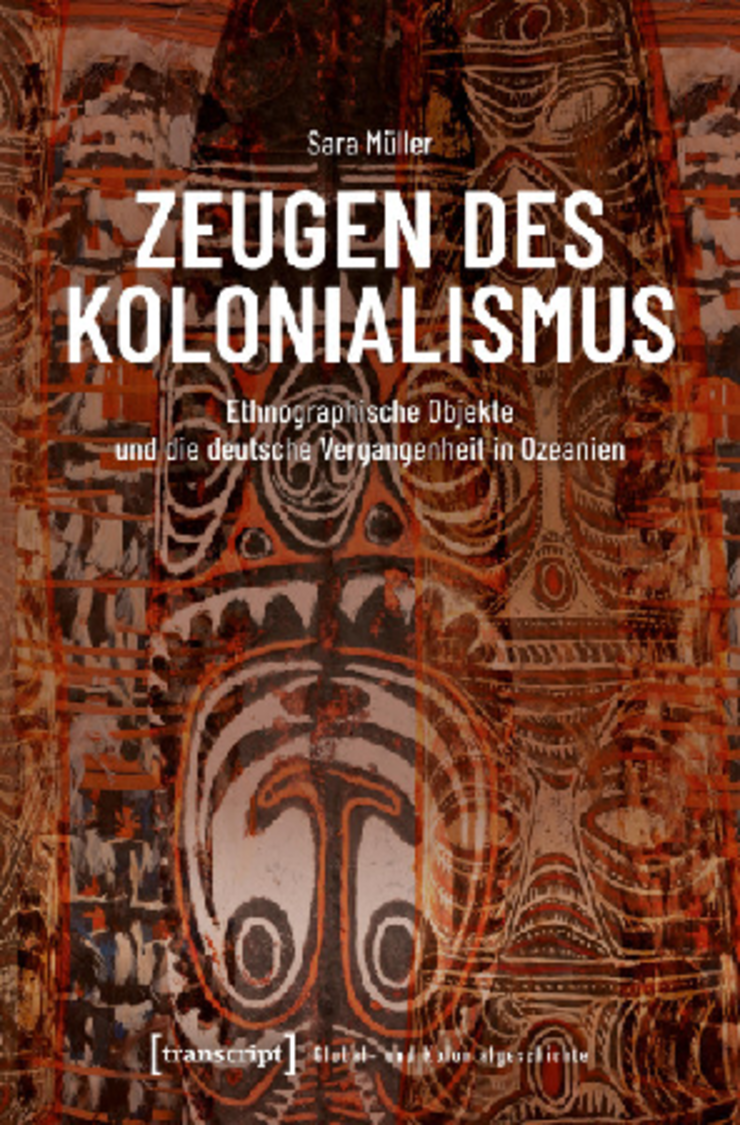
Müller, Sara, Zeugen des Kolonialismus Ethnographische Objekte und die deutsche Vergangenheit in Ozeanien, Bielefeld 2025.
The connections between ethnographic objects and German colonialism have long been no secret. However, the influence of scientific expeditions on the acquisition of objects is less well known. In 1912 and 1913, the Empress Augusta River Expedition explored the Sepik region in German New Guinea. Using selected object biographies from the Ethnological Collection in Göttingen and with the help of historical provenance research, Sara Müller examines the entire context of the appropriation of the objects. They thus become witnesses to economic exploitation, political interests, violence against people, and the logistics and handling of objects in German collections in the 20th century.
“Zeugen des Kolonialismus” was published by transcript Verlag in November 2025.
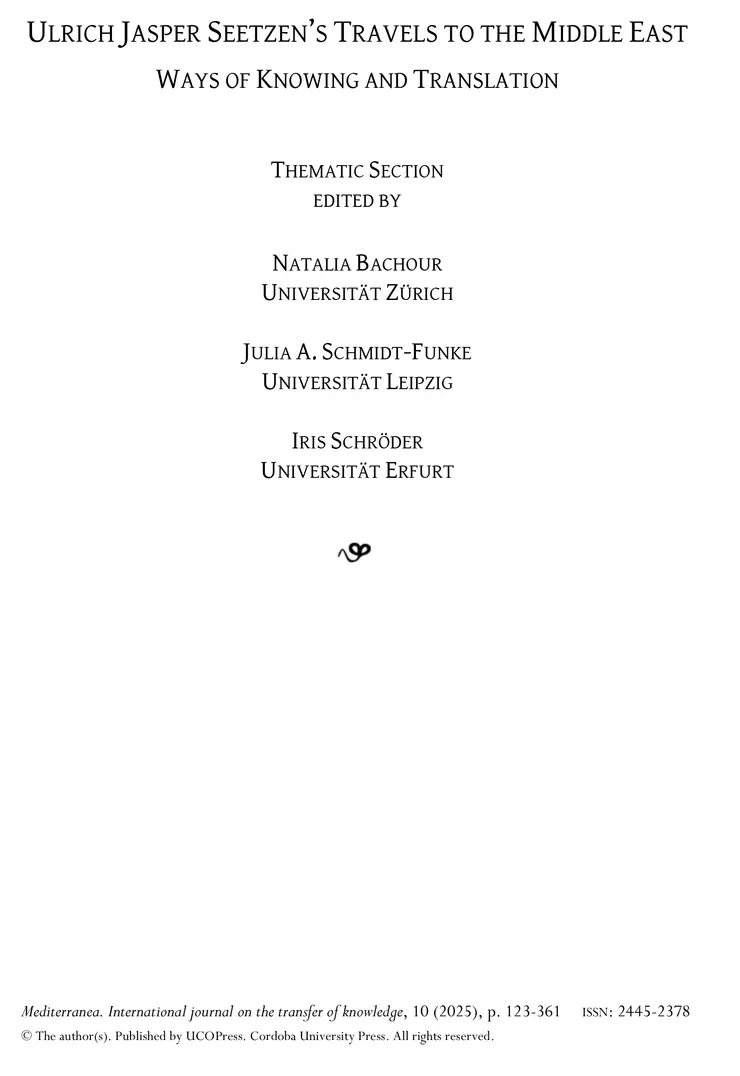
Schröder, Iris/Bachour, Natalia/Schmidt-Funke, Julia (eds.), Thematic Section: Ulrich Jasper Seetzen's Travels to the Middle East: Ways of Knowing and Translation, in: Mediterranea. International Journal on the Transfer of Knowledge 10 (2025), pp. 123-361
This thematic section explores Ulrich Jasper Seetzen's (1767-1811) travels through the Middle East, framing him as a knowledge broker between Europe and the Ottoman world. Drawing on his diaries and collections, the contributions examine Seetzen's observations of local physicians, religious groups, and cultural practices, as well as his role in collecting manuscripts, artefacts, and linguistic data. By analysing his encounters with Ottoman society - from medical traditions to renegades and Bedouin communities - the articles highlight Seetzen's efforts to document and translate knowledge across cultural boundaries. The section challenges simplistic Orientalist narratives, instead emphasising the complexities of cross-cultural exchange, the limits of European understanding, and Seetzen's position as an intermediary in a transnational network of scholarship. It invites a critical reassessment of how knowledge about the Middle East was produced, circulated, and contested during the early nineteenth century.
This thematic section was published in April 2025 in Mediterranea. International Journal on the Transfer of Knowledge.
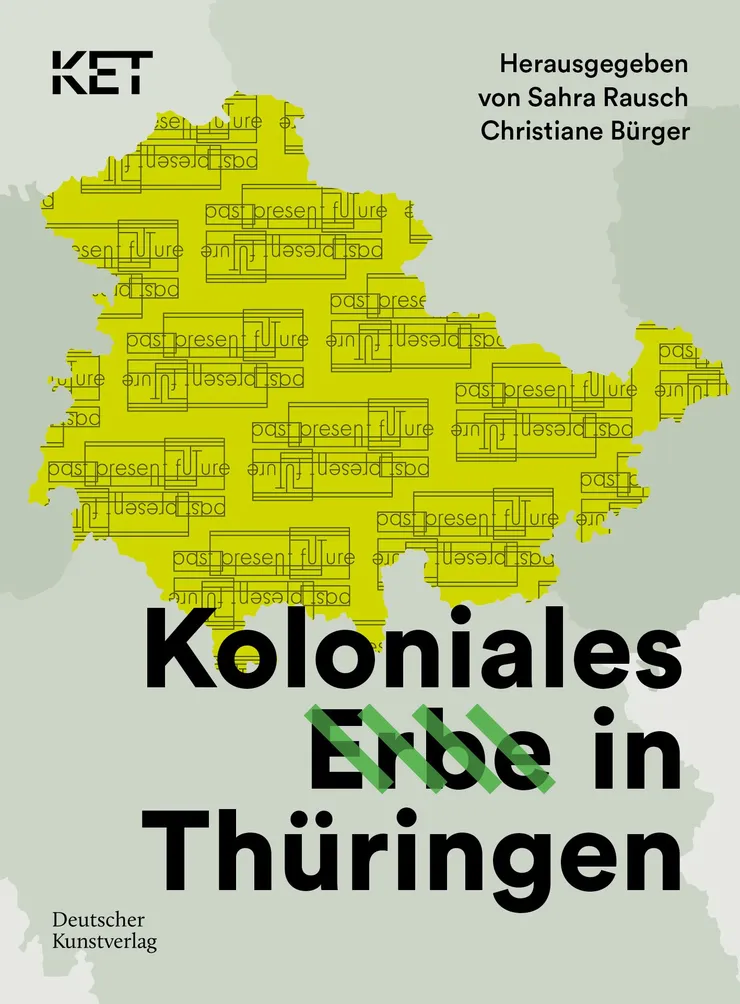
Rausch, Sahra/ Bürger, Christiane (eds.), Koloniales Erbe in Thüringen, Berlin 2025.
The significance of the colonial past for the present is currently fuelling public debate like no other topic. The regions far away from the metropolises are increasingly coming under scrutiny, as the colonial lines of communication reached as far as the village colonial goods shop. This anthology examines the traces of the colonial past at a local level and also traces Thuringia's involvement in colonial structures at a global level. The contributions range from the early modern period to the transformation period from 1990 onwards. The book takes stock of current research initiatives at Thuringian universities and also presents the socio-political perspectives of decolonial initiatives and artists. The volume was produced in collaboration with the artist Patricia Vester. Her graphic novel and illustrations, designed especially for this publication, provide inspiration for addressing the colonial past in and out of school.
"Koloniales Erbe in Thüringen" was published by Deutschen Kunstverlag (DVK) in January 2025.

Tobias Mörike, Understanding Palestine. Wissensdinge, Akteursnetzwerke, Raumerzählungen (1877-1929), Frankfurt a. M./New York 2024.
Things convey ideas and provide evidence of knowledge. The "Holy Land" has been the subject of theological research and scientific regional studies since the late 19th century. Maps, plant specimens and ethnographic objects, which Tobias Mörike explores as things of knowledge, conveyed ideas of an open-air museum of the Bible and a modern future colony. Based on the relationships mediated by objects, this book traces the connections between Christian imperial Palestine research and the scientific regional studies of early Zionism from the late 19th century to the mid-1920s.
"Palästina begreifen" was published by Campus Verlag in December 2024.
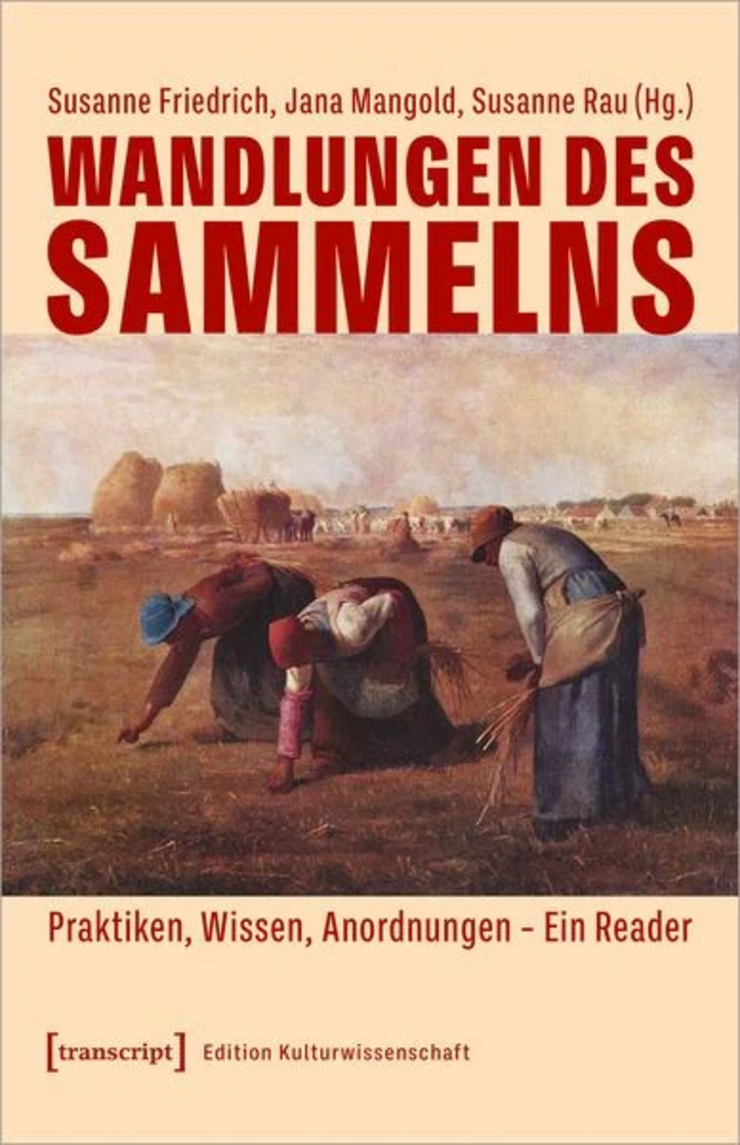
Friedrich, Susanne/ Mangold, Jana/ Rau, Susanne (eds.), Wandlungen des Sammelns. Praktiken, Wissen, Anordnungen – Ein Reader, Bielefeld 2024.
Collecting is to be understood as a cultural technique that has various synchronous forms and is subject to constant diachronic change. Collections are the results of specific practices: in their epistemological and aesthetic arrangement, they reflect the cultural orders and topographies of their time, whereby they form and shape knowledge spaces. The contributors to this reader focus on collection-related knowledge and cultural histories and thus establish interdisciplinary cultural studies research on collections - an innovative approach that makes the connections between collections and cultural history visible from multiple perspectives.
"Wandlungen des Sammelns" was published by Transcript publishing house in October 2024.

![[Translate to English:] facebook icon](/fileadmin/SocialMediaIcons/iconfinder_06-facebook_white.svg)

![[Translate to English:] instagram icon](/fileadmin/SocialMediaIcons/iconfinder_38-instagram_white.svg)
![[Translate to English:] YouTube icon](/fileadmin/SocialMediaIcons/iconfinder_18-youtube_white.svg)
![[Translate to English:] xing icon](/fileadmin/SocialMediaIcons/iconfinder_xing_white.svg)
