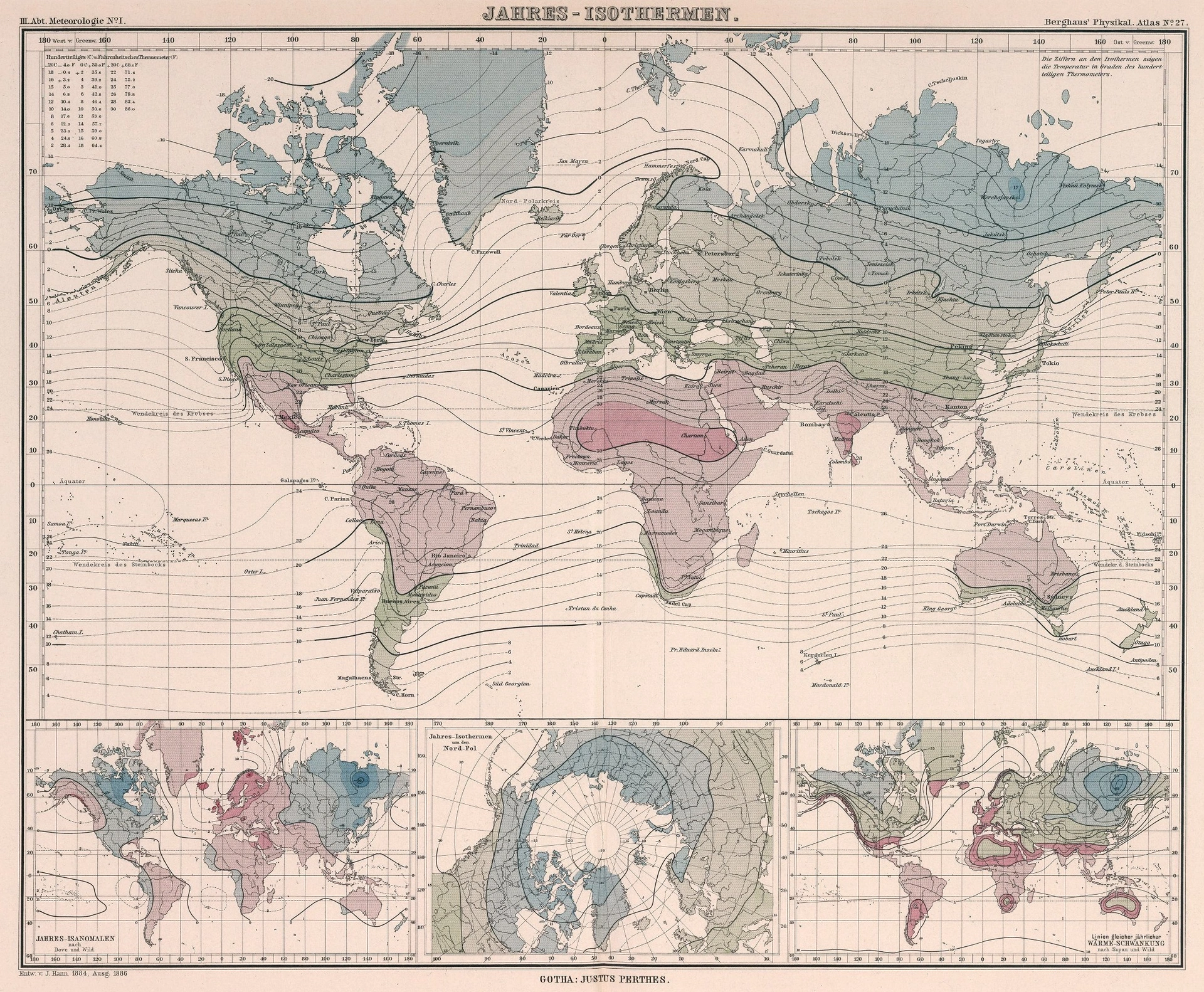
Knowledge about the climate, anthropogenic climate change and its effects on the environment characterises today's debates. However, the understanding of climate and by whom it was understood changed considerably in the course of the 19th and 20th centuries. Climate was not only an important topic of scientific debate, but also part of political, economic, colonial and medical discourse as well as bourgeois conversation. Climate was used to organise ideas of time, past and future, and space. This is the starting point for the habilitation project, which is located at the interface of knowledge and media history, and examines the changes, shifts and narrowing of knowledge about climate (change) in the period between around 1800 and around 1970. Using selected case studies, the study therefore aims to investigate questions about the emergence, communication and dissemination of the various interwoven aspects of climate knowledge. Three perspectives are guiding here: firstly, the medial production and distribution practices, logics and conditions of climate knowledge will be analysed; secondly, the various dimensions of climate knowledge with and beyond the purely scientific dimension will be investigated. Thirdly, climate knowledge will be understood as an approach to processes of organising space and time; firstly, it will be examined how temporal orders are challenged by the preoccupation with climate; secondly, the conditions of construction under which climate knowledge enables scaling between the local, regional and global will be investigated.

![[Translate to English:] facebook icon](/fileadmin/SocialMediaIcons/iconfinder_06-facebook_white.svg)

![[Translate to English:] instagram icon](/fileadmin/SocialMediaIcons/iconfinder_38-instagram_white.svg)
![[Translate to English:] YouTube icon](/fileadmin/SocialMediaIcons/iconfinder_18-youtube_white.svg)
![[Translate to English:] xing icon](/fileadmin/SocialMediaIcons/iconfinder_xing_white.svg)

University of Erfurt (Campus)
Nordhäuser Str. 63
99089 Erfurt