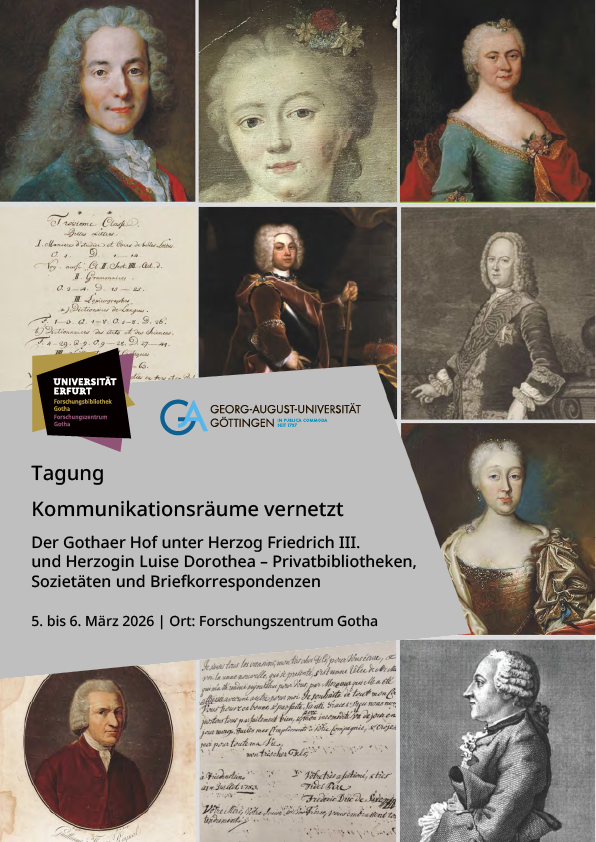

In the middle of the 18th century, the court of Luise Dorothea and Frederick III of Saxe-Gotha-Altenburg was characterised by new beginnings, sociability and productive engagement with the Europe of the Enlightenment and its (media) centres in Berlin, Göttingen, Leipzig, Paris, London and Amsterdam. The Gotha circle of nobility and scholars networked via correspondence and active membership of societies and thus participated in the literary and scholarly debates of the time via the expanding book and journal market. These communication processes had a significant influence on the collecting practices of the actors involved, particularly in their bibliophilic endeavours.
Against the background of praxeological approaches from the field of network research and the history of knowledge, and taking into account methods of digital humanities, the event is dedicated to the interconnections of early modern institutions and media at and around the Gotha court. The focus is on the question of the entanglement structures of aristocratic and scholarly actors in the communication spaces "book collection", "société" and "letter correspondence" as well as the discursive formations that constituted these spaces. The object of investigation is not only the book collections of the central protagonists – Duchess Luise Dorothea and Duke Friedrich III – and other learned and princely private libraries preserved in the Gotha Research Library, but also associations such as Masonic lodges or the mixed-gender Ordre des Hermites de bonne humeur. Particular attention will also be paid to the literary correspondence of outstanding personalities associated with the Gotha court, such as Juliane Franziska von Buchwald, Gottfried Christian Freiesleben, Friedrich Wilhelm Gotter, Laurent Angliviel de La Beaumelle and Voltaire, which frames the field of research.
The main questions of the conference are aimed at reconstructing the constellation of actors around the ducal couple: To what extent can practices of cooperation between Frederick and Luise Dorothea in the area of cultural and scientific activities at court be proven? Can the central position attributed to the duchess in this area be verified? What implications did her role have for the female networks at the Gotha court, which have so far only been partially investigated? What was the relationship of learned men and women to the courtly centre of power? The aim is to further analyse the communication and knowledge spaces at the Gotha court in the middle of the 18th century in their praxeological dimension.


![[Translate to English:] facebook icon](/fileadmin/SocialMediaIcons/iconfinder_06-facebook_white.svg)

![[Translate to English:] instagram icon](/fileadmin/SocialMediaIcons/iconfinder_38-instagram_white.svg)
![[Translate to English:] YouTube icon](/fileadmin/SocialMediaIcons/iconfinder_18-youtube_white.svg)
![[Translate to English:] xing icon](/fileadmin/SocialMediaIcons/iconfinder_xing_white.svg)