The Gotha FactGrid is wikibased and the broad platform is especially used for working on projects in "Digital Humanities". It is a regular MediaWiki equipped with the latest database technology. Users can create database objects and equip them with any statements of their research interest, which they can then evaluate and visualise in different ways.
What can FactGrid do?
In the first exploration phase in summer 2018, the FactGrid was filled with a good 16,000 data records from Gotha Illuminati research. Data from the research of Herrmann Schüttler and Reinhard Markner between 1998 and 2007 was incorporated - data on 9,000 documents, 2,000 people, hundreds of events, places and institutions, which in later project stages will allow the complete linking to digital copies and archival records. These can now be explored in different languages. The transcripts of the documents that were evaluated in recent years are currently being successively transferred to the resource. At the new location, they can be evaluated in German and English.
The project has since expanded - on the one hand to the larger complex of Freemasonry (with data from Christian Wirkner's research) and an extended survey of student associations of the 18th and 19th centuries (Martin Gollasch); on the other hand with a focus on Gotha, which is currently testing the work with citizen participation in a denser local data situation.
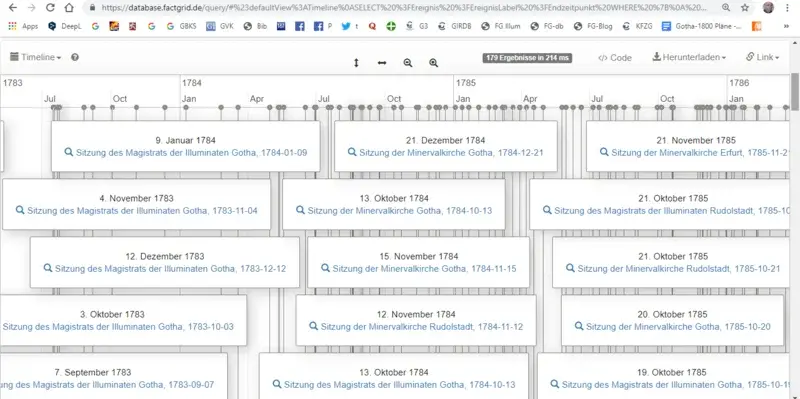
Image: The meetings of the Thuringian Illuminati, FactGrid Timeline
The expansion of the platform...
Today, the FactGrid is basically available to historical research as an explorative workspace. We are trying to go beyond the previous framework in three directions:
The major project at the moment is the cooperation with the German National Library (and continued with Wikidata), in the framework of which the database is to be equipped with a broad data basis in the next few months - with this data basis the research in German-speaking regions should be referenced wherever possible anyway.
…and the focus
In the same developing process at the Research Centre Gotha, FactGrid can be very useful for the exploration of Gotha's collections. Our goal is to encourage the local institutions to open up selected data collections as an example and to make them accessible across institutional boundaries - in this interesting case, not only to researchers who visit the collections in Gotha, but also to the citizens of the city for the purposes of current Citizen Science projects.
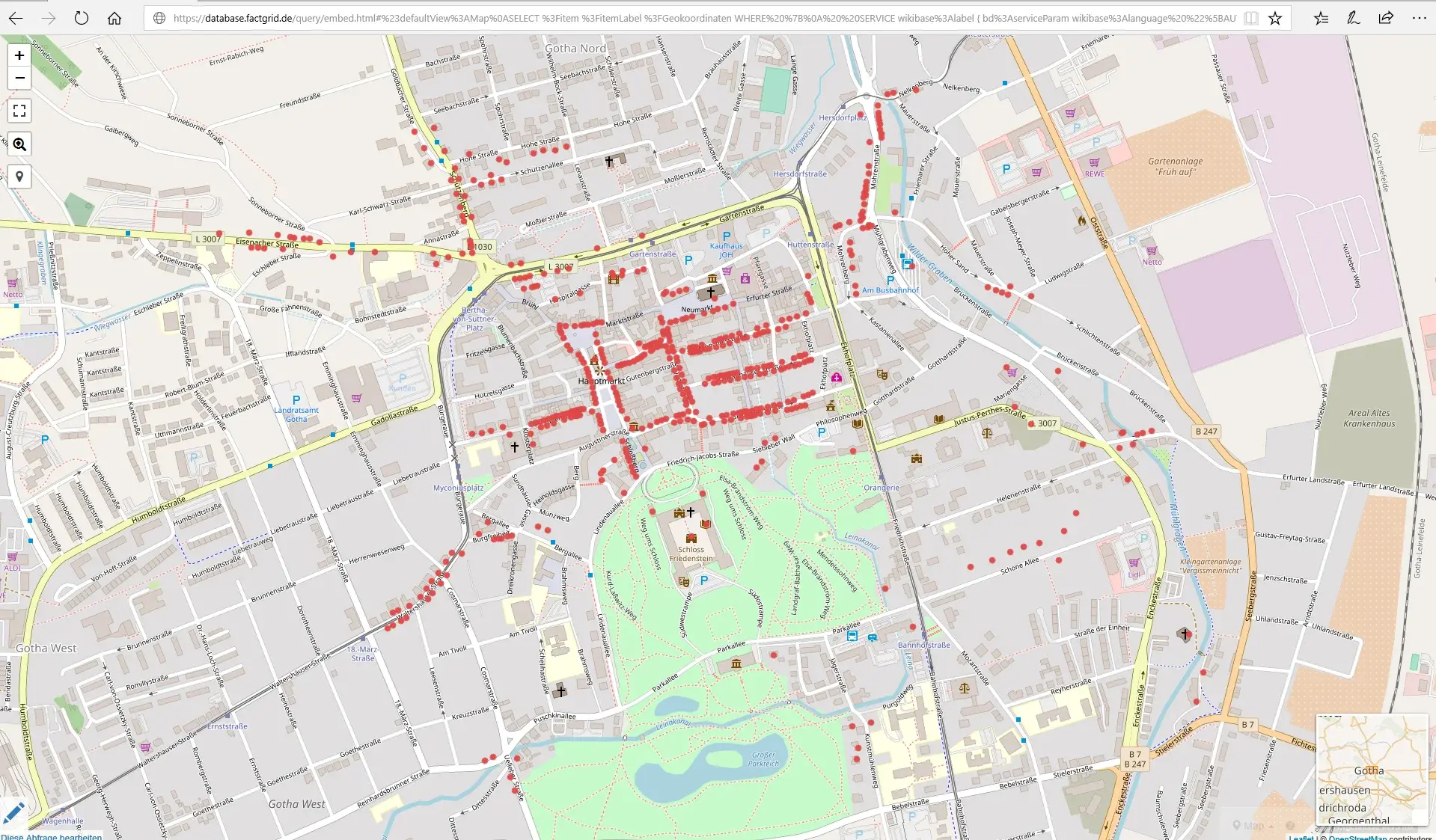
The FactGrid already contains data records on all addresses in Gotha before 1859, including the names and numbering that changed in the 19th century. In a cross-section, these were confirmed by the male voting population of 1848, which can now be expanded (for example, social and family history).
At the beginning of 2019, the archives of the Evangelical Lutheran Church of Gotha entered its records in the FactGrid. From the Genealogical Association this data is currently being interpenetrated with the database of the Thuringian Parish Register, which records the occupation of parishes in the duchy up to the Reformation biographically and genealogically.
An important desideratum is to provide the collaborative project „Gotha around 1800: Nature – Sience – History“ with a research infrastructure,
Image: Georeferenced Gotha addresses, representation on the city map.


University of Erfurt (Campus)
Nordhäuser Str. 63
99089 Erfurt