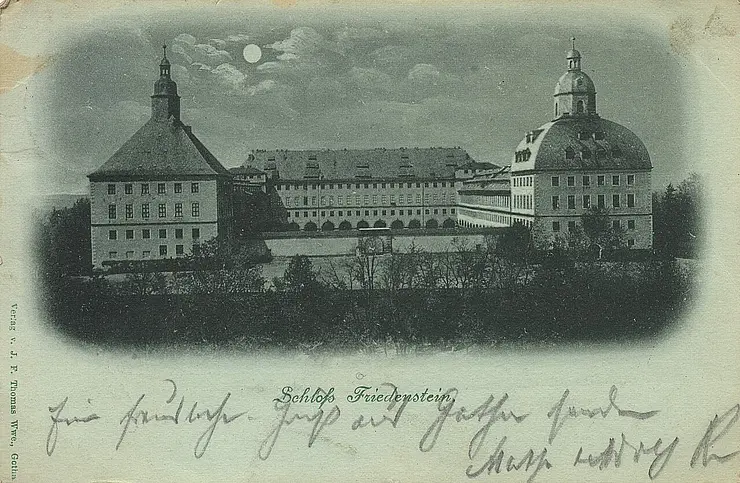
Organisers: Historical Commission for Thuringia and the Thuringian Treasury, in collaboration with the Gotha
Research Centre Venue: Gotha Research Centre, Schloßberg 2, Lecture Theatre
Date: 29 October 2026
Programme
9.30 am Arrival
10.00 am Kai Lehmann, Schmalkalden: Welcome
10.10 am Marko Kreutzmann, Jena: Bericht vom 33. Tag der Thüringischen Landesgeschichte und Projektbeschreibung „Residenzen – Landschaft – Raum?“ (Report on the 33rd Thuringian Regional History Day and project description ‘Residences – Landscape – Space?’)
10.30 am Sabrina Lüderitz, Rudolstadt: Die Sammlung des Residenzschlosses Heidecksburg und der Schwarzburger Raum um Rudolstadt (The collections of Heidecksburg Palace and the Schwarzburg region around Rudolstadt)
11.15 am Tobias Pfeiffer-Helke, Gotha: Die Sammlungen der Friedenstein Stiftung Gotha (The collections of the Friedenstein Foundation, Gotha)
12.00 pm Lunch break
1.00 pm Philipp Adlung, Meiningen: Die Sammlung der Meininger Museen und der Landschaftsraum der Meininger Herzöge (The collections of the Meiningen Museums and the landscape of the Dukes)
of Meiningen 1.45 pm Ingo Weidig, Veßra Monastery / Janis Witowski, Schleusingen: Das neue Schaumagazin des Museums Schloss Bertholdsburg und des Klosters Veßra – Geschichte und Zukunft (The new exhibition gallery at Bertholdsburg Castle Museum and Veßra Monastery – history and future)
2.30 pm Coffee break
3.00 pm Kai Lehmann, Schmalkalden: Was passiert, wenn Residenz auszieht? (What happens when the court moves out?)
3.45 pm Closing remarks
5.15 pm Public evening lecture
by Kai Lehmann, Schmalkalden: Hexen vor Gericht! Krisen, Angst und Massenmedien (Witches on trial! Crises, fear and the mass media)
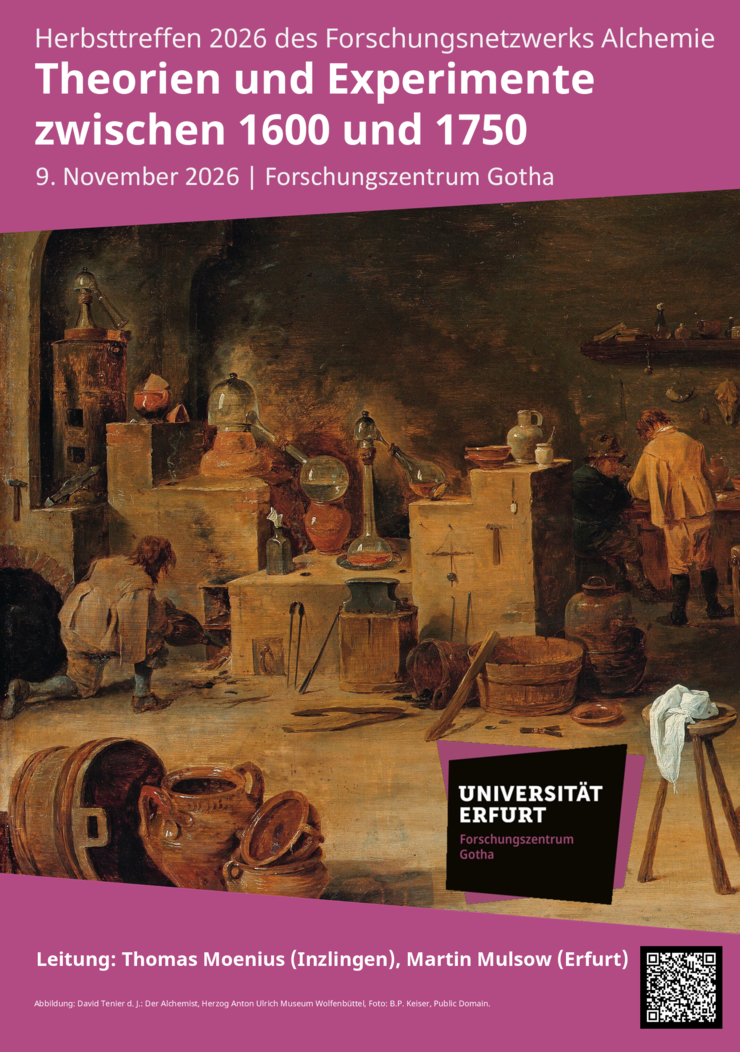
Organisers: Thomas Moenius (Inzlingen) & Martin Mulsow (Erfurt)
Date: Monday, 9 November 2026
Venue: Lecture Theatre at the Research Centre, Schloßberg 2
Programme (Download PDF)
9.30 am – 9.45 am: Introduction
Session: Gunter Eberhardt (Weil)
9.30 Uhr – 09.45 Uhr: Einführung
Session: Gunter Eberhardt (Weil)
09.45 Uhr – 10.15 Uhr: Michael Moennich (Karlsruhe), Die Alchemie in Thomas Campanellas Schriften
10.15 Uhr – 10.45 Uhr: Tobias Bulang (Heidelberg), Edition der pseudoparacelsischen Aurora Philosophorum mit Kommentar. Ein Werkstattbericht
10.45 Uhr – 11.00 Uhr: Coffee Break
11.00 Uhr – 11.30 Uhr: Tina Asmussen (Bochum), Schlacke, Rauch und Saturn: Alchemisches Wissen, Ausbeute und die Rückstände des frühneuzeitlichen Bergbaus
11.30 Uhr – 12.00 Uhr
Vera Faßhauer (Frankfurt): Medizinische Alchemie bei Johann Christian Senckenberg (1707-1772)
12.30 Uhr – 13.30 Uhr: Lunch Break
Session: Thomas Moenius (Inzlingen)
14.00 Uhr – 14.30 Uhr: Rainer Werthmann (Kassel), „Processus Universalis“ – Ergebnisse eines Forschungsprojektes des Netzwerkes Alchemie
14.30 Uhr – 15.00 Uhr: Sarah Lang (Berlin): Computergestützter Zugang zu der Geschichte der Alchemie und Chemie
15.00 Uhr – 15.30 Uhr: Pause
15.30 Uhr – 16.00 Uhr: Jürgen Hollweg (Weidenberg): Netzwerkstrukturen frühneuzeitlicher Chemiker um 1600. Regionale Verteilung
16.00 Uhr – 16.15 Uhr: Closing remarks
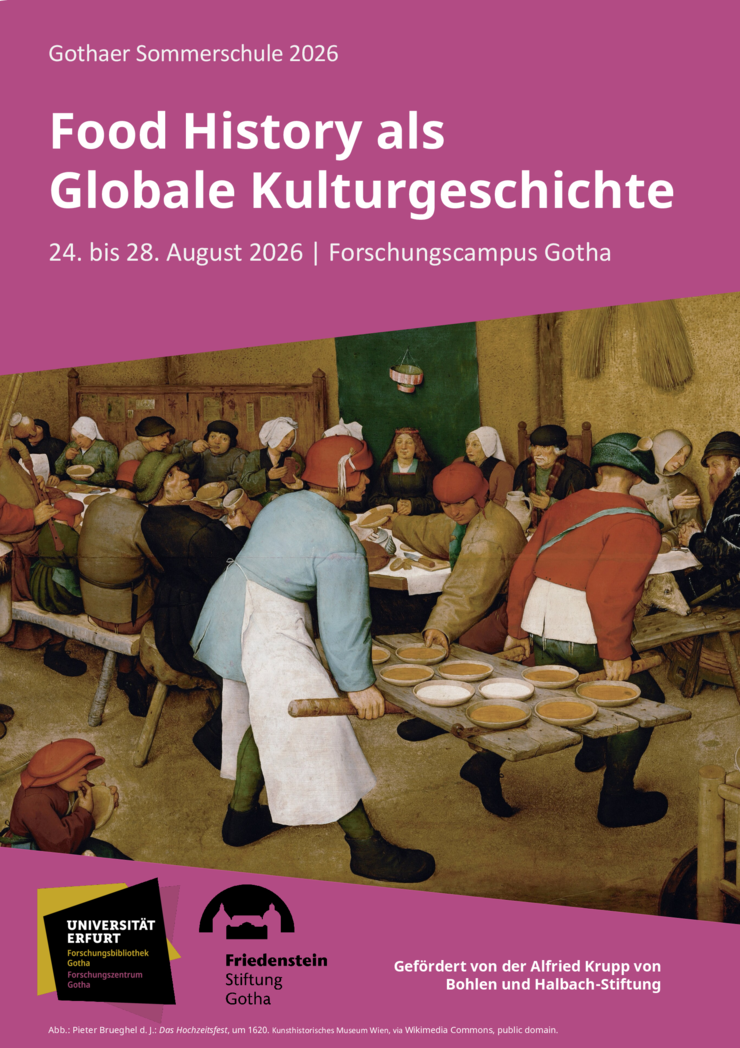
Date postponed to: 15–19 March 2027
Organised by: Organised by the Gotha Research Centre in collaboration with the Gotha Research Library and the Friedenstein Foundation Gotha; funded by the Alfried Krupp von Bohlen und Halbach Foundation
Director and Concept: Professor Martin Mulsow
The field of ‘food history’, which has been flourishing for more than two decades, is a branch of historical studies in which many disciplines converge: the history of nutrition, the history of botany, global history, human geography, economic history and the study of material culture. The culture of human eating habits, foodstuffs and spices across the centuries; the interplay of food, infrastructure and culture in specific regions (so-called ‘foodscapes’); the global transfer of crops, spices and recipes (so-called ‘foodways’), the history of the production and dissemination of key consumer goods (salt, sugar, tea, coffee, chocolate), the socio-political and emotional-cultural contexts of diets and dietary practices (such as vegetarianism, ritual laws), the cultural and symbolic representations of food (proverbs, metaphors, imagery, novels), right through to the preservation and transmission of knowledge through recipes – these are research aspects pursued in this field, many of which overlap. Today, there are countless publications on the global history of individual foodstuffs and luxury goods, but also comprehensive overviews of the history of food culture and related phenomena of cultural transfer and interconnection (from the ‘Columbian Exchange’ to the ‘spice routes’, from the translation of herbals to the spread of American fast food).
The summer course will introduce students to the various issues and focus on the global aspects of food history in the pre-modern era (from the earliest civilisations to around 1800). As Gotha is home to numerous collections, the course will draw on examples such as artefacts (at Friedenstein Castle), old prints, manuscripts and maps (at the Gotha Research Library and the Gotha Perthes Collection). It will also include a practical component: the group preparation of historical recipes (ranging from Mesopotamian lentil stew to 18th-century court cuisine).
Thematically, the course will explore what food history contributes to global history and to what extent it can be extended into the global history of culture and knowledge: from coffee houses and drug-induced religious experiences to ways of thinking specific to food culture and the challenges of transmitting implicit knowledge through recipes.
The one-week course is aimed at advanced undergraduates working on their master's thesis, PhD students and postdoctoral candidates working in the broader field of this subject who wish to deepen their interest, as well as employees at museums and similar institutions engaged with food history.
Venue: Gotha Research Centre, Schloßberg 2, 99867 Gotha.
Contact
Kristina Petri, MA
Gotha Research Centre, University of Erfurt
Schloßberg 2
99867 Gotha
Email: gotha.research.centre@uni-erfurt.de
Tel.: +49 (0)361 737 1712

![[Translate to English:] facebook icon](/fileadmin/SocialMediaIcons/iconfinder_06-facebook_white.svg)

![[Translate to English:] instagram icon](/fileadmin/SocialMediaIcons/iconfinder_38-instagram_white.svg)
![[Translate to English:] YouTube icon](/fileadmin/SocialMediaIcons/iconfinder_18-youtube_white.svg)
![[Translate to English:] xing icon](/fileadmin/SocialMediaIcons/iconfinder_xing_white.svg)

University of Erfurt (Campus)
Nordhäuser Str. 63
99089 Erfurt