
The Health Creation Lab is a space for participatory research and co-creation in health communication at the Institute for Planetary Health Behaviour (IPB) at the University of Erfurt. It brings science and society together: members of the public, patients, experts from academia and practice, businesses, and other stakeholders work together on issues related to health and health communication. Participants use structured creative and ideation techniques to explore new perspectives, develop different approaches to solutions, and gradually refine their ideas. A wide range of creative and prototyping materials helps bring these ideas to life and develop them further.
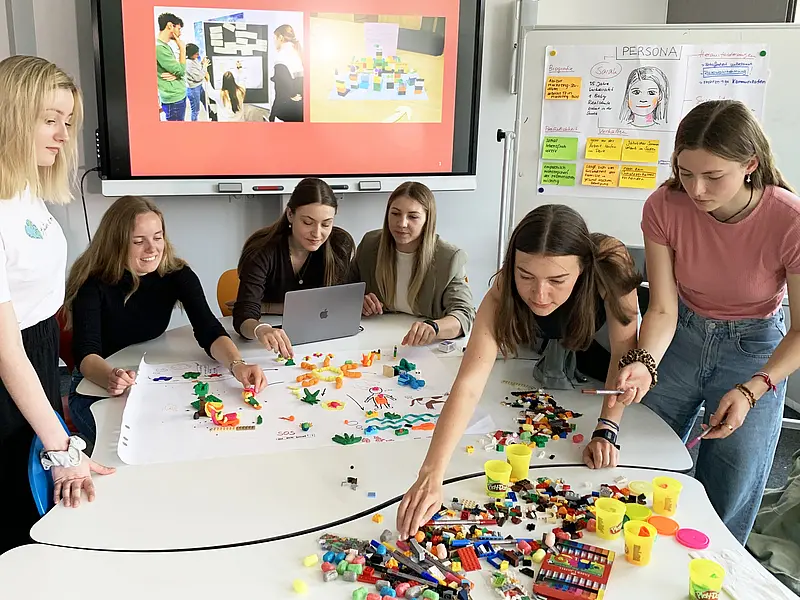
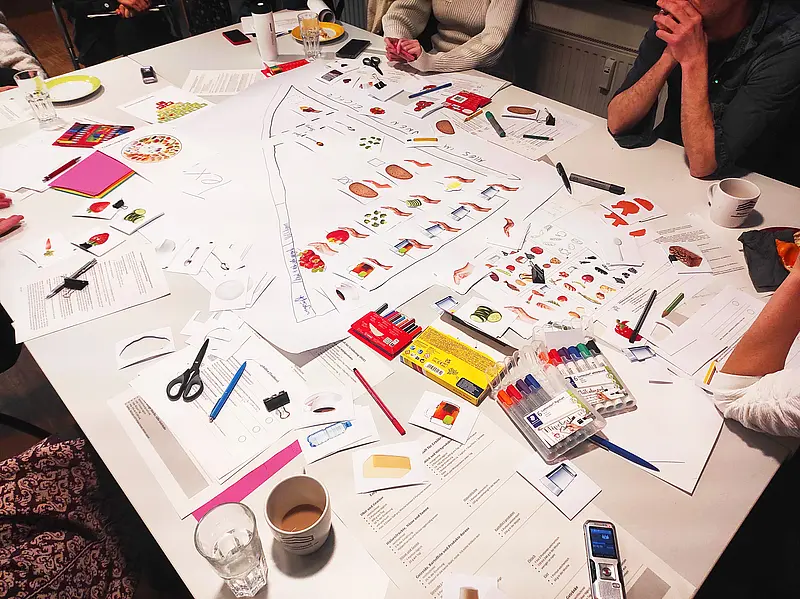
Participatory research: actively involving people in research processes
For us, participatory research means involving people in research and development processes as early as possible. Their perspectives are not simply collected after concepts or communication strategies have already been finalised. Instead, they can help define problems, contribute their own experiences and needs, reflect on existing solutions, develop ideas, jointly make decisions, design prototypes and test new approaches.
Who is involved depends on the specific research question. At the Health Creation Lab, for example, participants may include members of the public, patients and their relatives, healthcare professionals, teachers, researchers, media professionals, representatives from businesses, organisations and other areas of practice, as well as students.
It is precisely this combination of different experiences and skills that makes participatory research so valuable. Solutions for health communication often emerge at the intersections: between scientific evidence and everyday life, between professional expertise and personal experience, and between the needs of different target groups.
Empirical support: Scientifically investigating creative processes
A key feature of the lab is that these processes are systematically documented and evaluated using empirical research methods. Depending on the research question, qualitative or quantitative methods, as well as mixed-methods designs, are used. Data collection methods include, for example, interviews, group discussions, think-aloud techniques, observations and photographic documentation. In this way, the Health Creation Lab combines participation, creative development and empirical research. Participants’ contributions are not only used to jointly develop ideas, but are also systematically documented and analysed and, depending on the research question, tested in further studies.
Methods and materials: Developing and visualising ideas
An important part of the Health Creation Lab’s work is providing methodological support for idea generation. Depending on the issue at hand, suitable creative and ideation techniques are employed – including elements of design thinking – which help to shift perspectives, understand problems more precisely, develop different approaches to solutions and gradually flesh these out. In this way, creative processes are not left to chance, but are deliberately stimulated and guided.
This process is supported by a wide range of facilitation, creative and prototyping materials. As a result, ideas do not have to remain abstract. They can be drawn, built, arranged, modified and discussed directly with others. Depending on the project, materials such as cards and visual aids, collages, mood boards, model-making materials or simple prototypes are used.
One lab, many locations
The Health Creation Lab is not limited to a single physical space. Depending on the research question and target group, workshops can take place in the lab itself, in seminar rooms, directly at partner organisations or practices, or at other suitable locations. Materials for creative work, visualisation and prototyping are selected to be easily transported and used in a variety of settings.
This flexibility is particularly important for participatory research: it does not always make sense to bring participants to the university. Often, it is more helpful to go to where people live, work or already interact with one another. Depending on the project, the Health Creation Lab can therefore serve as a permanent workspace or as a mobile research and development setting.
From Science to Society – and back again
The Health Creation Lab understands research communication as an exchange between science and society. Scientific findings are communicated in an accessible way and made available to a range of target groups. At the same time, experiences, questions, needs and perspectives from society and professional practice inform research and contribute to the further development of research questions, communication formats and approaches to solutions.
Equally important is sharing the insights gained: findings are scientifically analysed and then translated and presented in ways that make them understandable and useful to participating and interested target groups. In this way, the Health Creation Lab brings together research, research communication and participation, strengthening the ongoing exchange between science and society.
Combining research and teaching
The Health Creation Lab also plays an important role in teaching on the Master’s programme in Health Communication. Students work there on real-world issues relating to health prevention and health promotion and, in collaboration with partners from professional practice, develop scientifically sound communication and intervention strategies.
This process brings together research findings, interdisciplinary and transdisciplinary perspectives, and creative and innovative methods. Students learn to examine problems from the perspectives of different stakeholders, systematically develop ideas and test them at an early stage through prototyping. The Lab thus becomes a place where research, teaching, innovation and knowledge transfer come together.
Current projects at the Health Creation Lab
- In the “FBDG Visual” project, different target groups – including children, young people, adults, older people, teachers and nutritionists – develop ideas for clear and practical visualisations of dietary recommendations. After jointly reviewing existing representations, such as the DGE Food Circle and the food pyramid, participants develop their own concepts and prototypes. The insights gained are then incorporated into the experimental evaluation and further development of the visualisations.
- In the “UncertainTEAM” project, members of the public from Thuringia are helping to communicate scientific uncertainty in a way that is more understandable and better tailored to different target groups. The workshops combine science communication with participatory research: participants gain insights into how scientific findings are generated, contextualised and communicated, and why uncertainty is a fundamental part of scientific research. Building on this, they contribute their own experiences, expectations and perspectives and jointly develop ideas for communicating research findings in a way that is transparent, understandable and, at the same time, provides guidance.
- In the student project “PRO-HEALTH”, students of Health Communication work alongside students of photonics at Friedrich Schiller University Jena (FSU Jena) on real-world global health challenges faced by international practice and research partners. Working in interdisciplinary teams, they develop both cost-effective medical and technical solutions for resource-limited settings and communication concepts that are sensitive to different target groups, cultures and contexts and support the implementation of these solutions. Local partners and experts are systematically involved in the development process; selected solutions are then jointly refined and tested in their respective application contexts. The teaching format is funded through PRO-HEALTH by the Foundation for Innovation in Higher Education Teaching.


![[Translate to English:] facebook icon](/fileadmin/SocialMediaIcons/iconfinder_06-facebook_white.svg)

![[Translate to English:] YouTube icon](/fileadmin/SocialMediaIcons/iconfinder_18-youtube_white.svg)
![[Translate to English:] xing icon](/fileadmin/SocialMediaIcons/iconfinder_xing_white.svg)