C19 – research building "Weltbeziehungen" / C19.01.27
Institute for Planetary Health Behaviour (IPB)
C19 – research building "Weltbeziehungen"
Max-Weber-Allee 3
99089 Erfurt
Universität Erfurt
Institute for Planetary Health Behaviour (IPB)
Postfach 90 02 21
99105 Erfurt
C19 – research building "Weltbeziehungen" / C19.01.27
Faculty of Philosophy
C19 – research building "Weltbeziehungen"
Max-Weber-Allee 3
99089 Erfurt
Universität Erfurt
Faculty of Philosophy
Postfach 90 02 21
99105 Erfurt
C19 – research building "Weltbeziehungen" / C19.01.27
Department of Media and Communication Studies
C19 – research building "Weltbeziehungen"
Max-Weber-Allee 3
99089 Erfurt
Universität Erfurt
Department of Media and Communication Studies
Postfach 90 02 21
99105 Erfurt
Bernhard-Nocht-Institut für Tropenmedizin
Bernhard-Nocht-Straße 74
20359 Hamburg

Our research aims to help design effective policy frameworks and good, explanatory communication. To do this, we try to understand as comprehensively as possible what influences climate-friendly behaviour in order to find good levers.
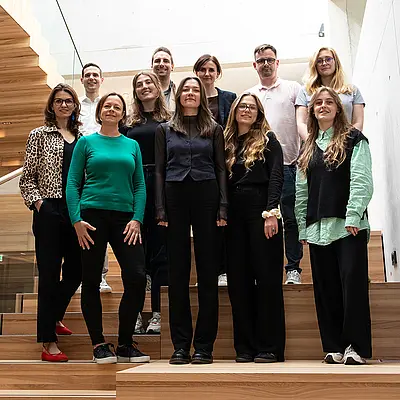
Cornelia Betsch is the director of the Institute for Planetary Health Behaviour at the University of Erfurt, where interdisciplinary social and behavioral science perspectives are applied to the study of planetary health and the climate crisis.
Research
Betsch is a psychologist and professor of health communication at the University of Erfurt. She also leads the Health Communication Working Group at the Bernhard Nocht Institute for Tropical Medicine in Hamburg (BNITM). Her research covers health- and climate-related behaviour, such as readiness to act against the climate crisis, prudent antibiotic use, and vaccination behaviour. She extends her research to other continents, for example, investigating the prudent use of antibiotics and vaccination behaviour in various African countries. Her latest research also looks into how the New Space race affects planetary health. During the COVID-19 pandemic, she initiated the COVID-19 Snapshot Monitoring (COSMO) and subsequently the Planetary Health Action Survey (PACE). These large-scale studies regularly gather insights into people's knowledge, risk perception, protective behaviour, and trust regarding the respective crises, contributing to societal and political discourse.
Teaching
In 2017, Betsch launched Germany's first master's program in health communication, where she still teaches its methodological foundations
Engagement
She received the German Psychology Prize (2021), the Thuringian Research Prize (2022), and the Franz-Emanuel-Weinert Prize (2026). Betsch was a member of the Corona Expert Council of the Federal Chancellery. She is a member of the German Ethics Council and the Thuringian Advisory Council for Climate Protection and Climate Impact Adaptation (Climate Advisory Council). At the BNITM, she established the WHO Collaborating Center for Behavioural Research (BRIGHT) in Global Health, where she and her team support the WHO in improving global health through social and behavioural science insights.
Research Funding
Her research is funded by independent research funding organizations, ministries, and foundations.



Publikationen in Hochschulbibliographie anzeigen
Betsch, C., Korn, L., Sprengholz, P., Felgendreff, L., Eitze, S., Schmid, P., & Böhm, R. (2020). Social and behavioral consequences of mask policies during the COVID-19 pandemic. P Natl Acad Sci USA, https://doi.org/10.1073/pnas.2011674117.
Habersaat, K., Betsch, C., Danchin, M., Sunstein, C., Böhm, R., Falk, A., Brewer, N.T., Omer, S.B., Scherzer, M., Sah, S., Fischer, E.F., Scheel, A.E., Fancourt, D., Kitayama, S., Dubé, E., Leask, J., Dutta, M., MacDonald, N.E., Temkina, A., Lieberoth, A., Jackson, M. Lewandowsky, S., Seale, H., Fiethe, N., Schmid, P., Gelfand, M., Korn, L., Eitze, S., Felgendreff, L. Sprengholz, P., Salvi, C., Butler, R (2020). Ten considerations for effectively managing the COVID-19 transition. Nat Hum Behav. doi.org/10.1038/s41562-020-0906-x
Betsch, C. (2020). Behavioural science data can help mitigate the COVID-19 crisis. Nature Human Behaviour. https://doi.org/10.1038/s41562-020-0866-1.
Betsch, C., Wieler, L.H., Habersaat, K. and the COSMO group (2020). Rapid, flexible, cost-effective monitoring tool for behavioural insights related to COVID-19 across countries. The Lancet, https://doi.org/10.1016/S0140-6736(20)30729-7 .
Betsch, C., Bach Habersaat, K., Deshevoi, S., Heinemeier, D., Briko, N., Kostenko, N., Kocik, J., Böhm, R., Zettler, I., Wiysonge, C. S., Dubé, È., Gagneur, A., Botelho-Nevers, E., Gagneux-Brunon, A., & Sivelä, J. (2020). Sample study protocol for adapting and translating the 5C scale to assess the psychological antecedents of vaccination. BMJ Open, 10(3), e034869. https://doi.org/10.1136/bmjopen-2019-034869
Omer, S. B., Betsch, C., & Leask, J. (2019). Mandate vaccination with care. Nature, 571(7766), 469–472. https://doi.org/10.1038/d41586-019-02232-0
Schmid, P., & Betsch, C. (2019). Effective strategies for rebutting science denialism in public discussions. Nature Human Behaviour. https://doi.org/10.1038/s41562-019-0632-4
Betsch, C., Böhm, R., Schmid, P., Korn, L., Steinmeyer, L., Heinemeier, D., Eitze, S. & Küpke, N.K. (2019). Impfverhalten psychologisch erklären, messen und verändern. Bundesgesundheitsblatt, 1-10. https://doi.org/10.1007/s00103-019-02900-6
Betsch, C., Schmid, P., Heinemeier, D., Korn, L., Holtmann, C., & Böhm, R. (2018). Beyond confidence: Development of a measure assessing the 5C psychological antecedents of vaccination. PLOS ONE, 13(12), e0208601. https://doi.org/10.1371/journal.pone.0208601 Open Data Open Materials
Betsch, C. & Böhm, R. (2018). Explaining herd immunity makes moral values regarding harm and fairness relevant for vaccination decisions. Nature Human Behaviour.
Wiysonge, C.S., Cooper, S., Sambala , E.Z. & Betsch, C. (2018). Vaccine hesitancy - a potential threat to the achievements of vaccination programmes in Africa. Human Vaccines & Immunotherapeutics, 14(10):2355-2357.
Betsch, C. (2017). Advocating for vaccination in a climate of science denial. Nature Microbiology, 2, 17106.
Betsch, C., Böhm, R., Korn, L., & Holtmann, C. (2017). On the benefits of explaining herd immunity in vaccine advocacy. Nature Human Behaviour, doi:10.1038/s41562-017-0056.
Korn, L., Betsch, C., Böhm, R., & Meier, N. (2017). Communicating high vaccine rates of refugees: How the best intentions can lead to harm. The Lancet Infectious Diseases, 17, 364–365.
Böhm, R., Betsch, C. & Korn, L. (2016). Selfish-Rational Non-Vaccination: Experimental Evidence from an Interactive Vaccination Game. Journal of Economic Behavior & Organization, 131, 183-195.
Betsch, C. & Böhm, R. (2016). Detrimental Effects of Introducing Partial Compulsory Vaccination: Experimental Evidence. European Journal of Public Health, 26(3):378-81.
Betsch, C., Korn, L., Holtmann, C. (2015). Don’t try to convert the anti-vaccinators, instead target the fence-sitters. Proceedings of the National Academy of Sciences of the United States of America, PNAS, 112(49): E6725–E6726.

![[Translate to English:] facebook icon](/fileadmin/SocialMediaIcons/iconfinder_06-facebook_white.svg)

![[Translate to English:] instagram icon](/fileadmin/SocialMediaIcons/iconfinder_38-instagram_white.svg)
![[Translate to English:] YouTube icon](/fileadmin/SocialMediaIcons/iconfinder_18-youtube_white.svg)
![[Translate to English:] xing icon](/fileadmin/SocialMediaIcons/iconfinder_xing_white.svg)

University of Erfurt (Campus)
Nordhäuser Str. 63
99089 Erfurt