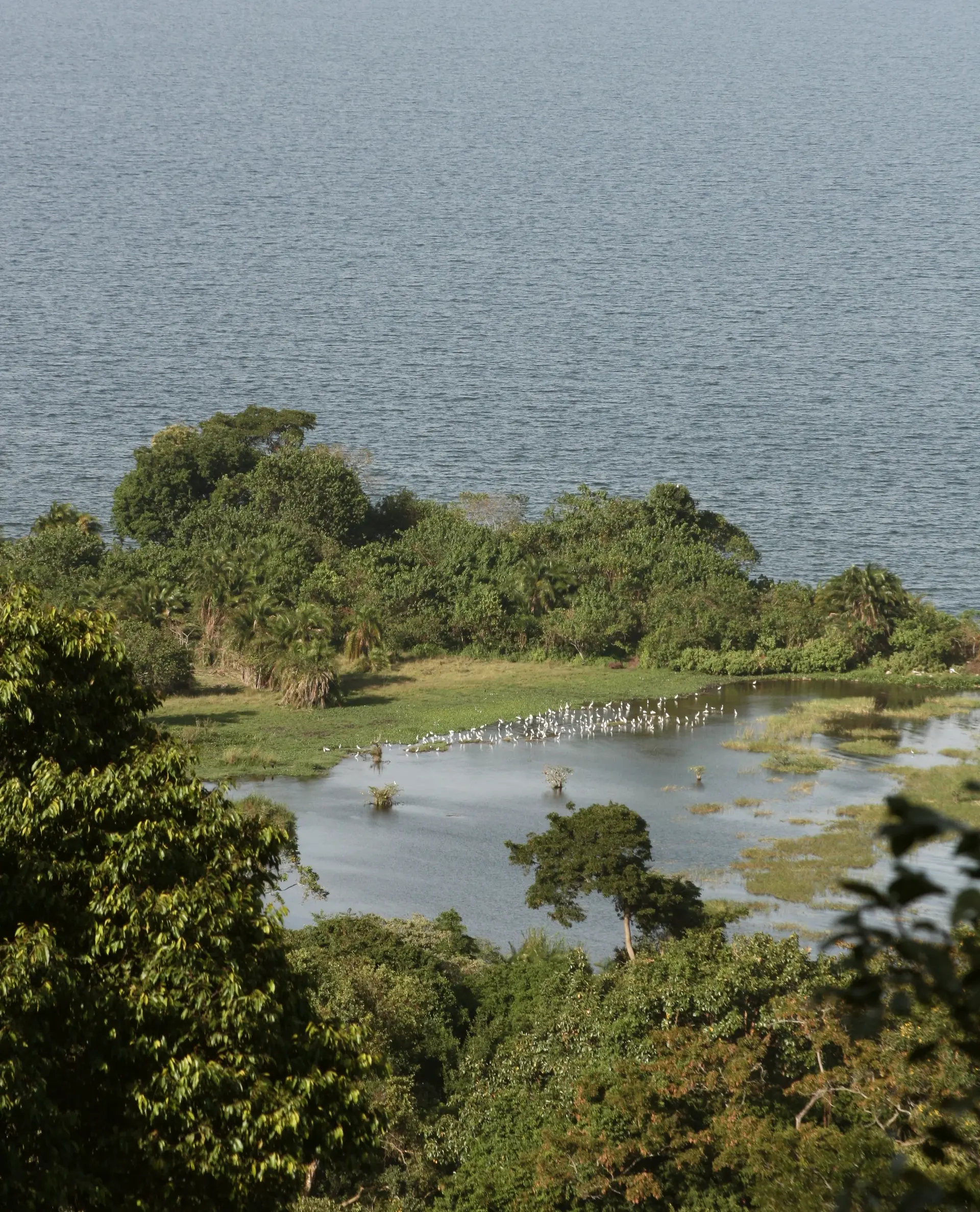
Why did the postcolonial upheaval in East Africa – the "Revolt against the West" (Geoffrey Barraclough) – not also entail a departure from Western concepts of nature and its protection? How did decolonization permeate the handling of the natural environment, and what role did nature policy initiatives play in shaping postcolonial conditions? I seek exemplary answers to these questions in a close examination of the history of Rubondo Island, the oldest and largest nature conservation island in Africa, located in the southwestern part of Lake Victoria.
The case gains particular significance because Rubondo's transition from a fishing to a nature conservation island occurred during the transition from late to postcolonial rule: on the eve of Tanganyika's independence (1961), British colonial wildlife keepers planned to relocate rhinos from the surrounding savannas to Rubondo to protect them from the feared uncontrolled hunting in the postcolonial era. For the resettlement of the non-indigenous animals that began in 1963, the authorities displaced the Banyarubondo, the people living there. Starting in 1966, the German zoologist Bernhard Grzimek expanded the animal settlements with the support of the "Frankfurt Zoological Society," introducing chimpanzees, elephants, and other species to profile Rubondo as an "ark" for endangered wildlife and thus remove it from non-ecological use. With the consolidation of the one-party system, the Nyerere government declared the island a national park in 1977, not least to capitalize on its value for the national tourism industry.
Examining the often-neglected ecological dimension of decolonization contributes to a better understanding of the effects of historical upheavals on the natural environment. Additionally, looking at decolonization from the perspective of its nature policy facets helps assess the depth of the rupture in East Africa's history and makes nature comprehensible as a factor influencing political and social contexts. As the first monographic presentation of the history of Rubondo Island, the study also includes nature policy measures on the island during German colonial rule and is positioned at the intersection of research on decolonization in East Africa, environmental history, human-animal studies, and historically oriented island studies.
Picture: Rubondo Island in March 2015 © Felix Schürmann

![[Translate to English:] facebook icon](/fileadmin/SocialMediaIcons/iconfinder_06-facebook_white.svg)

![[Translate to English:] instagram icon](/fileadmin/SocialMediaIcons/iconfinder_38-instagram_white.svg)
![[Translate to English:] YouTube icon](/fileadmin/SocialMediaIcons/iconfinder_18-youtube_white.svg)
![[Translate to English:] xing icon](/fileadmin/SocialMediaIcons/iconfinder_xing_white.svg)

University of Erfurt (Campus)
Nordhäuser Str. 63
99089 Erfurt