
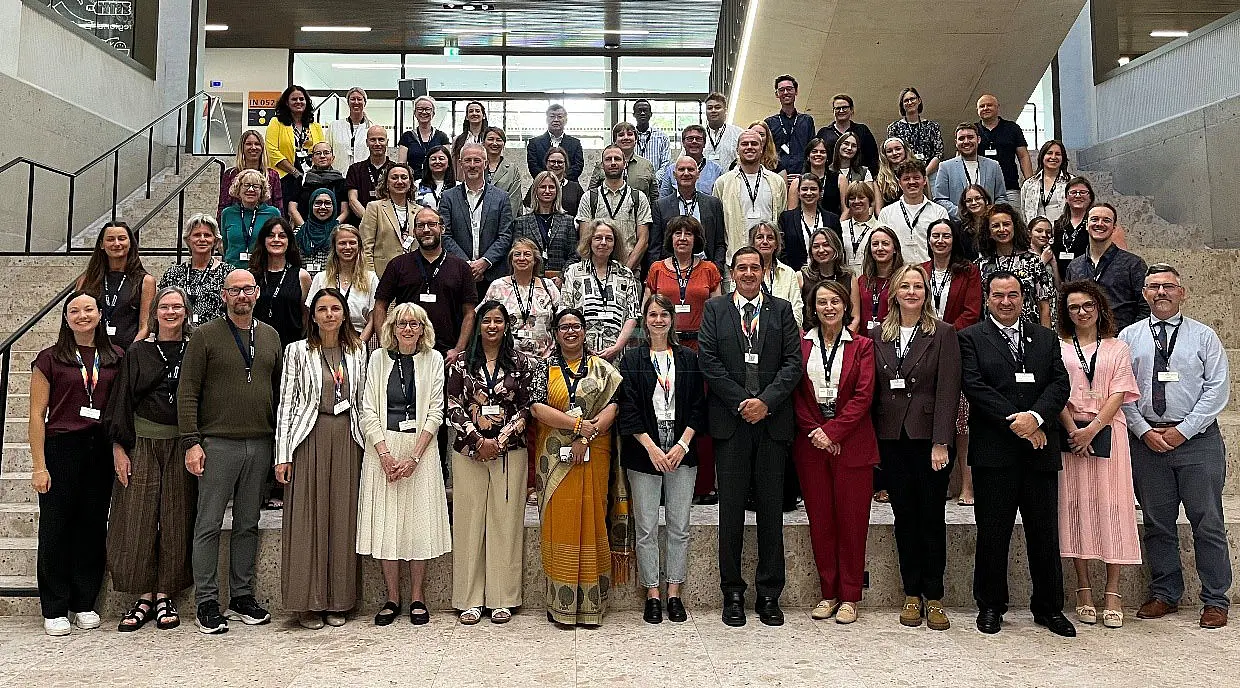
The symposium, organised jointly by the University of Innsbruck, Hamburg University of Applied Sciences and the World Development Research and Transfer Centre, brought together over 70 researchers from around the world who have been working on the role of key competencies for sustainability in the transformation of higher education institutions into sustainable universities. Key competencies integrate not only knowledge and systemic thinking but also social skills, normative competencies and vision-building into a unified concept that takes into account not only cognitive aspects but also values, habits and emotions.
For example, the University of Manchester presented how the ‘Whole Institution Approach’ was used, amongst other things, as a basis for strengthening core competencies for sustainability, with the aim of transforming the university’s overall profile – including the goal that 100 per cent of degree programmes should address aspects of sustainability.
Alongside many higher education institutions from Europe (including Belgium, Finland, Ireland, Italy, the Netherlands, Austria, Switzerland and Sweden), researchers from Brazil, Colombia, Israel, India, Malaysia, the USA and New Zealand helped to move beyond a purely Eurocentric perspective. Overall, the role of experiential learning and skills development was emphasised, with particular importance attached to collaboration with non-university partners. For example, the researchers from Israel highlighted the co-creation of academic knowledge with the local knowledge of Bedouins in the Negev Desert, who have long-standing experience of periods of drought. Members of a university of art and society also highlighted the role of vision development, using artistic and nature-based methods to forge resonant relationships.
Bettina Hollstein presented her research on the contribution of Hartmut Rosa’s theory of resonance to raising the profile of service learning as a tool for implementing education for sustainable development. Service learning is a teaching and learning arrangement that combines students’ engagement with the local community (service) with reflection on their learning experiences and the associated acquisition of competencies (learning). In practice, student project groups work with non-university partners on small-scale projects that contribute to the common good. This form of teaching is particularly well-suited to the topic of sustainability, but service-learning is also an exceptionally successful tool for many other subjects and, in particular, for competencies development. Bettina Hollstein has examined a series of studies on service learning in general and on education for sustainable development in particular, demonstrating how, by incorporating insights from Hartmut Rosa’s theory of world relations, service learning can be integrated into a conception of the good life, thereby further improving service learning courses.
Overall, it can be concluded that the issue of sustainability and the importance of competecies that go beyond specialised subject knowledge for solving the complex and long-term problems of our time represent a significant field of research internationally. “I really enjoyed the positive feedback on my work and the important insights from other researchers at this conference – not to mention, of course, the many interesting encounters with people who work in completely different regions and contexts,” said Bettina Hollstein after the conference had concluded.


![[Translate to English:] facebook icon](/fileadmin/SocialMediaIcons/iconfinder_06-facebook_white.svg)

![[Translate to English:] instagram icon](/fileadmin/SocialMediaIcons/iconfinder_38-instagram_white.svg)
![[Translate to English:] YouTube icon](/fileadmin/SocialMediaIcons/iconfinder_18-youtube_white.svg)
![[Translate to English:] xing icon](/fileadmin/SocialMediaIcons/iconfinder_xing_white.svg)
