Think about the future
Sustainability is an important issue for us. This applies to our teaching and research, but also to everyday life on campus. The university is therefore involved in various sustainability networks and has taken key steps such as participating in the competition for the ‘Ökoprofit’ environmental seal, which has been awarded several times, as well as the ongoing conversion of procurement to sustainable offerings and the consideration of sustainability aspects in the construction development of the campus. Our students have also been involved in university groups such as the Sustainability Working Group for many years. Since 2007, this group has been a practical partner of the student-organised Studium Fundamentale course ‘Sustainability – Improving the world with practical projects’, in which numerous students from all disciplines have participated every year since then. On this website, we would like to introduce you to various projects and people involved.
However, we are also aware of our special responsibility as an institution and in our role as a multiplier."
We are involved in the following networks
The University of Erfurt is aware of its responsibility to anchor sustainability beyond its own campus. It therefore participates in various networks whose aim is to establish sustainable thinking and action in different areas of life in today's and future society.
Start-up Network of Thuringian Universities
University Network Education through Responsibility
The University of Erfurt is one of the founding members of the university network Education through Responsibility, which was founded in 2009. The network, which is an association of universities that deal with the method of "service learning" and civic involvement of students ("community service"), aims to promote social responsibility of and at universities.
Innovation Network Education for Sustainable Development
KLIMA network for more sustainability in Thuringia
Universities play a key role in the process of social transformation. They are places where future decision-makers are trained and (discursive) spaces that can serve as a laboratory for sustainability. Four Thuringian universities are therefore pooling their expertise in this project and continuously developing it further as part of the research project ‘KLIMA-Netzwerk für mehr Nachhaltigkeit in Thüringen’ (KLIMA Network for more Sustainability in Thuringia).
link to the website (in German only)
Sustainability Agreement Thuringia (NAT)

Since the end of 2010, the University of Erfurt has been supporting the Thuringian Sustainability Agreement (NAT), in which Thuringian commercial enterprises and public institutions work together to improve the framework conditions for the further economic development of Thuringia in terms of sustainability.
Thuringian University Network for Sustainability
In addition, Thuringia's universities, the Thuringian Ministry of Education, Science and Culture and the Thuringian Energy and GreenTech Agency (ThEGA) signed a cooperation agreement in February 2025 to introduce a joint energy management system. ThEGA is providing the software to be implemented and is supporting the universities with training and assistance in taking inventory of their properties. This project is another building block towards achieving the state administration's goal of climate neutrality by 2030.
Awards
Ökoprofit
The University of Erfurt has been awarded the “Ökoprofit” environmental seal several times since 2001. It is one of more than 110 institutions in Erfurt to have received this award since 2000. In Germany, more than 2,000 companies in over 90 cities have received this coveted municipal award to date. They are all committed to the sustainable use of resources and to actively contributing to reducing environmental pollution and energy costs.
"Bee Friends" plaque
Actors and Contacts
Presidium representative for sustainability

Green Office
In 2026, a so-called ‘Green Office’ was set up at the University of Erfurt – initially for a period of two years – in the ‘Weltbeziehungen’ research building. Funding is provided by the Klima-N project. The ‘Green Office’ is run by the Sustainability Officer of the Presidium in collaboration with the Sustainability Unit of the Students’ Union. Its aim is to coordinate, consolidate and initiate projects and activities relating to sustainability at the university. At the same time, it is intended to serve as a sustainability platform and a source of ideas, enabling students and employees to drive sustainability forward.
Further information can be found in the interview with the organisers.
university groups and initiatives (students)
The following three university groups at the University of Erfurt are developing projects on the topic of sustainability:
- Sustainability working group
- Campus Green
- Greenpeace
Further information and contact details can be found on the website of the Student Council.
Sustainability Office of the Student Council
The current contact persons at the Student Council can be found on the website of the department at: www.uni-erfurt.de/der-stura-der-uni-erfurt-stellt-sich-vor/gremium/der-stura/referat-nachhaltigkeit.
environment team of the University of Erfurt
Your contact for questions about the ‘Ökoprofit’ environmental seal and for questions about sustainable operating technology on campus:
Stefan Doogs
Head of Operating Technology at the University of Erfurt
phone: +49 361 737-5341
e-mail: stefan.doogs@uni-erfurt.de
Sustainability in studies and teaching
study profile "Sustainability/Education for Sustainable Development"
As part of the KLIMA-N project funded by the Federal Ministry of Education and Research, the University of Erfurt has committed itself to strengthening education for sustainable development (ESD). There are already many courses in the compulsory, elective and optional areas, as well as in the Studium Fundamentale, that contribute to this. In order to give students the opportunity to document their in-depth knowledge in this area, the study profile “Sustainability/Education for Sustainable Development” is to be introduced in the 2025/26 winter semester.
“Our students appreciate the courses on sustainability and ESD that already exist here and have expressed a desire to have their participation in such courses recognised so that they can better explore career fields in the area of sustainability and education for sustainable development,” explains Professor Julia Knop, Vice President for Academic Affairs. “With the introduction of the study profile, the University of Erfurt now intends to meet this demand from the 2025/26 winter semester onwards." This interdisciplinary and cross-faculty study profile is based exclusively on study options that already exist within the existing regulations. The Presidium Commissioner for Sustainability, Bettina Hollstein, had previously asked the course instructors to what extent corresponding modules or courses exist in their course offerings. Julia Knop: ”The response was good and showed that it is realistic and attractive to set up such a study profile."
The study profile will be certified when students have earned 24 LP/ECTS credits in relevant courses during their bachelor's degree. The relevance of a course is determined by the instructor. Proof is provided via the transcript of records, and the certificate is issued by the Presidium Commissioner for Sustainability.
Further information can be found on our website on teaching at the University of Erfurt (in German only).
Studium Fundamentale "Sustainability"
Launched in 2007, the Studium Fundamentale "Sustainability – Improving the world with practical projects” offers students enrolled in Bachelor's programmes at the University of Erfurt and the University of Applied Sciences Erfurt the opportunity to make an active contribution to the sustainable development of society.
further information on the Studium Fundamentale “Sustainability”
Commitment Award for Social Entrepreneurship
Since 2012, the Engagementpreis Foundation and the Willy Brandt School of Public Policy at the University of Erfurt have been organising the Commitment Award in close cooperation. It offers students and graduates of the Brandt School the opportunity to apply what they have learnt during their studies and to launch new social initiatives in Erfurt and around the world. The projects are pitched in the spring of each year to an independent panel of experts as part of the Brandt School’s Social Innovation Lab, headed by Professor Heike Grimm. The three winning projects are selected based on the criteria of public benefit, effectiveness, and potential for success and sustainability. The prizes include start-up capital of 1,000 euros each, mentoring and networking opportunities.
Find out more about the winning projects from previous years here!
sustainability in the educational garden
Many children today no longer know that cherries do not grow in plastic punnets and rhubarb does not grow on trees. Or what a compost heap is. Many of them simply lack direct experience of nature. Their perception comes second-hand – from the internet, television or other media. Fortunately, there is school garden education. And the less contact children have with nature, the more important the school garden becomes. It offers children the opportunity to discover biological and ecological phenomena. Here, they can help shape and form nature, plant something themselves and, of course, harvest it. To ensure that they have competent guidance, the University of Erfurt offers a course in educational gardening for prospective teachers. This is unique in Germany. Students of the Master's programme in Primary School Teaching have the opportunity to acquire specialist and didactic skills in a very special elective subject. In spring 2002, a teaching garden was created on the university campus for the practical training of students. Further information can also be found on the educational garden website.
Campus bees
Did you know? Germans are world champions when it comes to eating honey. It’s no coincidence that sayings such as those about ‘hard-working little bees’ or ‘the land of milk and honey’ reflect the positive perception of bees. However, the fact that bees actually play a crucial role in our ecosystem – 80 per cent of all native cultivated and wild plants depend on pollination by bees – is, unfortunately, far too little known. Campaigns such as ‘Save the Bees’ and urban beekeeping are now increasingly drawing attention to the importance of bee colonies and to the problem of bee mortality, which has been affecting us for several years now.
Thanks to collaboration between its General Studies subject area (Sachkunde), the University’s University Communications Office and a dedicated employee who is also an amateur beekeeper, the University of Erfurt joined Erfurt’s ranks of ‘urban beekeepers’ in the summer of 2015 and now hosts two bee colonies in its educational garden. We believe this is an excellent and sustainable collaboration. After all, not only our educational garden, but also the entire university campus and the neighbouring meadows offer a rich variety of plants, which will certainly be evident in the flavour of our “Campusgold” honey. And last but not least, our trainee educational garden teachers are learning how to care for the bees. This will benefit their future pupils across several areas of learning.
The university has even been recognised for its commitment to bees: in 2018, the Thuringian Ministry of Infrastructure and Agriculture awarded it the ‘Friends of the Bees’ plaque.
+++ Unfortunately, our bee colonies have been stolen for the second time during the summer term of 2024, so we don’t have any bees at the moment. We are currently discussing how to proceed and, if necessary, how we can better protect any new colonies from theft and vandalism. :-( +++
Selected (research) projects
Whether it is education for sustainable development, sustainable vocational training or research into the impacts of the climate crisis – sustainability is a theme that is reflected in many (research) projects at the University of Erfurt and in the work of numerous groups. We present a few of these below.
BBNE Hubs. Regional networks for the sustainability-focused training of vocational education and training staff
The BBNE-Hubs project aims to transfer educational interventions from successfully implemented pilot schemes and ensure their long-term sustainability. As a first step, two existing regional BBNE networks (BBNE Hubs) will be expanded to include experienced stakeholders from previous projects as well as new partner institutions in the regions of East Westphalia (North Rhine-Westphalia) and Thuringia. In a second phase, a new BBNE network will be established in the Schleswig-Holstein region with new partners and stakeholders. The BBNE networks in East Westphalia and Thuringia will serve as templates for adaptation and models of good practice.
The BBNE Hubs project is funded as part of the ‘SustainableCareers – Future-OrientedTraining’ programme by the Federal Ministry of Education and Research and the European Union through the European Social Fund Plus.
Duration: May 2024–April 2026 (1st funding phase) and May 2026–April 2028 (2nd funding phase)
Central Germany Battery Education Consortium
BatterieMD is a collaborative project aimed at sustainably developing specialist skills for the Central German region across the entire value chain of battery cell manufacturing – based on two key pillars:
- training, further education and professional development for employees of existing companies to help them navigate the transition, with particular support for SMEs in the area of human resources development;
- Developing retraining and further education programmes for skilled workers as a location factor to attract new businesses to the region and to support existing companies in their growth prospects.
The BMWK (Federal Ministry for Economic Affairs and Climate Action) is funding the project until 2028 with a total of 7.6 million euros; the University of Erfurt is also involved in this project through its Department of Vocational Education and Further Education and will receive just under 593,000 euros of the total funding.
Duration: 04/2023 – 03/2028
COEVOLVERS
How can nature-based solutions (NBS) contribute to the societal transformation required to tackle the current biodiversity and climate crises? The answer is to be provided by so-called ‘nature-basedsolutions’, a new policy concept from the European Commission that harnesses nature’s potential to tackle climate change and its social consequences: one example is ecologically adapted urban allotments. The project comprises seven ‘LivingLabs’ in Finland, Spain, Italy, Slovakia, Scotland, Hungary and Estonia, where new approaches to implementing such concepts are being developed and tested, following the principles of ‘co-creation’ and ‘co-evolution’: In this context, co-creation means that all affected groups are involved in the development and implementation, and co-evolution means that human institutions and technologies are considered in interaction with the ecosystem and its living organisms, with the aim of involving them on an equal footing in the co-creation process and, as a result, finding solutions that benefit all living beings. In the case of urban kitchen gardens, for example, the question is how these not only provide people with vegetables but also promote local biodiversity. To this end, new forms of mutual understanding between human and non-human environments must be found, encompassing artistic media as well as ‘virtual reality’ technologies.
The Erfurt subproject, led by Professor Carsten Herrmann-Pillath, a Fellow at the Max-Weber-Kolleg, focuses on theoretical questions, in particular the new concept of ‘co-evolutionary technology’, and supports the ‘LivingLabs’ in various capacities, such as by facilitating theoretical reflection on the experiences gained. The aim is ultimately to present the Commission with a handbook for the development of co-evolutionary nature-based solutions.
Duration: November 2022 – October 2026
The project is funded by the European Union’s ‘Horizon Europe’ Framework Programme for Research and Innovation.
Concern-Behaviour Gap
Most people in Germany know that climate change is a serious problem – yet by no means everyone has switched to green electricity or is buying sustainably produced products. This disconnect between environmental awareness and actual behaviour – known as the ‘concern-behaviourgap’ – is being investigated by a team led by Professor Guido Mehlkop at the Institute for Planetary Health Behaviour at the University of Erfurt. Through surveys and experiments, they are investigating the question: what prevents sustainable behaviour in everyday life – is it the cost, the way a decision is presented, or the fact that people justify their own inaction by claiming it is ineffective (“WhatI do as an individual doesn’t make any differenceanyway”)? The findings are intended to show exactly where communication and policy need to focus in order to ensure that environmental awareness actually translates into environmentally responsible behaviour.
HEATCOM
The ‘Behavioural Data for Effective Heat Communication – HEATCOM’ project investigates how members of the public behave in heat-related situations, which factors influence their protective behaviour, and which interventions could contribute to health-promoting adaptation. The aim of the project is to gather scientific data and insights that can be used by relevant organisations, authorities or the public health service to design specific communication campaigns and intervention programmes. The project contributes to both theoretical and practical advances in the field of heat protection behaviour and heat protection communication. As part of a concerted action on heat organised on the initiative of the Federal Ministry of Health, and whilst respecting federal competences and with the participation of all relevant stakeholders, it aims to generate recommendations for heat-related communication and the design of behavioural science-based measures for the German Heat Protection Plan.
As part of the project, the HeatFuture Lab Thuringia – HeatSound & Vision for the Medicine of the Future , a walk-in future lab designed to encourage people to think, empathise and help shape the future. After all, hot summers are becoming more frequent – even in Thuringia. But how does heat change our everyday lives, our health and the medicine of the future? At the HeatFuture Lab, the Institute for Planetary Health Behaviour at the University of Erfurt invites you to explore together how heat is experienced, what health risks arise, and what a heat-resilient Erfurt might look like. The HeatFuture Lab combines research communication, participatory research, AI-supported future scenarios and dialogue between research and society. The project was recognised as one of the top ten project ideas out of 220 submissions in the ‘Year of Science 2026 – Medicine of the Future’ and was implemented in August 2026 at the Defensionskaserne on Erfurt’s Petersberg. Over three weekends, it provided an opportunity to bring scientific findings to the general public – in the spirit of participatory research and research communication aimed at the wider public.
KoProNa
How can sustainability be integrated into the training of industrial mechanics and electronics technicians – right at the heart of day-to-day operations, without disrupting ongoing business? This is precisely what the KoProNa project (2016–2019), led by Claudia Müller at the University of Erfurt, investigated. The focus was on Thuringian companies in the metal and electrical industries: trainers and HR managers were made aware of the issue through workshops and advised on how they could make their training programmes more sustainable.
At the same time, the team investigated the conditions under which this succeeds in practice – and where it often fails. The findings were incorporated into a second project called Pro-DEENLA (focusing on a commercial apprenticeship) and were later passed on to the field of further vocational education through the TraNaxis project. KoProNa was funded by the Federal Ministry of Education and Research.
Duration: May 2016 – April 2019
Further information on the project can be found on our research pages.
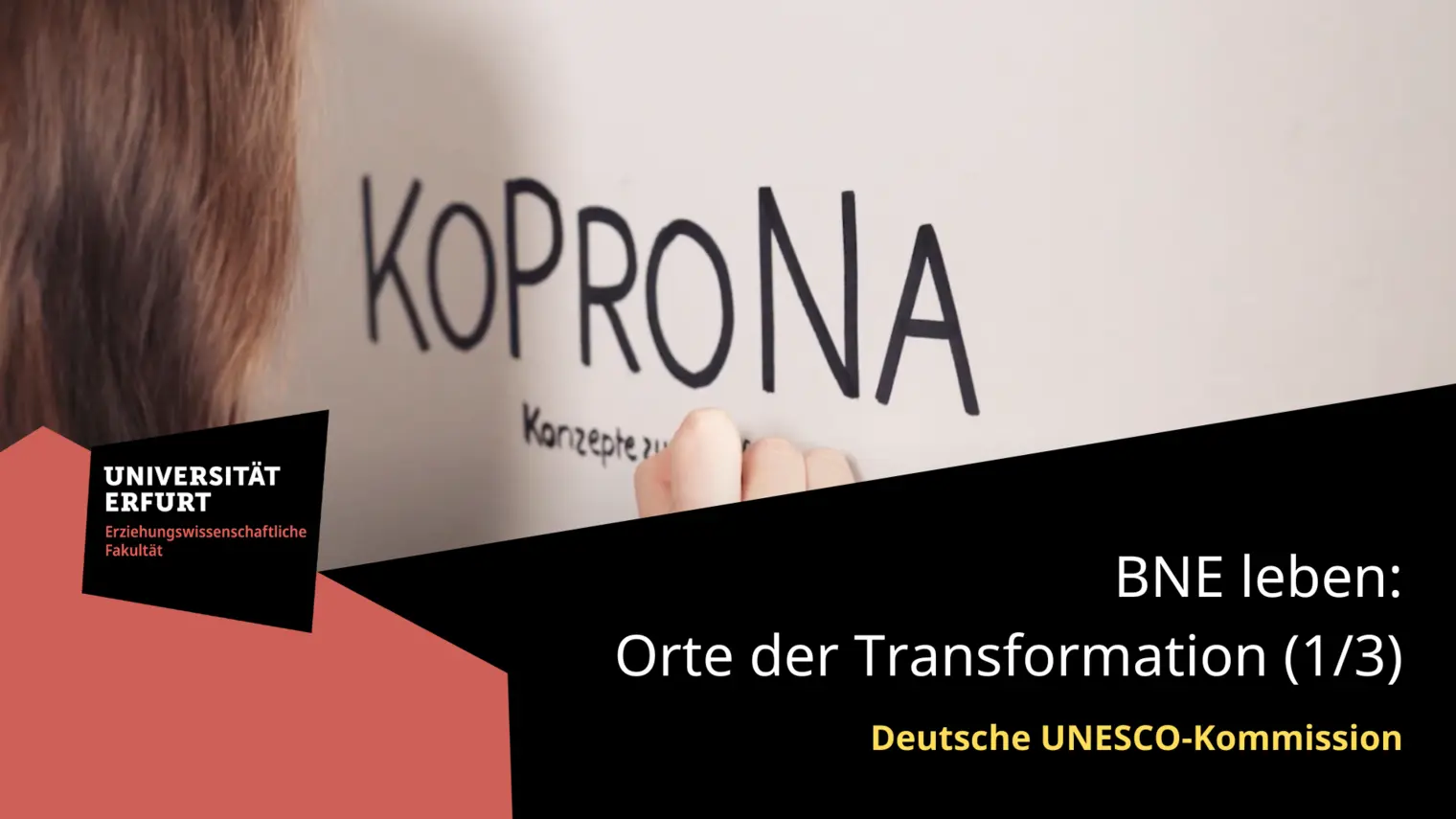
The KoProNa project is also featured in the video ‘Living ESD: Places of Transformation (1/3)’ by the German Commission for UNESCO (from 06:30).
Please note: Once you watch the video, data will be transmitted to Youtube/Google. For more information, see Google Privacy.
Planetary Health Action Survey (PACE)
How well informed is the public actually about climate change and other global crises – and what would need to change for more people to act accordingly? These questions are addressed by the Planetary Health Action Survey (PACE) project, a joint project between the University of Erfurt, the Bernhard Nocht Institute for Tropical Medicine in Hamburg, the Robert Koch Institute, the Federal Institute for Public Health, the Leibniz Institute for Psychology and the Science Media Centre, and is financially supported by the Klaus Tschira Foundation.
The PACE data provide a very comprehensive and continuously updated picture of both the attitudes and behaviour of the German population regarding the climate crisis. The scope of the survey ranges from respondents’ general level of knowledge and political participation (such as taking part in demonstrations or discussions about climate change amongst friends and family) to the assessment of specific policy measures, such as a speed limit or a ban on domestic flights. The results are made available to the public on the project website.
Social & Human Infrastructures for Future Transitions (SHIFT)
Climate change and digitalisation are transforming our lives simultaneously and at a rapid pace – yet in research, these two upheavals are usually examined in isolation. The interdisciplinary SHIFT research group at the University of Erfurt brings together political science, sociology, psychology, communication studies, education and economic research to change precisely that: It investigates how states, organisations and individuals are coping with this ‘dualtransformation’ – from political systems, through the media and political parties, to individual attitudes and educational backgrounds.
The aim is to derive concrete recommendations from this: how must climate policy and other measures be designed so that they are not only effective but also socially acceptable and actually feasible? SHIFT involves researchers from the Willy Brandt School of Public Policy working alongside colleagues from several faculties at the University of Erfurt.
KLIMA-N: Subproject ‘Education for Sustainable Development’ (ESD)
How can we not only learn about sustainability, but actually start behaving differently? This is precisely what the University of Erfurt is investigating in the ‘Educationfor Sustainable Development (ESD)’ subproject of the Thuringia-wide KLIMA network. Instead of traditional lectures, the team is developing teaching formats that directly involve students in real-world sustainability projects – such as through service-learning with the association Zukunftsfähiges Thüringen e.V., where students undertake practical project work. Whether these formats actually contribute to a change in mindset is continuously assessed in collaboration with those involved and directly translated into improvements. The aim is to establish the best of these formats (“KLIMA.LLA”) at all four participating higher education institutions (the University of Erfurt, Nordhausen University of Applied Sciences, Erfurt University of Applied Sciences and the Technical University of Ilmenau).
TraNaxis – Integrating sustainability into vocational education and training through the training of multipliers
How can sustainability be integrated into the very places where training actually takes place – in workshops, offices and workplaces? In the TraNaxis project, the University of Erfurt, in collaboration with Leuphana University Lüneburg, is ensuring that learning materials from two previous projects are put into practice: one focused on commercial apprenticeships, the other on industrial and technical ones. TraNaxis brings both perspectives together.
The key to this is a two-stage approach: first, the universities train trainers in further education. These trainers then go on to train instructors from regional companies independently – with support and guidance from the universities. In this way, the project ultimately reaches far more businesses than it could on its own. The training for in-company trainers is also recognised as an IHK certificate course, which is intended to increase its acceptance in practice.
Trainers who were previously involved in the predecessor projects are once again being brought on board – partly so that commercial and technical perspectives can enrich one another.
The project is funded by the Federal Institute for Vocational Education and Training with funding from the Federal Ministry of Education and Research.
Duration: 11/2020 – 10/2022
You can find further research projects on our overview page.
Measures to ensure the sustainable use of resources on campus
operations Engineering
The university was first awarded the Ökoprofit seal back in 2001; since then, a great deal has been done to ensure it is once again eligible for the award. “We are aware of our special responsibility as an institution, but also in our role as opinion leaders,” says Stefan Doogs, who plays a key role in coordinating the Ökoprofit measures at the University of Erfurt. “That is why it is part of our daily work to consider how we can use raw materials and energy in line with our needs, optimise our consumption and, where possible, return them to the cycle.” In this context, economic efficiency and environmental protection should no longer be seen as conflicting goals, but should instead be meaningfully integrated. This also means that, when awarding contracts to external service providers, the university ensures that only environmentally sound resources, processes and methods are used.
Measures to ensure the sustainable use of resources on campus include, for example,
- the systematic replacement of old heating pumps and the use of high-efficiency pumps across the campus;
- the energy optimisation of the library in terms of lighting, heating, ventilation and air-conditioning systems to save energy and reduce operating costs;
- optimising the cooling system for the library’s server room, including through the use of water-cooled server cabinets (completed);
- the installation of water-saving fittings on washbasins and in showers (completed);
- the installation of waterless urinals in the library (completed);
- renovation of the façade of Building C23 (including to save heating energy);
- refurbishment of the sports hall, including measures to optimise the building’s energy efficiency (completion of construction work planned for the 2025/26 winter term);
- a review of the waste management strategy; and
- the conversion of campus lighting to LED technology.
photovoltaic systems


Building C23
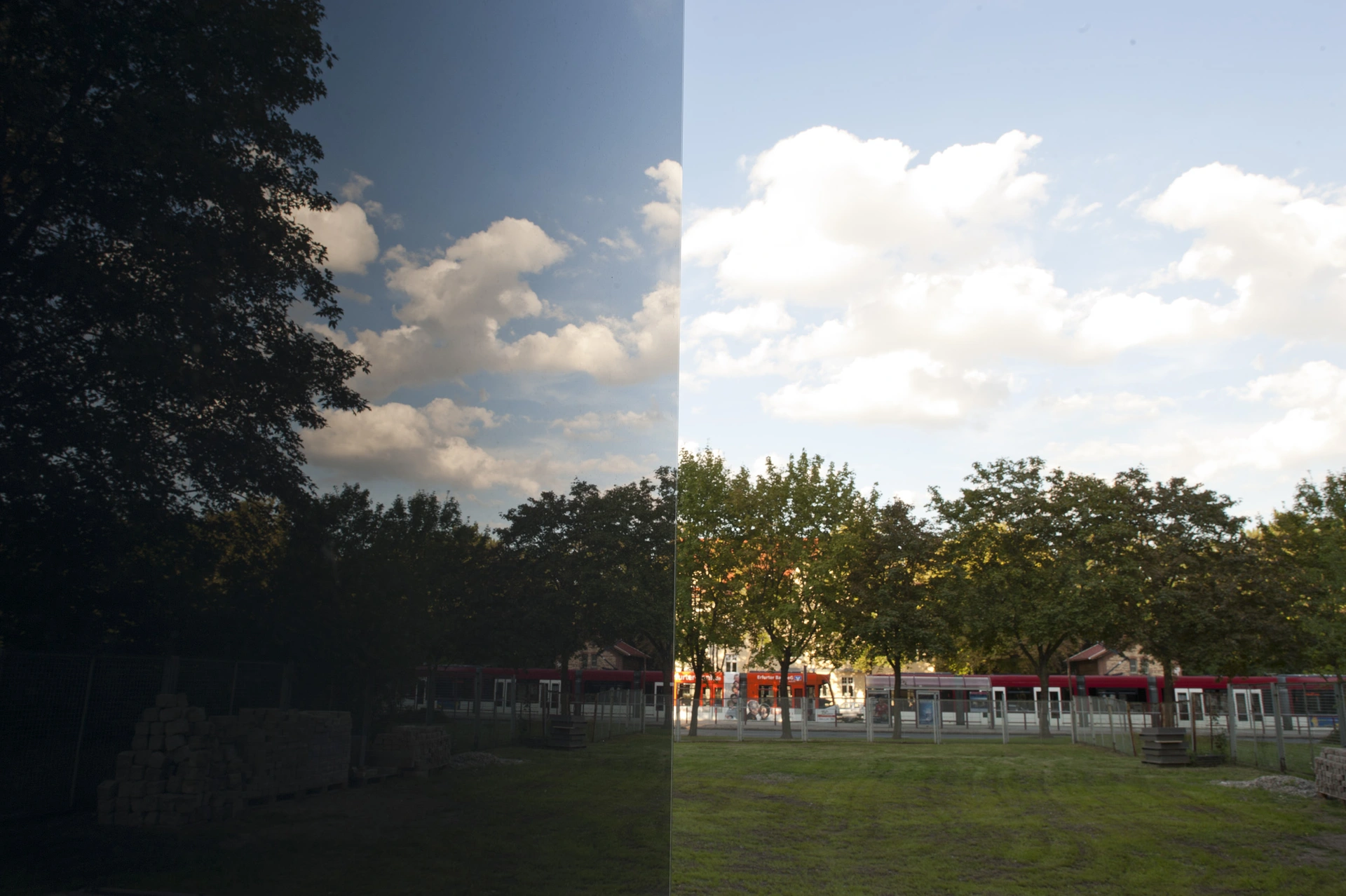
As part of the economic stimulus package, the external façade of the listed high-rise building on the University of Erfurt campus was refurbished in 2010. To ensure a second structural escape route, a second emergency stairwell had to be built on the south side of the building. Following joint consultation between the building authority, the heritage authority, the fire service, the TLBV and the University, this extension was planned and carried out with a photovoltaic system installed on the façade. The system has been in operation since 23 December 2010. Its 352 solar panels have a rated output of around 28 kWp and are expected to generate approximately 17,300 kWh of solar power per year.
Building C21 (KIZ)
In August 2024, a 117 kWp system was officially commissioned on the roof of the Communications and Information Centre (C21). In future, all the electricity generated there is to be consumed on campus.
Building C03
In the summer of 2025, a 137 kWp photovoltaic system was installed on the west side of Building C03. It now supplies additional solar power to our campus.
Building C13 (sports hall)
Another system with a capacity of 148 kWp is located on the roof of the sports hall, which is currently undergoing renovation. Completion is currently scheduled for the 2026/27 winter term.
Further photovoltaic systems are either under construction or in the planning stage:
As part of the upcoming refurbishment of Building C12, a PV system comprising 96 modules with a total capacity of approximately 43 kWp is also planned.
geothermal energy
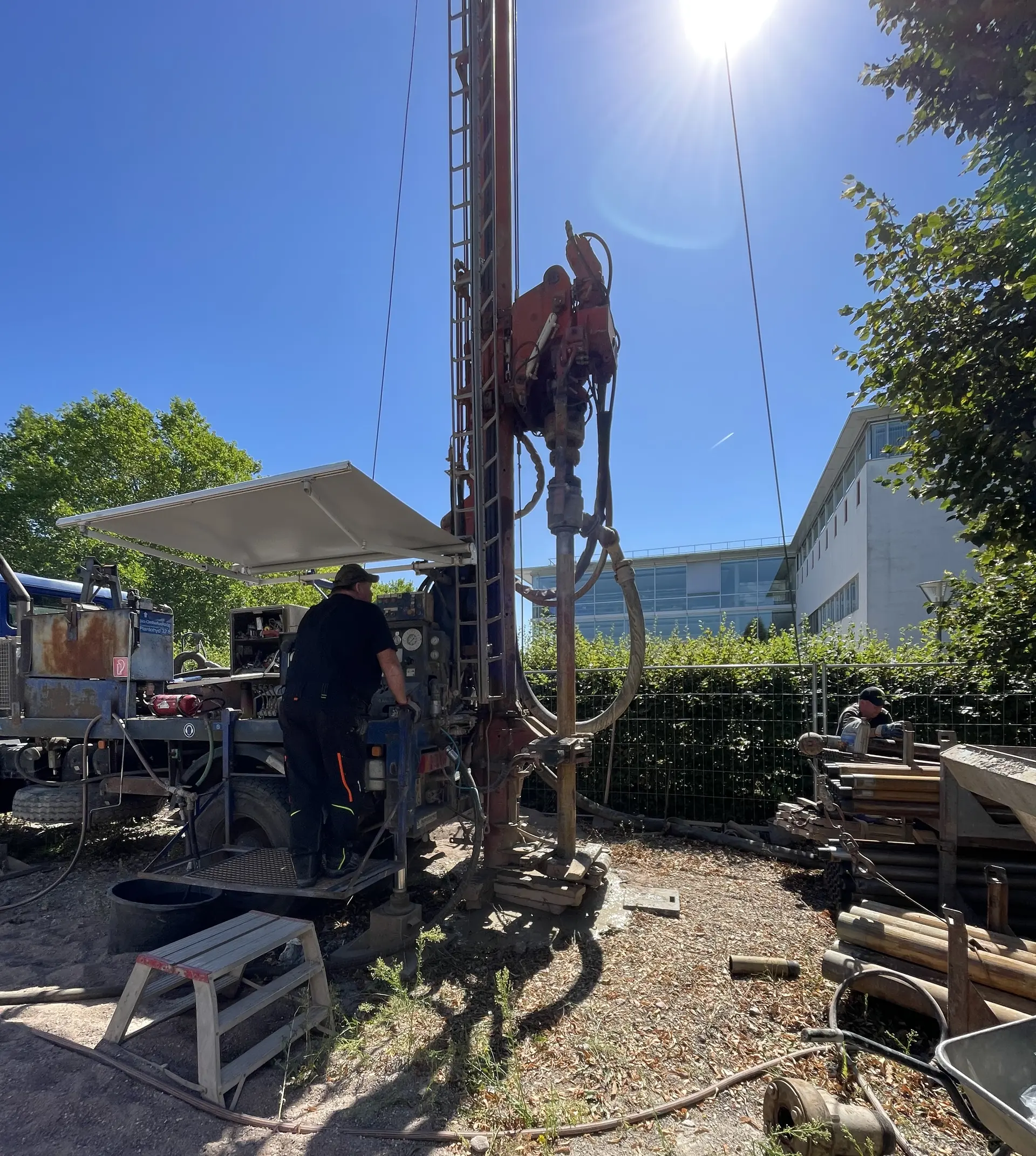
In 2018, the University of Erfurt submitted a so-called ‘major construction project’ to the State of Thuringia for the refurbishment and modernisation of Building C12 and was granted the status of project owner. The building has not been in use since spring 2024 due to its significant defects. Work to set up the construction site began in May 2025. For the first time, the construction plans include the installation of a geothermal system for this building. The necessary drilling took place in the summer of 2025.
Puzzlekiste
The Puzzlekiste is a sustainable swap scheme for household items and other useful things. The service is aimed at international students who come to Erfurt to study and need household items such as pots, crockery, towels, etc. These can be borrowed from the Puzzlekiste (subject to availability). Ideally, the items should be returned at the end of the study period. Of course, all other students and university employees are also welcome to support the project by donating household items, cutlery, glasses, towels, etc., that they no longer need to the Puzzlekiste. Please make an appointment!
Where? The Puzzlekiste is located in the basement of Teaching Building C07, Room 3b (-112).
Contact: international.puzzlekiste@uni-erfurt.de
The “Puzzlekiste” is a student project run by the International Office with the support of the Student Council, the Exchange Student Network (ESN) and the SWE Stöberhaus.
![[Translate to English:] facebook icon](/fileadmin/SocialMediaIcons/iconfinder_06-facebook_white.svg)

![[Translate to English:] instagram icon](/fileadmin/SocialMediaIcons/iconfinder_38-instagram_white.svg)
![[Translate to English:] YouTube icon](/fileadmin/SocialMediaIcons/iconfinder_18-youtube_white.svg)
![[Translate to English:] xing icon](/fileadmin/SocialMediaIcons/iconfinder_xing_white.svg)
