
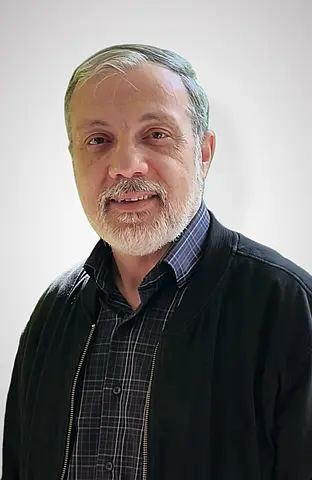
Dr. Younes Nourbakhsh
younes.nourbakhsh@uni-erfurt.deAssociate Fellow (Max Weber Centre for Advanced Cultural and Social Studies)
Office hours
by appointment
Visiting address
Max Weber Centre for Advanced Cultural and Social Studies
C19 – research building "Weltbeziehungen"
Max-Weber-Allee 3
99089 Erfurt
Mailing address
Universität Erfurt
Max Weber Centre for Advanced Cultural and Social Studies
Postfach 90 02 21
99105 Erfurt
Personal Information
Younes Nourbakhsh (born 1965 in Marand, Iran) is an Associate Professor in the Department of Social Sciences at the University of Tehran, a position he has held since 2009. His academic work focuses on the sociology of religion and culture, with particular emphasis on the intersections between religion, society, and contemporary global challenges.
He completed his early studies in Islamic Theology before earning a B.A. in Sociology from the University of Tehran (1993). He subsequently obtained his M.A. in Sociology from Allamah Tabatabai University, Tehran (1995), and completed his Ph.D. in Sociology at the University of Hamburg in 2008. His previous academic leadership roles include Dean of the Faculty of Social Sciences at the University of Tehran and Founder and Head of the Department of German Studies, as well as Associate Member of the Faculty of World Studies .
He’s research spans several interconnected fields. Since 2007, he has been actively engaged in research and social initiatives related to social health and sustainable development. His work in this area led to his appointment in 2018 as Chairholder of the UNESCO Chair in Social Health and Development. He has also contributed to international academic communities through membership in the International Sociological Association and the Iranian Sociological Association.
A significant part of his scholarship has focused on Muslim minorities worldwide, culminating in the publication of the book Atlas of Muslim Minorities in the World (in Persian). In recent years, he has concentrated on the relationship between religion and the environment, exploring how religious values shape ecological attitudes and behaviors (Green Revelations? : ecologically relevant teachings in the Quran and the Bible).
From 2023 to 2025, Nourbakhsh spent a research stay at the University of Bamberg in collaboration with Joachim Kügler. Since 2015, Nourbakhsh has been developing a research project within the framework of resonance theory titled From World-Alienation to Self-Alienation: Revisiting Resonance Theory in a Global Perspective. This project was initiated during his tenure as an Associate Fellow at the Max Weber Kolleg, where he began systematically exploring the transformation of human–world relations from a global perspective. Drawing on contemporary social theory, the project analyzes processes of alienation and resonance across diverse cultural contexts.
Research Project
From World-Alienation to Self-Alienation: Revisiting Resonance Theory in a Global Perspective
The present research project examines the transformation of alienation in late modernity from a global and comparative perspective. It starts from the diagnosis that modern societies are characterized by multiple forms of alienation—not only in economic or social terms, but also at cultural, emotional, and existential levels. While classical theories of alienation, such as those of Hegel, Marx, and Weber, primarily emphasize structural or labor-related dimensions, Hartmut Rosa’s theory of resonance offers an expanded approach by interpreting alienation as a disturbed relation to the world.
The project builds precisely on this point and aims to critically extend Rosa’s approach. It argues that although resonance theory provides a convincing analysis of “alienation from the world,” it pays insufficient attention to the dimension of “self-alienation.” Particularly in non-Western and postcolonial contexts, alienation often appears primarily as a loss of the self. Against this background, the central research question is formulated as follows: How can resonance theory be theoretically deepened and made globally applicable through Islamic-anthropological concepts of the self?
Methodologically, the study is based on a qualitative, hermeneutically oriented concept analysis. In line with the principle of functional equivalence, key texts of Critical Theory are compared with selected positions in Islamic philosophy and social theory, especially the approaches of Ali Shariati and Muhammad Iqbal. The aim is not to transfer Western categories, but rather to identify structural similarities and differences in addressing fundamental questions of self, world, and meaning.
A central outcome of the project is the development of an extended theoretical model that complements Rosa’s three axes of resonance (horizontal, diagonal, vertical) with a fourth dimension: “inner resonance.” This dimension describes a dialogical relationship of the subject with itself, encompassing self-awareness, ethical orientation, and spiritual reflexivity. Concepts such as Shariati’s “return to the self” (bazgasht be khod) and Iqbal’s khudi are interpreted as complementary perspectives that highlight the importance of inner self-relations for successful relations to the world.
In this way, the project contributes to a globally oriented sociology of alienation that systematically integrates cultural and religious perspectives. It demonstrates that overcoming alienation is not possible solely through institutional or structural changes, but also fundamentally requires processes of self-formation and inner coherence. In doing so, the study opens up new theoretical and empirical perspectives for analyzing modern societies in the tension between acceleration, loss of meaning, and the search for resonant forms of life.
Selected Publications
- Nourbakhsh, Y. (2025). Green revelations? Ecologically relevant teachings in the Quran and the Bible.
- Nourbakhsh, Y., Gerami, R., & Sadeghi, R. (2025). An investigation on identity challenges faced by Muslim women immigrants in Europe. Journal of Women in Development and Politics, 23(1), 119–147.
- Borzoo, M., & Nourbakhsh, Y. (2024). Investigation of the religious culture of the Iranian people in the Safavid era from the perspective of German travel writers Adam Olearius and Engelbert Kaempfer. Spektrum Iran.
- Nourbakhsh, Y. (2022). The effect of COVID-19 on religious beliefs and practices of women in Iran and their approach to the vaccine. Bible in Africa Studies.
- Dabbaghi, H., & Nourbakhsh, Y. (2022). Strategic principles for interdisciplinary management in the academic system. Interdisciplinary Studies in Humanities, 1(2), 249–276.
- Zamani, M., Nourbakhsh, Y., & Nayebi, H. (2021). Presenting a pattern for promoting social health through social networks (Case study: Instagram). New Media Studies, 7(28), 1–42.
- Nourbakhsh, Y., Kalantari, A. H., & Farhadi, E. (2020). Tourism is a reflection of the modern urban living world. Urban Tourism, 6(4), 95–110.
- Nourbakhsh, Y. (2020). Modernity in Iran and Turkey: Patterns and problems. Religious Inquiries, 9(18), 225–253.
- Khodayarifard, M., Ghobari Bonab, B., Shokouhi Yekta, M., & Nourbakhsh, Y. (2019). Religiosity interactional program for university students: Development and validation. Positive Psychology Research, 4(4), 69–84.
- Nourbakhsh, Y., & Ebrahimi, M. (2019). Religion in the market society. Journal of Islamic Social Studies, 6(4), 79–103.
- Nourbakhsh, Y., Heydarkhani, H., & Mohammadi, A. (2018). Investigating the relationship between social support and social health among youth in marginalized areas of Kermanshah. Iranian Journal of Social Issues, 8(2), 233–257.
- Nourbakhsh, Y., & Mowlaei, M. M. (2012). Glocalization of popular music: Exploring religious themes in Iranian rap.
- Nourbakhsh, Y. (2008). Culture and ethnicity: A model for cultural relations in Iran. Journal of Cultural Studies, 1(4).

![[Translate to English:] facebook icon](/fileadmin/SocialMediaIcons/iconfinder_06-facebook_white.svg)

![[Translate to English:] instagram icon](/fileadmin/SocialMediaIcons/iconfinder_38-instagram_white.svg)
![[Translate to English:] YouTube icon](/fileadmin/SocialMediaIcons/iconfinder_18-youtube_white.svg)
![[Translate to English:] xing icon](/fileadmin/SocialMediaIcons/iconfinder_xing_white.svg)
