
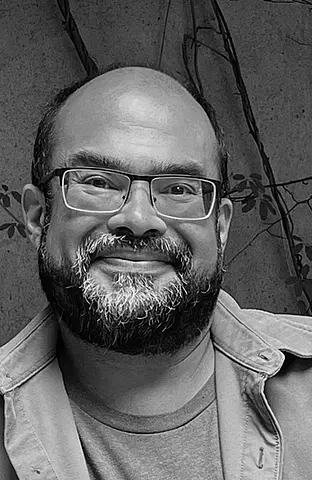
Duane Corpis
duane.corpis@uni-erfurt.deFellow (Max Weber Centre for Advanced Cultural and Social Studies)
Contact
C19 – research building "Weltbeziehungen" / C19.03.32
Office hours
by appointment
Visiting address
Campus
Max Weber Centre for Advanced Cultural and Social Studies
C19 – research building "Weltbeziehungen"
Max-Weber-Allee 3
99089 Erfurt
Mailing address
Universität Erfurt
Max Weber Centre for Advanced Cultural and Social Studies
Postfach 90 02 21
99105 Erfurt
Personal information
Duane J. Corpis studied European history as an undergraduate at the University of Chicago and received his PhD from New York University in the field of early modern German history from New York University. After teaching at Georgia State University in Atlanta and Cornell University in Ithaca, he joined New York University in Shanghai as an Associate Professor of the Humanities. Duane is the recipient of the 2013-2014 Smith Book Award from the Southern Historical Association and the 2013 Hans Rosenberg Article Prize from the Central European History Society. He has been an NEH Humanities Summer Scholar, a Senior Fellow at the Institute for Advanced Study at Central European University in Budapest, and a Herzog Ernst Fellow at the Gotha Research Center and Library. His general areas of research include the cultural construction of religious space and place, the role of soundscapes and noise as sources of social conflict, the relationship between migration and religious identity, and the globalization of faith-based charity projects.
Research project

Beyond the Parish
My ongoing research project “Beyond the Parish” examines the expansion of Protestant charity’s geographic scale as it grew from local, civic poor relief during the sixteenth-century Reformation to the transregional charity projects characteristic of international Protestantism during the seventeenth and eighteenth centuries. I situate this project within the scope of the KFG project “Religion and Urbanity” because of the central role played by Protestant urban communities in founding, financing, expanding, and exporting charitable projects across city-based networks and imperial routes of circulation. Responding to Catholicism’s global successes, Protestant communities in German cities began to network first with one another and later with other European cities like London, Rotterdam, Copenhagen, and Stockholm to design intercity infrastructures that facilitated the movement of charitable resources across ever increasing distances. These charitable resources had many aims: supporting the conversion of individuals from competing religions, resettling Protestant refugees fleeing persecution, ransoming Protestants taken captive by corsairs in the Mediterranean, rebuilding churches damaged by natural or wartime disasters, or establishing charity schools and orphanages. By the late 18th century, such charitable initiatives had connected not only Lutheran, Reformed, and Anglican urban communities, but also incorporated colonial port cities in India, the East Indies, and British North American. In turn, the urban worldviews of Protestants became infused with a cosmopolitan brand of empathy that was culturally expansive but also shaped by the imperial infrastructures and colonial ideologies that promoted the spatial expansion of charitable networks. Thus, while charitable networks were a vector for extending the global reach of evangelical Christianity, they were also anchored – socially, politically and spatially – within the urban communities that funded them.
Publications Relevant to Current Research:
Premodern Radicalisms, Radical Premodernisms, special issue of Radical History Review 130 (January 2018): 1-198. Co-editors Kaya Sahin and Dave Kinkela.
Sound Politics: Critically Listening to the Past, special issue of Radical History Review 121 (January 2015): 1-208 (co-authored editorial introduction, 1-7). Co-editors Daniel Bender and Danny Walkowitz.
Crossing the Boundaries of Belief: Geographies of Religious Conversion in Southern Germany, 1648-1800. Charlottesville, VA: University of Virginia Press, 2014. [Awarded the Smith Book Award of the Southern Historical Association for 2013-2014]
“Christianity in the Atlantic World.” In The Princeton Companion to Atlantic History, edited by Joseph C. Miller. Princeton: Princeton University Press, 2014.
“Marian Pilgrimage and the Performance of Male Privilege in Eighteenth-Century Augsburg.” Central European History 45 (September 2012): 375-406. [Awarded the Hans Rosenberg Article Prize for 2011-2012]
“Paths of Salvation and Boundaries of Belief: Spatial Discourse and the Meanings of Conversion in Early Modern Germany.” In Conversion and the Politics of Religion in Early Modern Germany, edited by David M. Luebke, et al., 14-31. New York: Berghahn Books, 2012.
“Losing One’s Place: Memory, History, and Space in Post-Reformation Germany.” In Enduring Loss in Early Modern Germany, edited by Lynne Tatlock, 327-367. Leiden and Boston: Brill, 2010.
Critical Approaches to Religion and Politics, special issue of Radical History Review 99 (Fall 2007): 1-284 (co-authored editorial introduction, 1-17). Co-editor Rachel Scharfman.
“Mapping the Boundaries of Confession: Space and Urban Religious Life in the Diocese of Augsburg, 1648-1750.” In Sacred Space in Early Modern Europe, edited by Will Coster and Andrew Spicer, 302-325. Cambridge and New York: Cambridge University Press, 2005.

![[Translate to English:] facebook icon](/fileadmin/SocialMediaIcons/iconfinder_06-facebook_white.svg)

![[Translate to English:] instagram icon](/fileadmin/SocialMediaIcons/iconfinder_38-instagram_white.svg)
![[Translate to English:] YouTube icon](/fileadmin/SocialMediaIcons/iconfinder_18-youtube_white.svg)
![[Translate to English:] xing icon](/fileadmin/SocialMediaIcons/iconfinder_xing_white.svg)
