
Noam Shoked
noam.shoked@uni-erfurt.deFellow (Max Weber Centre for Advanced Cultural and Social Studies)
Contact
C19 – research building "Weltbeziehungen" / C19.03.11
Office hours
by appointment
Visiting address
Campus
Max Weber Centre for Advanced Cultural and Social Studies
C19 – research building "Weltbeziehungen"
Max-Weber-Allee 3
99089 Erfurt
Mailing address
Universität Erfurt
Max Weber Centre for Advanced Cultural and Social Studies
Postfach 90 02 21
99105 Erfurt
Personal information
Noam Shoked is a scholar of the built environment. His work explores the relationship between politics and everyday spaces, with a particular focus on Israel and other sites of Jewish life. His book, In the Land of the Patriarchs: Design and Contestation in West Bank Settlements (University of Texas Press, 2023), received the 2024 PROSE Award in Architecture and Urban Planning from the Association of American Publishers, as well as the 2024 On the Brinck Book Award from the University of New Mexico School of Architecture and Planning. He is currently writing a book about the design and evolution of ultra-Orthodox Jewish enclaves in Israel and the United States.
Shoked is an assistant professor of architecture at Tel Aviv University. Before joining the faculty at Tel Aviv University, he was a Princeton-Mellon Fellow at Princeton University, and a senior lecturer at the California College of the Arts. He hold a PhD from UC Berkeley.
More information: https://english.tau.ac.il/profile/noamsh
Research project
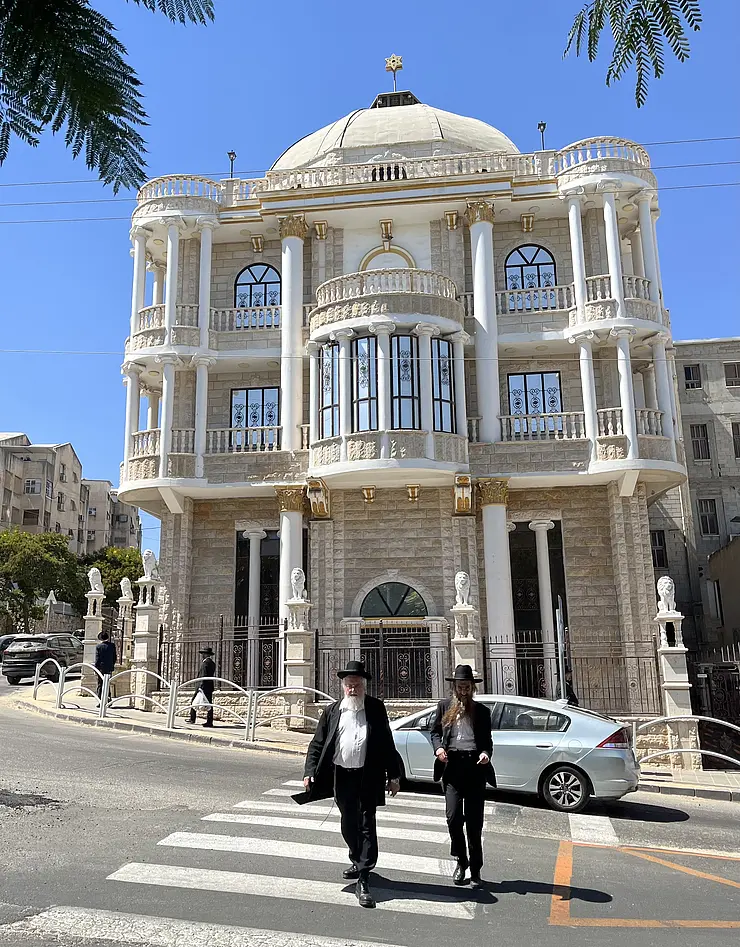
Haredi Landscapes: A Transnational Urban Story of Piety and Self-Segregation
Few groups are as well known for their tendency toward spatial separation as the ultra-Orthodox Jews, known in Hebrew as Haredim. It is less well understood how Haredi enclaves have developed and evolved, how these spaces are experienced and contested, and what they can reveal about the broader phenomenon of self-segregation. This project examines the making and transformation of Haredi enclaves, spanning the period from the end of World War II to the present. It studies Haredi communities in the United States and in Israel, paying attention to the individuals who migrated between the two countries and who brought with them their ideas about the built environment—what it is, and what it should be.
Drawing on ethnographic and archival material, the project asks how and why the Haredi tendencies towards spatial separation have emerged; how do these tendencies adapt when they cross national borders; and how the built environment might contribute to these tendencies. Along the way, the project offers new insights into Haredi society. It shows how the transatlantic ties between Haredi communities in Israel and the U.S. have shaped their identities and preferences, and how Haredim have, at times, even spurred modernization in urban planning and design.
The project traces the unfolding of Haredi enclaves across three episodes: (1) the settlement of Haredim in Tel Aviv and Brooklyn in the aftermath of World War II; (2) the migration of American Haredim to Israel in the 1960s and 70s, bringing new patterns of segregation; and (3) the transformation of Jerusalem into a Haredi city, beginning in the 1990s.

![[Translate to English:] facebook icon](/fileadmin/SocialMediaIcons/iconfinder_06-facebook_white.svg)

![[Translate to English:] instagram icon](/fileadmin/SocialMediaIcons/iconfinder_38-instagram_white.svg)
![[Translate to English:] YouTube icon](/fileadmin/SocialMediaIcons/iconfinder_18-youtube_white.svg)
![[Translate to English:] xing icon](/fileadmin/SocialMediaIcons/iconfinder_xing_white.svg)
