
Mitglied, Fachrichtung: Medienkultur, Mediengeschichte (Erfurter RaumZeit-Forschung)
Visiting address
Erfurter RaumZeit-Forschung
C18 – teaching building 4
Alfred-Weber-Platz 4
99089 Erfurt
Mailing address
Universität Erfurt
Erfurter RaumZeit-Forschung
Postfach 90 02 21
99105 Erfurt
Projektmitarbeiter (DFG/Eigene Stelle) (History Department)
Mailing address
Universität Erfurt
History Department
Postfach 90 02 21
99105 Erfurt
Fellow (Max Weber Centre for Advanced Cultural and Social Studies)
Contact
C19 – research building "Weltbeziehungen" / C19.03.32
Office hours
by appointment
Visiting address
Max Weber Centre for Advanced Cultural and Social Studies
C19 – research building "Weltbeziehungen"
Max-Weber-Allee 3
99089 Erfurt
Mailing address
Universität Erfurt
Max Weber Centre for Advanced Cultural and Social Studies
Postfach 90 02 21
99105 Erfurt
Personal Information
I am a media and cultural historian interested in intersecting and intertwined narratives, and in recent years I have focused extensively on sounds, noise, and the enjoyment of food and the science of taste. (Stahl 2022, 2025) I am particularly drawn to such research topics when they highlight the transitions between cultures and media, performances, and social and cultural entanglements and histoires croisées (Werner/Zimmermann 2002). This sheds light on the relationships between materials, products, and technologies as well as in terms of appropriation, modes of consumption, and attributions of meaning to space and time.
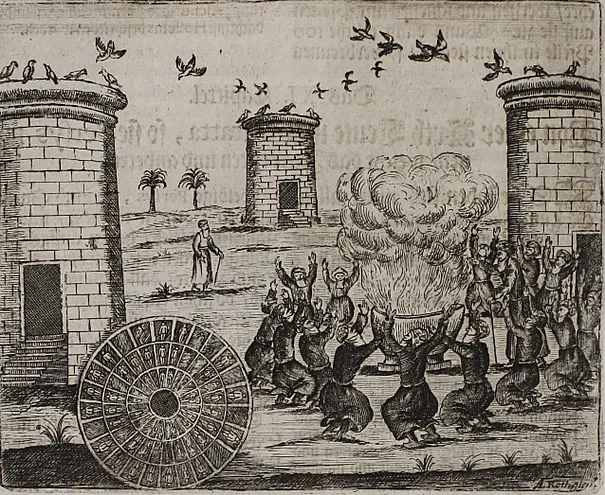
My current project deals with travelogues to and across India in the 17th and 18th century. I examine reports on Surat and Golconda and evaluate how sensory regimes, religious practices and the shaping of urban spaces are observed and reflected in these writings. These accounts were edited, printed and traded by Leiden, Amsterdam, Paris, London, and Hamburg based publishers.
Research Project
Sound, scent, sight, spatial sensing, taste, touch and smell in religious rituals and in urban spaces in Surat and Golconda. On sensory reception and receptiveness in travelogues to India (1600-1800).
This project connects travelogues to sensorial regimes. Travel literature in the 17th and 18th century has been compiled, translated and published in Leiden, Paris, London, Amsterdam or Hamburg. These texts are mediated compositions and contact zones. Those accounts dealt with history, politics, people, alimentary practices and religious matters in regions that were (or could have been made) located beyond the geographical and mental boundaries of what was then labeled as Europe. The observations that seafaring man, traders, military personal, explorers, adventurers and diplomats made passed through several stages of filtering before being fully prepared for publication. Content was shaped, assorted, assembled and composed.
In general, such sources are multifaceted, variegated and versatile. By all means, travelogues on India, especially on Surat and Golconda between 1600 and 1800 provide valuable insight in reciprocal formations of religious practices and the economies and ecologies of urban dynamics.
Senses evaluate and unscramble environments. They signify object/subject relations as well as space/place constellations. Furthermore, senses mark personal affiliation, knowledge and preexisting sets of experience. Sensory regimes are bound to spaces and places, to individual preadjustments and memories and to procedures of zoning urban landscapes. Senses do deceive. Senses resonate and do respond to rhythms and to tactility.

![[Translate to English:] facebook icon](/fileadmin/SocialMediaIcons/iconfinder_06-facebook_white.svg)

![[Translate to English:] instagram icon](/fileadmin/SocialMediaIcons/iconfinder_38-instagram_white.svg)
![[Translate to English:] YouTube icon](/fileadmin/SocialMediaIcons/iconfinder_18-youtube_white.svg)
![[Translate to English:] xing icon](/fileadmin/SocialMediaIcons/iconfinder_xing_white.svg)
