
Fellow (Max Weber Centre for Advanced Cultural and Social Studies)
Contact
C19 – research building "Weltbeziehungen" / C19.03.11
Office hours
on appointment
Visiting address
Max Weber Centre for Advanced Cultural and Social Studies
C19 – research building "Weltbeziehungen"
Max-Weber-Allee 3
99089 Erfurt
Mailing address
Universität Erfurt
Max Weber Centre for Advanced Cultural and Social Studies
Postfach 90 02 21
99105 Erfurt
Personal Information
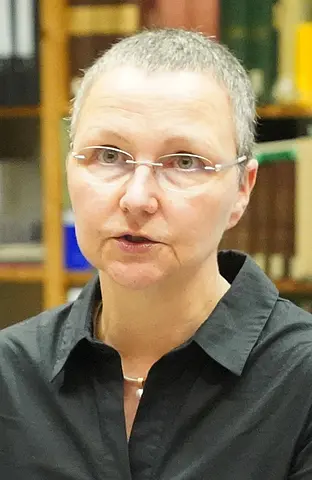
Ulrike Ehmig, Dr. phil., studied Classic Archaeology, Latin Philology, and Ancient History in Mainz and Heidelberg. She received her doctorate in 2000 in the Field of History and Culture of the Roman Provinces and her habilitation in 2009 at the University of Frankfurt/Main. Venia legendi for the Field of Archaeology and History of the Roman Provinces. Research assistant and head of numerous research projects in Germany and abroad. Interdisciplinary studies on issues of Roman economy and religion, the material impact of Roman law, and the perception and management of risks in Roman antiquity. The common thread linking all of her work is her interest in Latin inscriptions as a multimodal medium of communication. Since June 2018, head of the Corpus Inscriptionum Latinarum research center at the Berlin-Brandenburg Academy of Sciences and Humanities. Against this background, object-based contributions to the history of knowledge and critical engagement with corpus work.
Detailed profile page: https://ulrikeehmig.hcommons.org/
Research Project
The project is rooted in the tension between the comparatively low level of urbanisation in Raetia and the remarkable proportion of sacred inscriptions in the province. The following questions are among those that are central to the project: Where in the region, whose location between the heartland of the Roman Empire and the Danube and north-western provinces makes it a transit and contact region par excellence, is communication with higher powers expressed in religious inscriptions? Are the approximately 160 religious inscriptions concentrated in urban centres? Only Augsburg and Kempten were cities in the Roman legal sense. What role did the spatial reference points, mentioned in texts on milestones, a Legione and a Phoebianis – the legionary camp in Regensburg and the temple complex for Apollo Grannus in Faimingen –play? What is the spectrum of inscriptions there? Who are the people who addressed inscriptions to higher powers in the province? Is there any evidence to identify these people as travellers passing through? What concerns did they bring before the gods? In this context, the not inconsiderable number of defixiones in the province is also of interest. How do they complement the picture of communication with higher powers in the region?
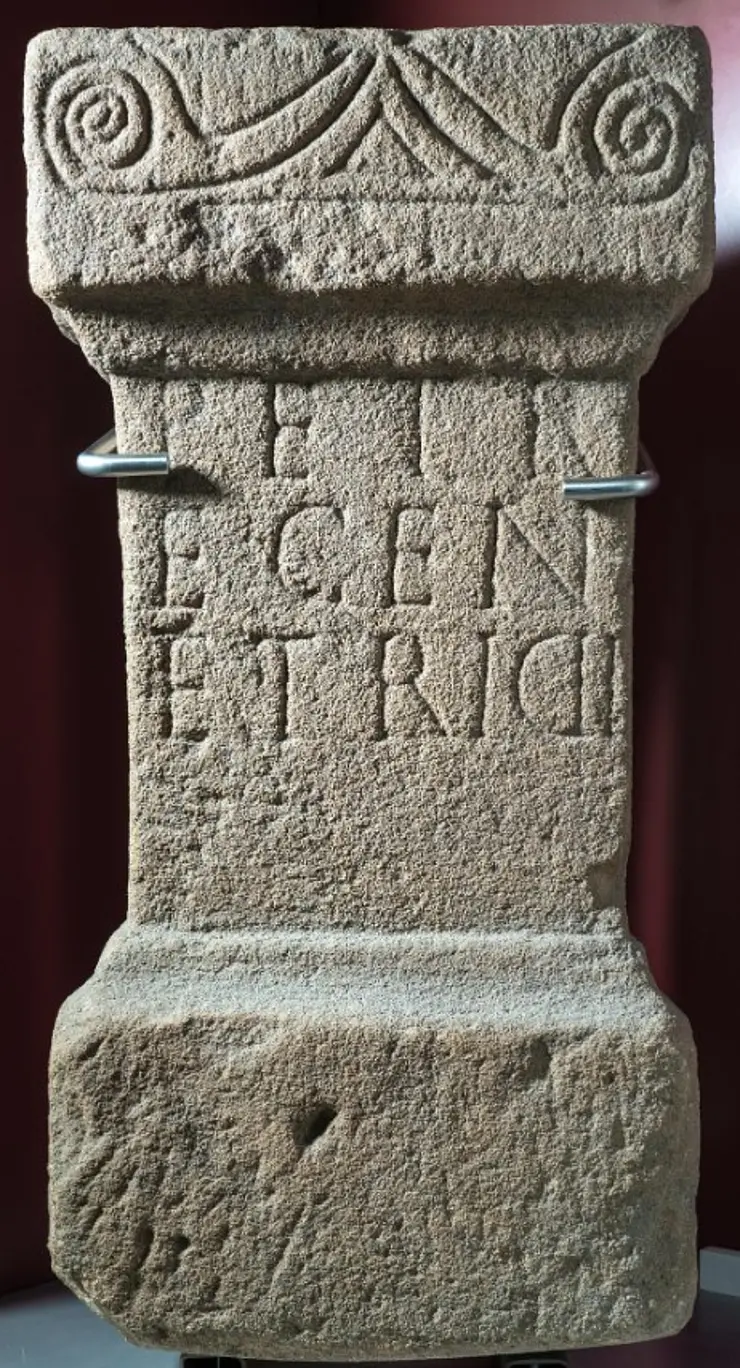
Figure: The inscription, an altar found in Theilenhofen in 1939, addresses Petra Genetrix, the birth rock of Mithras. Edition: Friedrich Wagner, Neue Inschriften aus Raetien (Nachträge zu Fr. Vollmer, Inscriptiones Baivariae Romanae), Berichte der Römisch-Germanischen Kommission 37/38, 1956/57, 237–238 no. 86 with plate 21; photo: Lupa.at/31622, image number 31622-2, Ortolf Harl, October 2021.

![[Translate to English:] facebook icon](/fileadmin/SocialMediaIcons/iconfinder_06-facebook_white.svg)

![[Translate to English:] instagram icon](/fileadmin/SocialMediaIcons/iconfinder_38-instagram_white.svg)
![[Translate to English:] YouTube icon](/fileadmin/SocialMediaIcons/iconfinder_18-youtube_white.svg)
![[Translate to English:] xing icon](/fileadmin/SocialMediaIcons/iconfinder_xing_white.svg)
