

Personal Information
Aneke Dornbusch (born 1991) studied Protestant theology in Göttingen and London from 2011 to 2018. In 2022, she was awarded a doctorate for her thesis “Hermann Dörries (1895–1977) – Ein Kirchenhistoriker im Wandel der politischen Systeme Deutschlands” (supervisor: Prof. Dr. Peter Gemeinhardt) at the University of Göttingen.
Since 2022, she has been a post-doc researcher at the Faculty of Protestant Theology at the University of Bonn. Her research focuses on ‘deviant’ Reformation movements of the early modern period and on the history of their research. In her second book project, she is investigating correspondence networks in southern German territories concerning the persecution of the Anabaptists. In doing so, she highlights the significance of political power structures and negotiation processes for the persecution of the Anabaptists.
She also works on questions of the implementation of digital humanities in Reformation studies and in contemporary church history, particularly women’s history. She currently heads the project group “Netzwerke in der Kirchengeschichte” funded by the Wissenschaftliche Gesellschaft für Theologie.
You may also find further information at her website of the University of Bonn.
Research Project
“Othering” of Religious Groups in Urban Spaces: 16th Century Mandates against Anabaptism in German Cities
Anabaptism was a phenomenon that spread rapidly in the early decades of the Reformation period, affecting both rural areas and cities. While there was no specific “urban” form of Anabaptism, it has long been argued that cities reacted more tolerantly to the phenomenon than territorial states. This raises the question if there is a form of “urban” Anabaptist persecution and whether the specific societal and political order of cities led to a specific reaction to Anabaptism.
Drawing on the theoretical framework of “othering” – originally developed in postcolonial studies – the project argues that the defamation and expulsion of Anabaptists were part of a process of urban identity formation and that Anabaptists were deliberately stylised as foreign and antisocial.
This project will further investigate this claim by analysing the corpus of anti-Anabaptist mandates issued by German-speaking cities up to 1618, combining close reading with Digital Humanities methods such as statistical analysis and mapping. Mandates have never been critically studied as a source genre and reflect both the idealised standards the cities themselves set for their treatment of Anabaptists and the realities of success or failure.
The findings will be complemented by insights gained from the investigation of administrative correspondence exchanged between South German Imperial cities in the 16th century, as well as petition letters by the Anabaptists themselves.
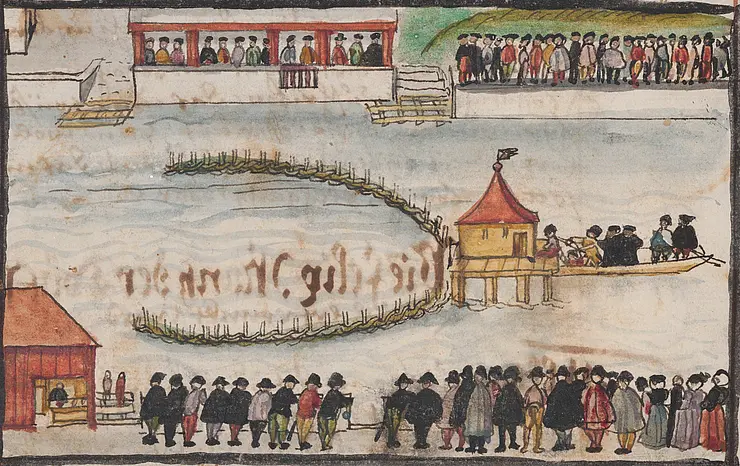
Figure: The Anabaptist Felix Manz is drowned in Zurich, Zentralbibliothek Zürich, Ms B 316, 284v.

![[Translate to English:] facebook icon](/fileadmin/SocialMediaIcons/iconfinder_06-facebook_white.svg)

![[Translate to English:] instagram icon](/fileadmin/SocialMediaIcons/iconfinder_38-instagram_white.svg)
![[Translate to English:] YouTube icon](/fileadmin/SocialMediaIcons/iconfinder_18-youtube_white.svg)
![[Translate to English:] xing icon](/fileadmin/SocialMediaIcons/iconfinder_xing_white.svg)
