by appointment
Gotha Research Centre
CG3 – Gotha Research Centre
Schloßberg 2
99867 Gotha
Universität Erfurt
Gotha Research Centre
Postfach 90 02 21
99105 Erfurt
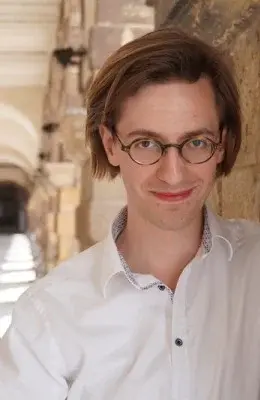
Since June 2026
Research Associate at the State Archives of Baden-Württemberg – Wertheim State Archives
Since February 2026
Freelance employee at the Museums of the City of Aschaffenburg (Public Relations)
since October 2024
Freelance employee in the project "Digitale Auswahledition der Tagebücher Johann Christian Senckenbergs" at Goethe University Frankfurt am Main
October 2025 - December 2025
Freelance employee of the State Office for Monument Preservation and Archaeology Saxony-Anhalt - Institute for Regional History (transcription services)
November 2024 - December 2024
Freelance employee of the Gotha Research Centre (preparation of a third-party funding application)
August 2024 - September 2024
Freelance employee of the Gotha Research Library (cataloguing early modern manuscripts)
April 2024 - September 2024
Adjunct lecturer at the University of Leipzig - Chair of Early Modern History (Professor Julia Schmidt-Funke)
January 2024 - June 2024
Research employee in the project "Cataloguing the Correspondence and Testimonies of Veit Ludwig von Seckendorff"
(University of Erfurt - Gotha Research Library)
since 2021
Member of the Gotha Research Centre
April 2019 - August 2023
Christoph-Martin-Wieland-Scholarship of the University of Erfurt
2019 - 2024
Doctoral student at the University of Erfurt - Gotha Research Centre in the graduate centre "History of Knowledge in the Modern Era"; supervisor: Professor Martin Mulsow
2018 - 2019
Student at the Christian-Albrechts-Universität zu Kiel: MA programme in History and Philosophy
2016 - 2018
Student at the University of Erfurt: MA programme in History
2014 - 2016
Student assistant at the Professorship of Ancient History (Professor Veit Rosenberger †) at the University of Erfurt
2013-2016
Student at the University of Erfurt: BA programme in History (major) and Catholic Religion (minor)
1994
Born in Aschaffenburg (Bavaria)
Contemporary historians see the social interaction and antagonism of the 17th and 18th centuries as being significantly characterised by a great sense of class in all social strata. The knowledge of one's own rank demanded its defence both against attacks from above and against ambitions from below. The frequent attempts to raise one's own status were the source of constant political, legal and social conflicts. The controversial questions about the order in which documents should be sealed, the coach parking spaces in the imperial Hofburg or the introduction of the office of chamberlain at the imperial courts were the outward expression of the rank accorded to oneself and others. Based on precedents, negotiations and provocative pretensions, political and courtly ceremonial reflected the hierarchy of the Holy Roman Empire.
The research project examines the emergence, preservation and dissemination of knowledge about ceremonial as a form of communication in the 18th century using the example of the Gotha ducal court. The extensive correspondence between the dukes of Gotha and other ecclesiastical and secular imperial princes plays just as important a role as the internal court documentation of individual ceremonial events. In addition to the files of the Privy Council and the Oberhofmarschallamt, including the well-known Fourierbücher, the holdings of ceremonial publications in the ducal libraries, the individual court orders and the dukes' private notes also bear witness to the omnipresence of ceremonial knowledge at court. A high value was placed on the consciously communicated external localisation of one's own rank within the political and social structure of Europe. In order to fulfil this requirement, those responsible had to be well informed at all times and have a large store of ceremonial knowledge at their disposal.
How this politically vital knowledge about the numerous and interlinked questions of rank was created, preserved and passed on will now be examined. The central question here is not so much what the ceremonies themselves looked like as acts, but rather what was considered worth passing on and why, and what benefits were derived from these traditions.
Monographs:
Verhandeltes Zeremoniell. Wissen und Normen am Gothaer Fürstenhof (1640-1800), Köln 2026 (Norm und Struktur 55).
Essays:
Umsonst ist der Tod? Die Ökonomie der Trauerkleidung am Gothaer Hof in der zweiten Hälfte der Frühen Neuzeit, in: Sebastian Becker, Matthias Schnettger (eds.): Der frühneuzeitliche Hof und die Kultur der Ökonomie (Mainzer Studien zur Frühen Neuzeit 5), Bielefeld 2026, pp. 271-294.
Ländliches Leinen, städtische Seide. Rudolph Zacharias Beckers Vorschläge zur Reform der bäuerlichen Kleidung zwischen Aufklärung und Reaktion, in: Martin Mulsow/Dirk Sangmeister (eds.): Aufklärung und Residenzstadt. Das intellektuelle Gotha um 1800, Göttingen 2026, pp. 573-592.
Die Entstehung der ersten Gothaer Fourierbücher zwischen Hofökonomie und Zeremoniell (1694–1699), in: Zeitschrift für Thüringische Geschichte 76 (2022), pp. 73-101.
„in Versammlung des ganzen Hofes“. Beobachtungen zur Beteiligung Bürgerlicher an Festen des Gothaer Herzogshofes im 17. und 18. Jahrhundert, in: Fürstliche Feste. Höfische Festkultur zwischen Zeremoniell und Amüsement, Petersberg 2020 (Jahrbuch der Stiftung Thüringer Schlösser und Gärten 23), pp. 209-223.
Online contributions:
Organising the société des princes: The Management of Titles in Eighteenth-Century German Chancelleries, in: The Court Observer. The Society for Court Studies Blog, 20.09.2023.
https://courtstudies.hypotheses.org/1072
Beredtes Schweigen. Symbole, Worte und Riten als Elemente der Kommunikation am europäischen Hof der Frühneuzeit, in: Clio-online, Themenportal Europäische Geschichte, 26.01.2023.
https://www.europa.clio-online.de/essay/id/fdae-131327
Vereinigt durch die Krise? Unerwartete Begegnungen mit den Korrespondierenden Fürsten, in: Forschen in Gotha. Ein Blog Gothaer Forschungseinrichtungen, 14. Mai. 2020.
https://www.gotha3.de/forschungsblog/archives/4665.
Reviews:
Paul Beckus (ed.): Reformen auf dem Prüfstand. Kontext und Wirkung der Reformpolitik Franz von Anhalt-Dessaus im Spiegel der neueren Forschung. Halle (Saale) 2024, in: Sachsen und Anhalt. Jahrbuch der Historischen Kommission für Sachsen-Anhalt 38 (2026), pp. 362–365.
Elisabeth Ruffert: Das Gesandtschaftszeremoniell des brandenburgisch-preußischen Hofes um 1700. Berlin 2022, in: HSozKult, 19.10.2022.
https://www.hsozkult.de/searching/id/reb-129282?title=e-ruffert-das-gesandtschaftszeremoniell-des-brandenburgisch-preussischen-hofes-um-1700&recno=1&q=ruffert&sort=&fq=&total=8
Thomas Dorfner, Thomas Kirchner, Christine Roll (eds.): Berichten als kommunikative Herausforderung. Europäische Gesandtenberichte der Frühen Neuzeit in praxeologischer Perspektive. Köln 2021, in: HSozKult 10.05.2022.
https://www.hsozkult.de/publicationreview/id/reb-114285?title=t-dorfner-u-a-hrsg-berichten-als-kommunikative-herausforderung
Conference reports:
Bericht über den Workshop 'Erfurt, Gotha und die Welt. Ein Kolloquium zum 400. Geburtstag des Äthiopisten und Universalgelehrten Hiob Ludolf (1624–1704)', in: HSozKult 08.10.2024.
https://www.hsozkult.de/conferencereport/id/fdkn-150368utm_source=hskhtml&utm_medium=email&utm_tm=2024-10&utm_campaign=htmldigest
Bericht zum Thementag zu frühneuzeitlichem Münzwissen am Forschungszentrum Gotha der Universität Erfurt, in: OZeAN. Online Zeitschrift für Antike Numismatik 6 (2024), pp. 11-17.
https://www.uni-muenster.de/Ejournals/index.php/ozean/article/view/5484
Bericht über den Workshop ‘Vom Erkunden zur Erkenntnis? Ansätze und Perspektiven digitaler Sammlungsvisualisierungen‘, in: Blog der Forschungsbibliothek Gotha, 13. Dezember 2023.
https://blog-fbg.uni-erfurt.de/2023/12/bericht-zum-workshop-am-10-11-2023/.
Bericht über den Workshop ‘Digitales Storytelling in der (sammlungsbezogenen) Wissenschaftskommunikation‘, in: Blog der Forschungsbibliothek Gotha, 20. Oktober 2021.
https://blog-fbg.uni-erfurt.de/2021/10/bericht-ueber-den-workshop-digitales-storytelling-in-der-sammlungsbezogenen-wissenschaftskommunikation/.
Gefährliche Freundschaften. Wissenschaftliches Kolloquium für Martin Mulsow zum 60. Geburtstag. 1.11.2019 bis 2.11.2019 in Gotha, in: H-Soz-u-Kult, 21.11.2019.
https://www.hsozkult.de/searching/id/tagungsberichte-8530?title=gefaehrliche-freundschaften-wissenschaftliches-kolloquium-fuer-martin-mulsow-zum-60-geburtstag&q=gef%C3%A4hrliche%20freundschaften&sort=&fq=&total=7&recno=2&subType=fdkn.

![[Translate to English:] facebook icon](/fileadmin/SocialMediaIcons/iconfinder_06-facebook_white.svg)

![[Translate to English:] instagram icon](/fileadmin/SocialMediaIcons/iconfinder_38-instagram_white.svg)
![[Translate to English:] YouTube icon](/fileadmin/SocialMediaIcons/iconfinder_18-youtube_white.svg)
![[Translate to English:] xing icon](/fileadmin/SocialMediaIcons/iconfinder_xing_white.svg)

University of Erfurt (Campus)
Nordhäuser Str. 63
99089 Erfurt