

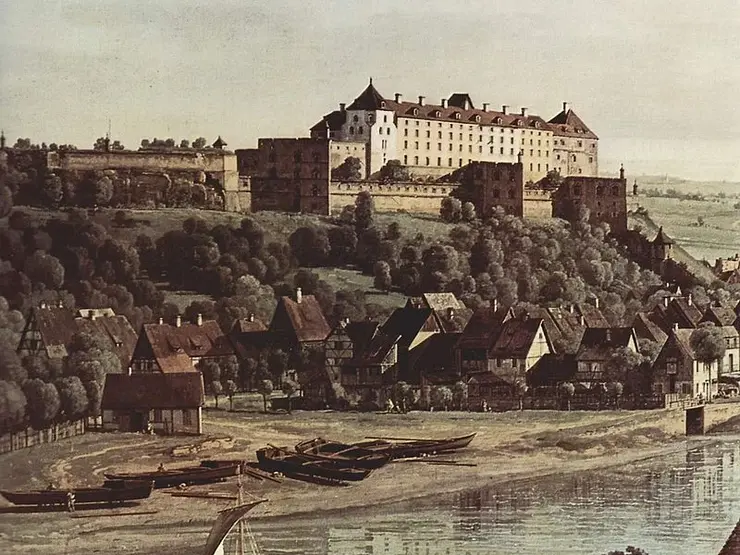
"...the endeavour of curing the fools..." - On the Production and Function of the Category of Healing in the Context of Psychiatric Practice at the Sonnenstein Sanatorium and Nursing Home in the First Half of the 19th Century
"Madness is curable!" This was the credo of the still young psychiatric sciences at the beginning of the 19th century in Europe. This healing maxim was also pursued in the Kingdom of Saxony when the first state sanatorium in the German-speaking world was opened there in 1811. The project aims to analyse the concept of healing in order to make statements about the constitution of bourgeois self-perceptions and social ideals in times of economic and social upheaval... more
Image: View of Pirna with Sonnenstein Fortress around 1757 © Wikimedia Commons.
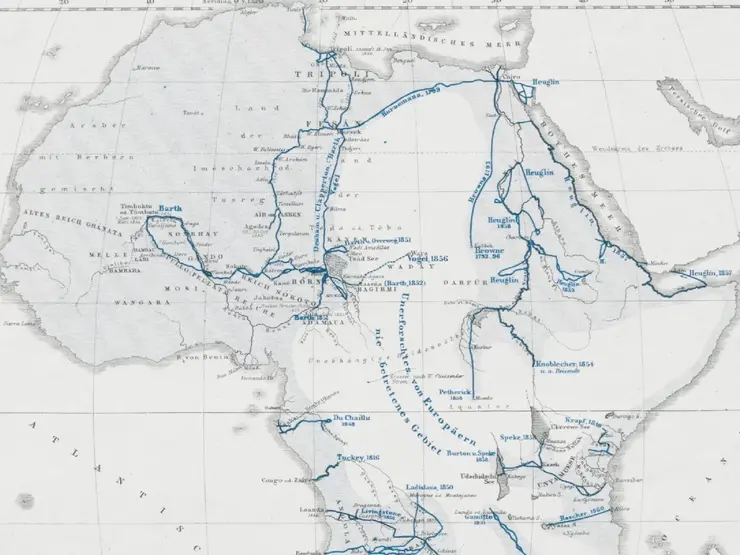
Politics in Motion. German Expeditions in the Sudan, 1860–74
If the connection between the European exploration of Africa and colonialism seems unequivocal in retrospect, it may be surprising that in the 1860s, African travelers, scholars, and politicians invited European scientists to join them, exchanged ideas with them, and supported them in their endeavors. They did so based on their respective motives and strategies, so the course of many pre-colonial expeditions was negotiated among very different interest groups, not solely European. In this context, it is necessary to no longer understand such endeavors as projects directed by individual actors, but rather as transcontinental co-productions... more
Image: Sketch map of Africa: An overview of the position of the voyages and discoveries in the interior of this continent, 1 August 1860, Gotha Research Library, Perthes Collection, SPK 40.01.01 A(02).
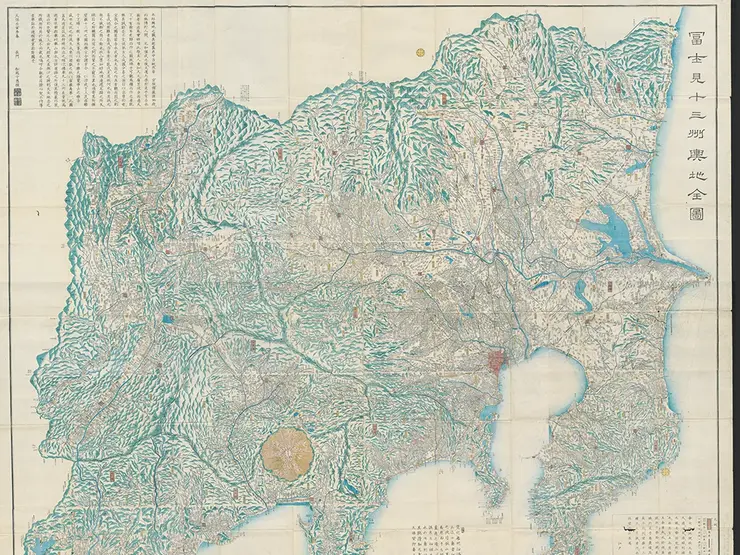
Bruno Hassenstein's Cartographies of Japan: A Different History of Japanese Studies in the German Language
In the 19th century, European interest in Japan increased significantly in scientific, economic, and artistic terms. On an economic level, the Unequal Treaties of 1858 and 1861 between Japan and several European nations marked a turning point in relations between these societies. In the preceding period of limited exchange (1639–1858), Japan had been only marginally accessible from a European perspective. In the decades following the signing of the treaties, research travelers, diplomats, and geologists journeyed to Japan to study its society, language, and economy. These developments triggered profound political, social, and cultural transformations within Japan that left a lasting impact on the country... more
Image: 秋山永年墨仙[作図] / 船橋渡 ; 船越守愚[撰], Fujimi Juusanshuu Yochi No Zenzu, Japan:Shūseidō 1843, 155 × 175cm, Gotha Research Library, Perthes Collection, SPK 30.15.b.06 C (01), sheet 8.
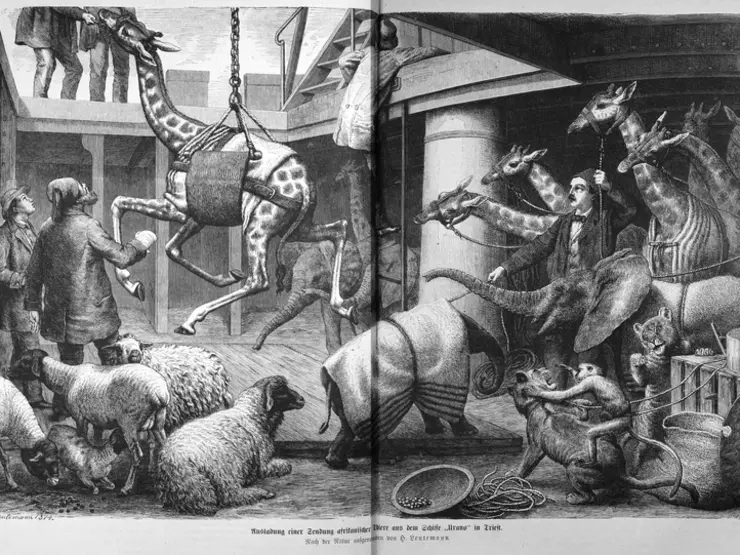
Trading Animals / Animals that act. Human-Animal-Relations between the Horn of Africa, Germany and the World
Living elephants, giraffes, ostriches, and camels, baboons, and donkeys unknown in Europe – the list of animals traded globally in the 19th century was extensive. Besides the numerous animals, various individuals were involved in this enterprise, bringing animals from interior Africa to European zoos or transporting animals to other African regions for use in colonial projects. German animal trader and catcher Josef Menges (1850–1910) was engaged in this business for more than thirty years, hunting, capturing, transporting, and selling thousands of large and small, living and dead animals during this period... more
Picture: "Unloading a consignment of African animals from the ship "Urano" in Trieste. Photographed from nature by H. Leutemann." In: The Garden Arbour, 1874.

The Scientific Age in the Province. Research, Collecting and Presenting as Social Practices around 1900
With the first assembly of the Society of German Naturalists and Physicians in 1822, according to Werner von Siemens (1886), a 'scientific age' began, in which the natural sciences opened up to broader segments of the population and were no longer exclusively discussed within professional circles. The dissertation project examines how this opening of the sciences, as noted by Siemens, unfolded in the provinces... more
Image: Gothaische Zeitung, 2 November 1881 © Gotha Research Library.

Researching Swahili. Africanist Linguistics in Germany, Great Britain and East Africa, 1843-1945
After the arrival of the first missionaries in what is now Kenya in the 1840s, the East African lingua franca Swahili aroused interest in Europe. Initially, it was individual missionaries who learned the language, argued about its standardization, recorded language samples and translated the Bible. With the institutionalisation of colonial science at the turn of the 20th century, the study of Swahili became firmly established in the metropolises of the colonial powers Germany and Great Britain. Africanist linguistics is thus closely linked to missionary and colonial claims to power throughout the political upheavals of the 19th and 20th centuries... more
Image: Manuscript of the Swahili poem "Qissati Yusufu", written by Muhamadi Kijuma, ca. 1937 © STAATSBIBLIOTHEK ZU BERLIN - Preußischer Kulturbesitz, Orientabteilung, Hs. or. 9893.
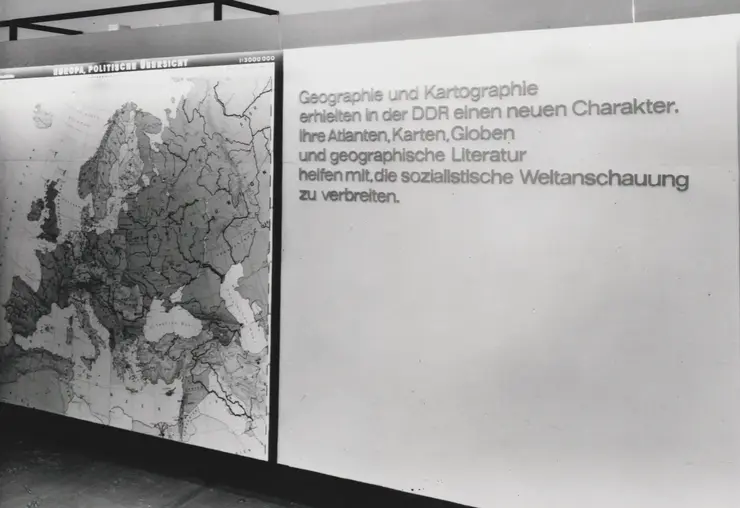
The Socialist Scale. Cartographic Production of the VEB Hermann Haack, 1955-1989
The history of the Justus Perthes Gotha publishing house was particularly shaped by various upheavals and the tensions of political system rivalries, especially in the 20th century. The location of the publishing house in the GDR ultimately led to expropriation in 1953 and subsequent nationalization, which was to have far-reaching consequences. Despite the long tradition associated with the publishing house, not only was the publishing house itself restructured as a state-owned enterprise (Volkseigener Betrieb), but also cartography was reorganized in line with the political ideology of socialism. However, how was cartography transformed under socialism? This project explores the question through the cartographic knowledge production of VEB Hermann Haack, examining how political interests influenced the modes and content of cartographic products... more
Image: Exhibition poster on geography and cartography in the GDR. Gotha Research Library, Perthes Collection, SPA-BA-Messefotografien-1963-1988, 7/1.

![[Translate to English:] facebook icon](/fileadmin/SocialMediaIcons/iconfinder_06-facebook_white.svg)

![[Translate to English:] instagram icon](/fileadmin/SocialMediaIcons/iconfinder_38-instagram_white.svg)
![[Translate to English:] YouTube icon](/fileadmin/SocialMediaIcons/iconfinder_18-youtube_white.svg)
![[Translate to English:] xing icon](/fileadmin/SocialMediaIcons/iconfinder_xing_white.svg)
