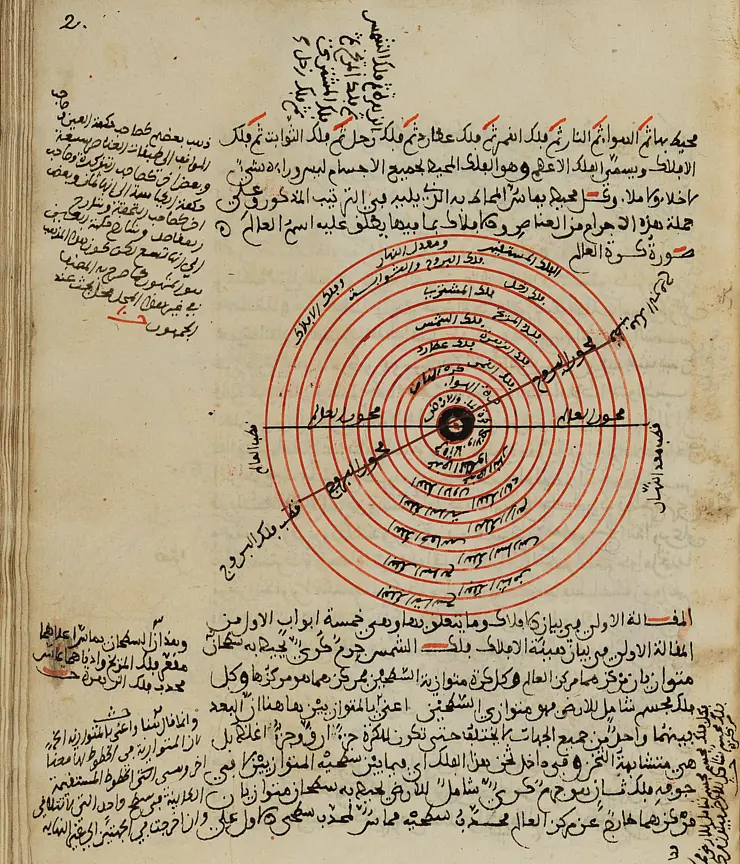
This talk presents observations on commenting practises in Arabic astronomical and astrological manuscripts. Commentaries in a variety of formats (such as sharḥ, taḥrīr, and tafsīr) as well as marginal and interlinear glosses functioned as important vehicles for the study and transmission of knowledge. Practises of commentary writing range from individual scholars annotating specific paragraphs of a base text to more substantial interventions, including reorganizing its structure or summarizing entire works. Commentaries may be written in a scholastic milieu, at the request of a teacher, or under the patronage of local elites, but can equally reflect more informal and personal modes of engagement.
At times emerging in and returning to the margins, commentary literature frequently offers insight into patterns of reception. References embedded in these layers can indicate which texts continued to be read, taught, and regarded as authoritative, thereby situating a given manuscript within broader reading practices.
A focus on annotations and commentaries thus invites us to place readers more centrally in our analysis. Rather than viewing transmission as a largely passive process of copying, it can be understood as an ongoing practice of engagement in which commentaries played a significant role in sustaining and rearticulating astronomical and astrological literature.
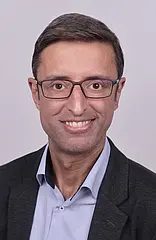
Nadine Löhr is an editor and researcher at the Institute for the History of Arabic-Islamic Science (Frankfurt am Main). Her work focuses on the transmission of manuscripts on astral sciences and networks of scholars. At Goethe University she coordinates an initiative to record and study manuscripts sold through the contemporary antiquarian book trade.
The online series "Gotha Manuscript Talks" provides impulses for an increased exchange on manuscript cultures across disciplinary boundaries based on the Oriental manuscript collection of the Gotha Research Library and brings researchers and interested parties into dialogue with each other.
Format: Lecture 45 min + discussion 45 min
![[Translate to English:] facebook icon](/fileadmin/SocialMediaIcons/iconfinder_06-facebook_white.svg)

![[Translate to English:] instagram icon](/fileadmin/SocialMediaIcons/iconfinder_38-instagram_white.svg)
![[Translate to English:] YouTube icon](/fileadmin/SocialMediaIcons/iconfinder_18-youtube_white.svg)
![[Translate to English:] xing icon](/fileadmin/SocialMediaIcons/iconfinder_xing_white.svg)

University of Erfurt (Campus)
Nordhäuser Str. 63
99089 Erfurt