

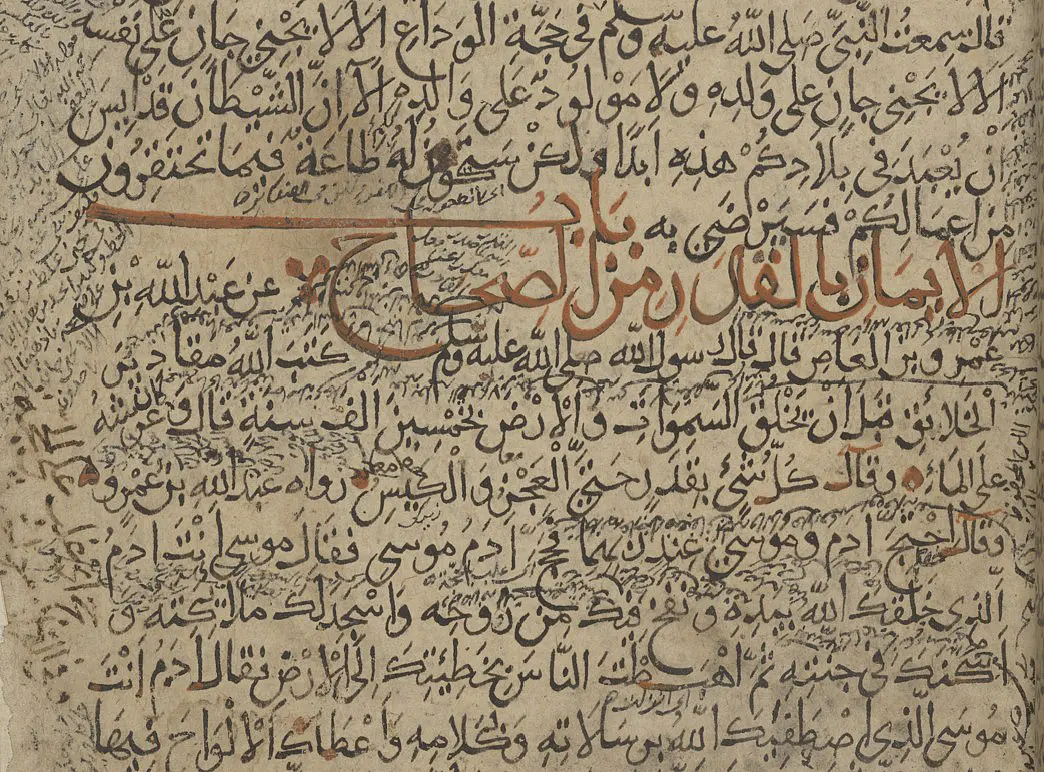
For centuries, readers have left notes in the margins and interlinear spaces of manuscripts—translating, paraphrasing, explaining, criticising, or supplementing the information contained in the main text. This talk examines such commentary glosses in Arabic manuscripts, with a particular though not exclusive focus on hadith. The manuscripts examined in this talk originate predominantly from the Middle East.
Although such glosses have often been dismissed as secondary accretions, they in fact constitute a valuable source for cultural and intellectual history by reflecting the circulation of texts and paths by which knowledge was transmitted and constructed in the Islamicate world. On the manuscript page, glosses embody a dynamic engagement between reader and text. In some cases, they preserve traces of classroom teaching or private study; in others they register critical engagement, editorial intervention, or the gradual transformation of annotations into stand-alone commentaries. The manuscript page thus emerges as a site in which knowledge was not only transmitted but also negotiated, and at times contested.
By attending closely to layout, script, markers of reference, and the social contexts of annotation, this talk calls for a reconsideration of the margin as a productive space of interpretation rather than a mere periphery. Ultimately, marginal glosses offer a distinctive route into the history of Arabic manuscript culture and into the practices by which texts were read, taught, and rendered authoritative.
Stefanie Brinkmann is Senior Research Fellow at the Bibliotheca Arabica project at the Saxon Academy of Sciences and Humanities in Leipzig, Germany, having previously held substitute professorships in Freiburg im Breisgau and Hamburg. With a PhD in Arabic and Islamic Studies she has a thematic focus on hadith and material culture, and has engaged in research, project leadership, and international scholarly governance in the field of manuscript studies.


![[Translate to English:] facebook icon](/fileadmin/SocialMediaIcons/iconfinder_06-facebook_white.svg)

![[Translate to English:] instagram icon](/fileadmin/SocialMediaIcons/iconfinder_38-instagram_white.svg)
![[Translate to English:] YouTube icon](/fileadmin/SocialMediaIcons/iconfinder_18-youtube_white.svg)
![[Translate to English:] xing icon](/fileadmin/SocialMediaIcons/iconfinder_xing_white.svg)
