

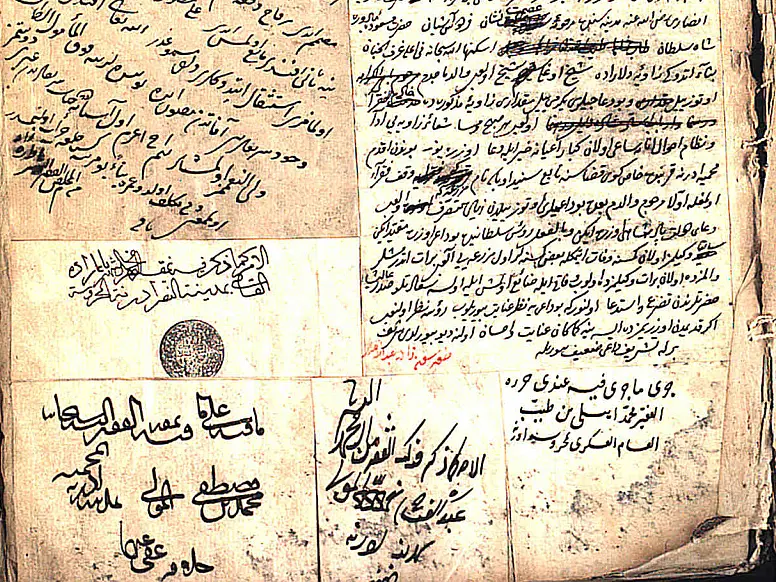
Münşeats (Ottoman Flowery Letters) constituted one of the principal forms of written communication in early modern Ottoman society. These highly ornate epistolary compositions drew extensively on the lexical resources of Arabic, Persian, and Ottoman Turkish and demanded considerable literary skill. Composing such letters required not only linguistic competence but also familiarity with contemporary literary conventions, the ability to incorporate references to Islamic textual traditions, and mastery of an elevated prose style. Consequently, producing a münşeat letter ready for dispatch was the outcome of a lengthy process of preparation and revision. Drawing on primary sources, this paper reconstructs the successive stages in the composition of Ottoman münşeat letters. It examines the drafting process, editorial revisions, scribal writing practices, and the preparation of fair copies before the letters were finally dispatched. By reconstructing these stages, the paper sheds light on the material and intellectual practices that underpinned Ottoman epistolary production.
Ercan Akyol (PhD) is a Senior Lecturer and Faculty Member in Turkish Studies at the University of Vienna. He also serves as the Principal Investigator (PI) of the project Early Modern Ottoman Letter-Writing. As part of this four-year project, he will be based at the Institute of Iranian Studies of the Austrian Academy of Sciences from August 1, 2026, to 2030. His research focuses on early modern Ottoman cultural history, particularly manuscript studies, literary history, and epistolary culture. He has published various articles and encyclopedic entries on Ottoman history, literature, and culture in journals such as Der Islam, Middle Eastern Literatures (Taylor & Francis), and the Journal of Near Eastern Studies (University of Chicago Press), as well as in the Encyclopaedia of Islam.


![[Translate to English:] facebook icon](/fileadmin/SocialMediaIcons/iconfinder_06-facebook_white.svg)

![[Translate to English:] instagram icon](/fileadmin/SocialMediaIcons/iconfinder_38-instagram_white.svg)
![[Translate to English:] YouTube icon](/fileadmin/SocialMediaIcons/iconfinder_18-youtube_white.svg)
![[Translate to English:] xing icon](/fileadmin/SocialMediaIcons/iconfinder_xing_white.svg)
