
Doctoral Researcher (Max Weber Centre for Advanced Cultural and Social Studies)
Contact
C19 – research building "Weltbeziehungen" / C19.03.30
Office hours
by appointment
Visiting address
Max Weber Centre for Advanced Cultural and Social Studies
C19 – research building "Weltbeziehungen"
Max-Weber-Allee 3
99089 Erfurt
Mailing address
Universität Erfurt
Max Weber Centre for Advanced Cultural and Social Studies
Postfach 90 02 21
99105 Erfurt
Personal Information
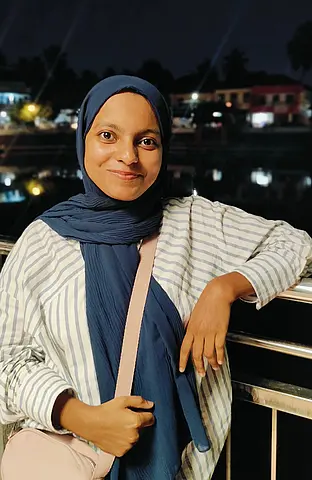
Fathima Thesni is a joint PhD scholar at Max Weber Centre for Advanced Cultural and Social Studies, University of Erfurt and Farook College (Autonomous), University of Calicut, India. She is also working as the editorial assistant for a book project titled ‘New History of Calicut’ under ‘Religion and Urbanity: Reciprocal Formations’ funded by German Research Foundation (DFG). Her research focuses on spatial history, medieval Indian Ocean trade networks and connections, port cities along the Malabar Coast, maritime history of South Asia, intersections of urbanity and religion. She is working on two important medieval port cities along the Malabar Coast, Calicut and Kannur.
Research Project
Towns and Trade Networks along the Malabar Coast: A Comparative Study of Calicut and Kannur (15th to 18th Centuries)
The west coast of India was known as Malabar Coast which is situated at the meeting point between the Arabian Sea and the Bay of Bengal, between East Africa and the Middle East to the west and Southeast Asia and China in the east. Malabar Coast was known for its maritime prowess and skilled seafarers who navigated the trade routes with great expertise which played a crucial role in shaping India's historical and economic landscape, serving as a gateway to international trade and fostering cultural diversity through its interactions with diverse civilizations. The port cities along the Malabar Coast have functioned as nodal points for Indian Ocean commerce. Calicut and Kannur were the two major port cities in the region during the medieval period. A comprehensive study focusing on the specific dynamics of Calicut and Kannur within the maritime trade network during the specified period remains absent. Existing research lacks depth in understanding spatial organisation, religious factors, economic influences, trade connections, development of city and cultural interactions that propelled these cities into prominence within the broader trade network of the Indian Ocean. While numerous studies have explored aspects of trade and commerce in the region, there is a notable dearth of comprehensive comparative analysis between Calicut and Kannur. And there is no prominent work on the urban history of Kerala.
The major research questions the study poses are how did the spatial organisation of these towns contribute to their prominence in regional and international trade networks? How did the trade networks of both cities differ in terms of their reach, connections with other regions, and the nature of trade relations? Who were the merchants and what were the key commodities traded in Calicut and Kannur during the specified period, and how did they contribute to the economic prosperity of the towns? What was the hinterland that those merchants accessed? Which religious groups came, conquered or settled in the region? How do religious agents, practices, and ideas contribute to the emergence and ongoing development of urban spaces and urbanity? etc.

![[Translate to English:] facebook icon](/fileadmin/SocialMediaIcons/iconfinder_06-facebook_white.svg)

![[Translate to English:] instagram icon](/fileadmin/SocialMediaIcons/iconfinder_38-instagram_white.svg)
![[Translate to English:] YouTube icon](/fileadmin/SocialMediaIcons/iconfinder_18-youtube_white.svg)
![[Translate to English:] xing icon](/fileadmin/SocialMediaIcons/iconfinder_xing_white.svg)
