
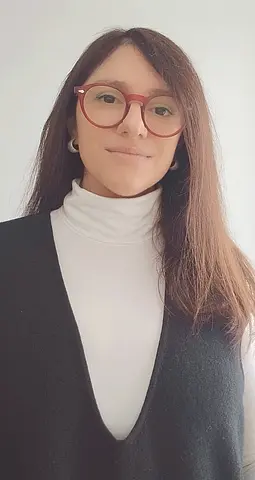
Dr. Maria Dell'Isola
maria.dellisola@uni-erfurt.dePostdoctoral Fellow (Max Weber Centre for Advanced Cultural and Social Studies)
Office hours
by appointment
Visiting address
Max Weber Centre for Advanced Cultural and Social Studies
C19 – research building "Weltbeziehungen"
Max-Weber-Allee 3
99089 Erfurt
Mailing address
Universität Erfurt
Max Weber Centre for Advanced Cultural and Social Studies
Postfach 90 02 21
99105 Erfurt
Personal Information
Maria Dell’Isola studied Classics at the University of Bologna. In 2016, she earned her PhD in Cultural Sciences from the Scuola di Alti Studi of the Fondazione San Carlo in Modena and the Max Weber Kolleg. Between 2013 and 2014, she spent six months as a doctoral student at Humboldt University of Berlin. In 2019, she was awarded a Marie Skłodowska-Curie Individual Fellowship at the University of Southern Denmark/Centre for Medieval Literature, with a research project on gendered temporality and female holiness between early Christianity and Byzantium. After working as a postdoctoral researcher between 2021 and 2022 on the sub-project A01 Divine Property: Solutions from Late Antiquity and the Middle Ages, within the framework of the Collaborative Research Centre TRR 294 Structural Change of Property, she served as Assistant Professor of History of Early Christianity at the University of Milan from 2022 to 2025. In 2023, she obtained the Italian National Scientific Qualification for Associate Professor In History of Christianity and the Churches. She is also a member of the editorial board of the book series Studien und Texte zu Antike und Christentum / Studies and Texts in Antiquity and Christianity by Mohr Siebeck and of the Scientific Committee of the journal Annali di storia dell’esegesi.
Research Project
Within the framework of the subproject A01, Ambiguous Property: From Late Antiquity to the Middle Ages, my research project seeks to examine the concept of divine property in Late Antiquity. By approaching property as a key factor in shaping both human and non human agency within Christian monastic and hagiographical texts, the project aims to identify a set of defining features that characterise the relationship and interaction between human and non human agents against the broader backdrop of ancient sacral, social, and economic practices.
The research will concentrate on a detailed analysis of terminology associated with the semantic field of property, exchange, donation, and theft, with the objective of delineating a wider conceptual framework that captures the complex range of forms and practices governing the dynamics of reciprocal transfer of property within a sacred context.
![[Translate to English:] facebook icon](/fileadmin/SocialMediaIcons/iconfinder_06-facebook_white.svg)

![[Translate to English:] instagram icon](/fileadmin/SocialMediaIcons/iconfinder_38-instagram_white.svg)
![[Translate to English:] YouTube icon](/fileadmin/SocialMediaIcons/iconfinder_18-youtube_white.svg)
![[Translate to English:] xing icon](/fileadmin/SocialMediaIcons/iconfinder_xing_white.svg)
