
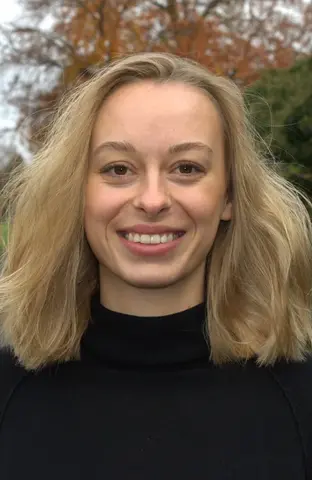
Helen Bönnighausen
helen.boennighausen@uni-erfurt.dePhD student (Max Weber Centre for Advanced Cultural and Social Studies)
Office hours
nach Vereinbarung
Visiting address
Campus
Max Weber Centre for Advanced Cultural and Social Studies
C19 – research building "Weltbeziehungen"
Max-Weber-Allee 3
99089 Erfurt
Mailing address
Universität Erfurt
Max Weber Centre for Advanced Cultural and Social Studies
Postfach 90 02 21
99105 Erfurt
Personal information
- since 04/2025: adjunct lecturer at the Chair of General and Theoretical Sociology | Friedrich Schiller University Jena
- since 02/2025: doctoral candidate Max-Weber-Kolleg, University of Erfurt | supervisors: Professor Hartmut Rosa and Professor Martina Löw
- 02/2024 – 01/2025: Collaborative Research Centre "Structural Change of Property" | project group: Professor Hartmut Rosa
- 09/2021 – 04/2022: Erasmus+ internships | Goethe Institute Ireland, Dublin | Université Toulouse – Jean Jaurès
- 03/2021 – 01/2024: scholarship German Academic Scholarship Foundation ("Studienstiftung des deutschen Volkes")
- 04/2021 – 01/2024: Master's programme in Social Theory | Friedrich Schiller University Jena
- 10/2020 – 03/2021: Master’s programme in German Literature (Master of Arts, no degree) | Humboldt University Berlin
- 10/2020 – 02/2025: Master’s programme in media philosophie (Master of Arts) | Bauhaus University Weimar
- 10/2016 – 09/2020: Bachelor’s programme in Literary and Cultural Studies, Politics and Society (Bachelor of Arts) | Rheinische Friedrich-Wilhelms-Universität Bonn
Research interests
Dissertation project (PhD)
Working Title: Transitions Between (Social) Situations of Everyday Life – A sociological Investigation
Starting from the fundamental sociological question concerning the relationship between society and the subject, this dissertation addresses differentiated contemporary society (whether one conceives of it as consisting of autopoietic systems, modes of existence, sub-universes, finite provinces of meaning, small worlds of modern man, or multiple relationships to the world) and more precisely the experience and handling of this societal structure on the level of the subject. How is the modern plurality of social contexts experienced and lived on a subjective level?
In order to contribute to this overarching question, the study focuses not on the various differentiated contexts themselves, but on the process of switching between them: the dissertation examines the everyday, recurring transitions subjects perform between different, differentiated spatiotemporal (social) situations (with “situation” understood here as the subjective experiential order of differentiation). Such transitions structure everyday life, connect and separate different life situations, and occur whenever we move from one (social) framing to another—for instance, from the breakfast table into a Zoom meeting, from work to an evening with friends, from a doctor’s appointment to picking up one’s child from kindergarten, or from a bustling birthday party back into our quiet, dark apartment. These transitions constitute an omnipresent everyday phenomenon. Without the continual shifting between different contexts and roles, between impressions and atmospheres, between workplaces, forms of transport, supermarkets, sports facilities, and our home, we could not participate in social life at all. Factors such as mediatization and urbanization further promote and intensify this structure.
I assume that by investigating these transitions between everyday situations, it becomes possible to observe and trace how life is carried out and oriented within this plural contemporary society. As a sociological study, the dissertation therefore undertakes a reconstruction of these everyday transition processes: first, through guided, narrative-based interviews, it reconstructs how, when, and where such transitions between situations are experienced and (ritually) practiced by subjects (fieldwork in Berlin). Building on this and drawing on various theoretical approaches (including Turner, Schütz, Goffman, and Plessner), it then seeks to develop an understanding of the structure and organization of these transitions. The findings are expected to reveal what social functions transitions have and what significance they hold both for late modern life and for its sociological investigation.
The central thesis is that transitions are structural moments that reveal how subjects organize their everyday lives, how they manage the multiplicity of different life-worlds (through routines, strategies), and how they negotiate meaning, orientation, and identity. The study also considers the contextual conditions that enable, shape, or hinder transitions—such as the organization of work (e.g., home office), media practices (e.g., switching costs), and spatial-infrastructural factors (e.g., transportation, urban design, architecture). Accordingly, further insights are also to be expected in these areas. Finally, the dissertation examines the potential consequences of both an excess of transitions and a lack thereof (understood as the blending or merging of situations).
To study transitions means to illuminate those interstitial spaces of the social in which subjects engage with diversity, change, and complexity—and thereby to understand how the conduct of life in a plural social structure can succeed.
Publications
- Jörg Oberthür, Christoph Henning, Malte Janzing, Henrike Katzer & Helen Bönnighausen: Zwischen Räumen. How the sharing economy is changing proximity and distance in cities, in: Berliner Journal für Soziologie 34, pp. 551-580 (2024) [https://link.springer.com/article/10.1007/s11609-025-00545-8]
- Jonathan Rinne, Malte Janzing, Helen Bönnighausen: Property vs. Usage Rights. Attitudes of Citizens and Political Elites. Working Paper No. 6 (2024), SFB Structural Change of Property [https://sfb294-eigentum.de/media/filer_public/ec/c0/ecc029f2-92b6-40d6-b5e3-c9a9edfb361f/wp_6.pdf; Publication in Journal in preparation].
Selected Presentations and Conference Activities
2025
- Die Erfahrungsqualität von Ordnungsübergängen in differenzierten Gegenwartsgesellschaften, Presentation at the DGS-Congress 2025, Section Sociology of Knowledge, 22.-26.9.2025, University of Duisburg-Essen
- Synthèse des doctorants, Short Presentation at the Conference: „Hartmut Rosa: accélération, résonance, énergies sociales.”, 30.8-5.9.2025, Cerisy (France)
- The Constitution and Crossing of everyday Boundaries between different Fields of Meaning in Contemporary Societies”, Presentation at the Conference „Making Boundaries - performing Religion and Urbanity”, KFG Religion and Urbanity – Reciprocal Formations, 4.-6.6.2025, Max Weber Centre Erfurt.
- The Experiential Quality of Transition Processes between different Contexts of Meaning, Poster Presentation at the Conference „Personalities, Pragmatic Affairs, and Playful Worlds On Multiple Realities 1945–2025” of the International Alfred Schutz Circle for Phenomenology and Interpretive Social Science, 24.-26.4.2025, Vienna
- Copenhagen Winter School in Phenomenology, 30.-31.1.2025, Center for Subjectivity Research, University of Copenhagen [participation]
2024
- Sharing as an Alternative: Ambivalent Developments in the Sharing Economy. Panel at the annual conference „Beyond (Private) Property”, Collaborative Research Centre Structural Change of Property, 9.11.2024, Universities Jena und Erfurt [Moderation]
- Praktiken und Ökonomien des Teilens als Ausweitung von Verbrauch und Konsum, Presentation at the Workshop: „Eigentum, soziale Rechte und Versorgung – zur Ausweitung der Verbraucherpolitik“, 28.6.2024, Universities of Kassel and Erfurt
- Ownership, Spacing and Community Spirit: How Energy Sharing is changing Our Relationship to the World, Presentation at the Science Technology and Society Conference Graz 2024, 7.5.24, TU Graz
![[Translate to English:] facebook icon](/fileadmin/SocialMediaIcons/iconfinder_06-facebook_white.svg)

![[Translate to English:] instagram icon](/fileadmin/SocialMediaIcons/iconfinder_38-instagram_white.svg)
![[Translate to English:] YouTube icon](/fileadmin/SocialMediaIcons/iconfinder_18-youtube_white.svg)
![[Translate to English:] xing icon](/fileadmin/SocialMediaIcons/iconfinder_xing_white.svg)
