
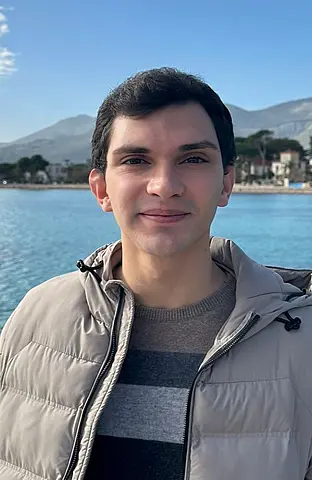
Claudio Anello
claudio.anello01@unipa.itDoctoral researcher (Max Weber Centre for Advanced Cultural and Social Studies)
Contact
C19 – research building "Weltbeziehungen" / C19.03.26
Visiting address
Max Weber Centre for Advanced Cultural and Social Studies
C19 – research building "Weltbeziehungen"
Max-Weber-Allee 3
99089 Erfurt
Mailing address
Universität Erfurt
Max Weber Centre for Advanced Cultural and Social Studies
Postfach 90 02 21
99105 Erfurt
Personal Information
Education:
(04/2026 – ongoing) Visiting Doctoral Researcher at the Max Weber Kolleg – University of Erfurt (supervisor: Prof. Dr. Jörg Rüpke).
(12/2024 – ongoing) PhD in Classical Studies for the Contemporary World (Studi classici per la Contemporaneità) (cycle XL), at the University of Palermo, with a research project titled “Tra uomini e dei. Segni divini e potere imperiale” (supervisor: Prof. Daniela Motta).
(10/2022 – 10/2024) Master’s degree in Philology, Literature and Ancient History at the University of Palermo, awarded on 03/10/2024, with a thesis in Roman history titled “Adriano, dio fra gli uomini. Forme del culto imperiale tra Grecia e Roma” (supervisor: Prof. Daniela Motta), and a final grade of 110/110 cum laude.
(09/2019 – 10/2022) Bachelor’s degree in Classical Studies from the University of Palermo, awarded on 13/10/2022, with a final grade of 110/110 cum laude.
Conferences:
(26/11/2025) Paper “Le notti inquiete degli imperatori: visioni, incubi e presagi di rovina”, in the Conference La notte e il momento. Azioni, immagini, parole della dimensione notturna in Grecia e a Rome, at the University of Palermo.
Main Research focuses:
My research focuses on the cultural and religious history of the ancient world, with particular attention to the relationship between imperial power, divine signs, and cult practices in Imperial Rome, as well as to their representation in literary sources and their cultural and social implications. My accademic interests:
Political, social and religious history of the Roman Empire
Anthropology of the ancient world
Greek and Latin literature
Greek and Roman epigraphy
Research Project
“Between men and gods: divine signs and imperial power”
This project investigates the role of divine signs in the construction and representation of Roman imperial authority from Augustus to Commodus (1st–2nd century CE). In Roman religious culture, communication between gods and humans was expressed through a wide range of signs — prodigies, omens, premonitory dreams, visions etc. — which permeated both public and private life, alongside divinatory practices through which humans actively sought to interrogate the divine will. These phenomena are here understood not as objective facts endowed with intrinsic meaning, but as events that become meaningful through collective and individual practices of recognition, interpretation, and narration. An event — however extraordinary — did not automatically constitute a sign: it became one when witnesses, religious authorities, political institutions, or individuals identified it as such and and inscribed it within the interpretive codes through which meaning was produced and contested.
This constructive process is inseparable from narrative. Since we have no direct access to the events themselves, but only to the layered accounts left by historians such as Tacitus, Suetonius, Cassius Dio, and the author(s) of the Historia Augusta, the analysis necessarily begins with the narrative dimension — examining how these texts shape, transmit, and contest the meaning of divine signs — before working back towards the individual and collective experiences they encode. The research approaches divine signs as cultural and social narratives actively shaped by a plurality of agents — emperors, senators, priests, provincial communities, historians, etc. — each with their own interpretive frameworks and communicative purposes.
While in the Republican period divine signs were primarily directed at the community as a whole and managed through the Senate and priestly colleges, the Imperial age witnessed a profound transformation: signs became increasingly centred on the emperor, giving rise to categories such as omina imperii (omens of power) and omina mortis (omens of death), and the emperor emerged as the privileged mediator between gods and humans. By examining this transformation, the project aims to show how supernatural phenomena functioned not as a top-down propaganda tool, but as a dynamic field of negotiation through which imperial power and its relationship with the divine were continuously constructed, contested, and transmitted.

![[Translate to English:] facebook icon](/fileadmin/SocialMediaIcons/iconfinder_06-facebook_white.svg)

![[Translate to English:] instagram icon](/fileadmin/SocialMediaIcons/iconfinder_38-instagram_white.svg)
![[Translate to English:] YouTube icon](/fileadmin/SocialMediaIcons/iconfinder_18-youtube_white.svg)
![[Translate to English:] xing icon](/fileadmin/SocialMediaIcons/iconfinder_xing_white.svg)
