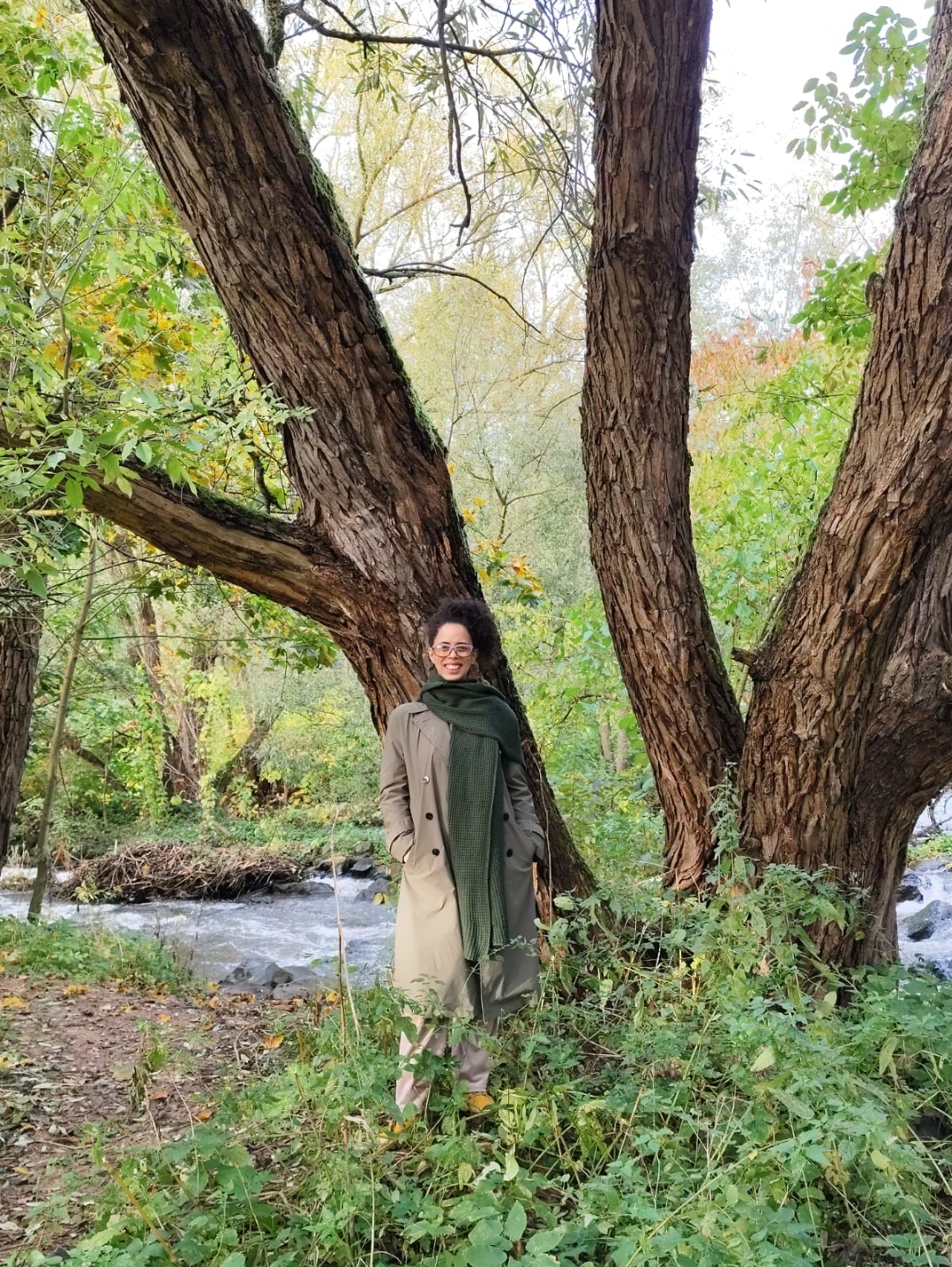
Luciana Santos Barbosa
Research Associate
E-Mail-Adress: luciana.santos_barbosa@uni-erfurt.de
I graduated in History at the Pontifical Catholic University of São Paulo. I developed, at the same University, my master thesis entitled Aureliza Alves do Nascimento (1927-1971): in search for a new beginning: woman, prostitution and violence in land of Jorge Amado, rescuing my grandmother's trajectory in a critical way and drawing parallels with the literature of Jorge Amado and oral history that I collected during the process. At the University of São Paulo, I wrote the thesis: Neurotecnoneoliberal ideologies: from Kurzweil's utopia to dystopic literature, in which I investigate the social impacts that emerge from the intersection between neurosciences and tecnologies. I currently work as an affiliated researcher at Universität Erfurt with the research: Philosophy and Ecology: towards a Phenomenology of Mixed Cultures, where I continue my doctoral work investigating how mixed peoples that have a close relationship with nature view disasters, environmental issues and the climate crisis; how they deal with these problems and how it is possible, based on understanding how these peoples relate to nature, to think about better and possible futures for humanity. I also dedicate myself to the studies of mixed cultures and religions in Brazil.
Publication list:
- SANTOS BARBOSA, Luciana; MARTINS DOS ANJOS SILVA, Júlio César. Computational language and the need to rethink the curriculum. ICT in education, São Paulo, 2018.
- Arte Africana no Contemporâneo. 1. ed. Curitiba: Editora Positivo, 2016. v. 6.
- O grito de denuncia de Tereza: história,corpo e literatura.. REVISTA CORDIS-REVISTA ELETRÔNICA DE HISTÓRIA SOCIAL DA CIDADE, v. 7, p. 1, 2011
- Tereza: A mulher nos espaços Baianos. REVISTA CORDIS- REVISTA ELETRÔNICA DE HISTÓRIA SOCIAL DA CIDADE, v. 3-4, p. 11, 2010.
Project description:
The Phenomenology of Ecology and Geocosmology: Environmental Disasters between History, Time, Space, Nature and Possible Futures
In view of the current climate crises and the way different environmental disasters have been portrayed since antiquity, this research is dedicated to investigating both ancient and new ways of thinking, feeling, and relating to the environment in which we live. In this regard, the analysis of historical and philosophical texts will be carried out from the perspective of the Phenomenology of Ecology and Geocosmology. The Phenomenology of Ecology, as it was conceived for this research, describes a path contrary to anthropocentrism: nature is not seen as a static backdrop, but as an active, operative and sensitive force that creates, shapes and challenges everything that inhabits it. In this phenomenological sense, it is not merely the imagination that changes and/or shapes nature, but rather nature that influences and/or shapes the horizon of meaning of the imagination. Geocosmology, in turn, is understood for this research as a way of inhabiting the world, according to which the Planet is not reduced to dead matter with resources to be exploited, but rather consists of a pulsating space of living and conscious relationships, imbued with meaning. From this perspective, the earth is understood as an active and dominant subject that generates knowledge and dictates the laws of coexistence, so that humans, as well as animals, plants, rivers and stones, are part of this living organism.
This research originates from the urgency of the climate crisis to explore and propose, as an alternative to the modern illusion of controlling nature, ways of thinking that embrace a stance of modesty towards other beings, acknowledging that the planetary system possesses a raw agency capable of shaping and destroying entire civilisations if natural limits – such as the critical thresholds currently defined by the IPCC as ‘Global Tipping Points’ – are not respected. In this regard, this research is understood as an intersection between the Phenomenology of Ecology and Geocosmology, insofar as it proposes to address historical and philosophical texts and analyse cosmologies that in some way deal with geological traumas and environmental disasters of the past and present in order to consider the challenges we face today due to the climate crisis. As we currently live in a moment of crisis, in which climate change is felt in the body, generates fear and threatens to disrupt various levels of the social and cultural fabric, the research aims to analyse how these philosophical, historical and cosmological narratives confronted environmental disasters and their consequences, in order to create roadmaps towards the forms of resilience and adaptation necessary for our common future.