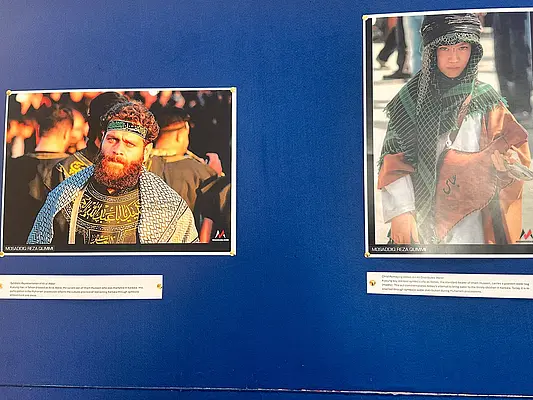
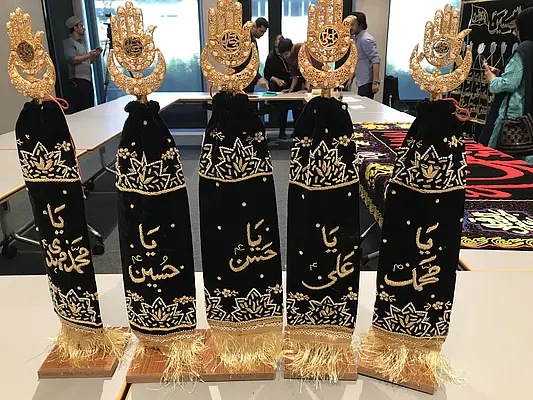
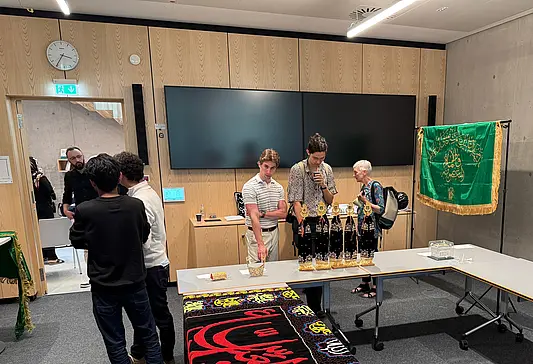
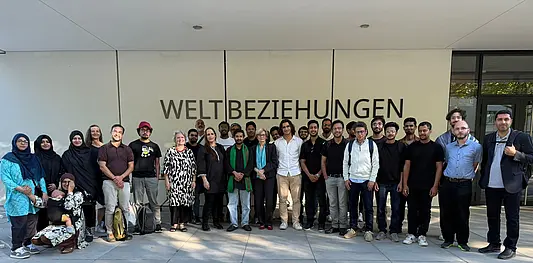
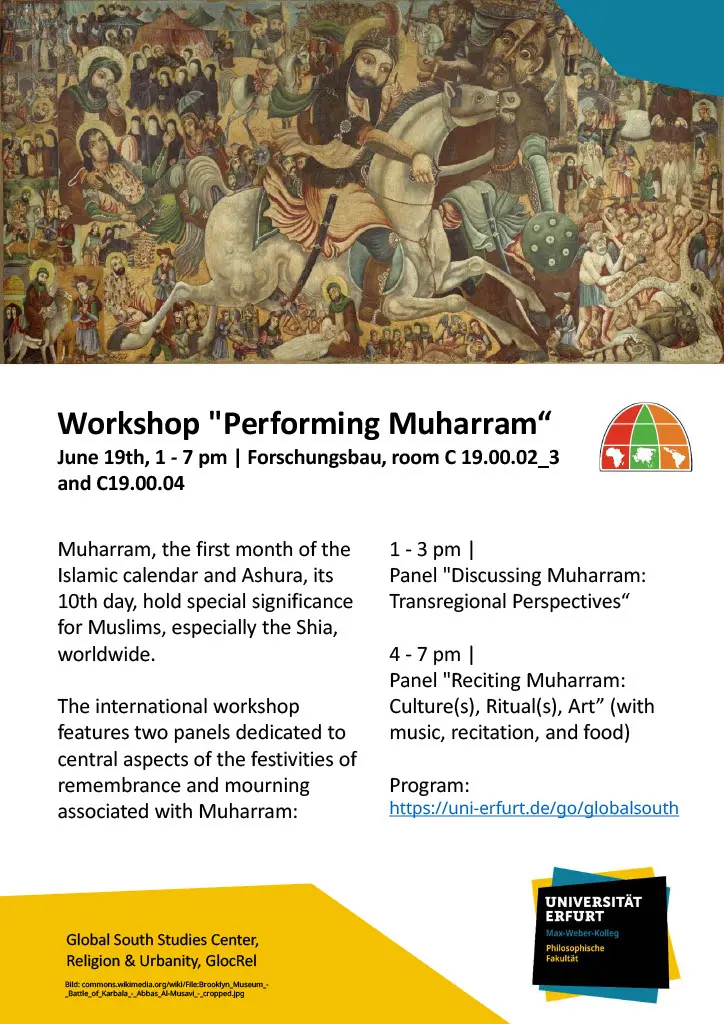
Workshop: “Performing Muharram”.
Where: Forschungsbau, Room C 19.00.02_3 & C 19.00.04
When: June 19th, 1-7 PM
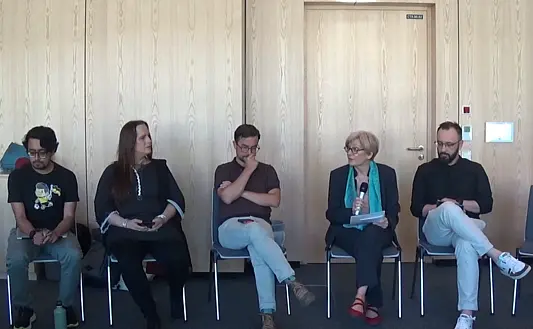
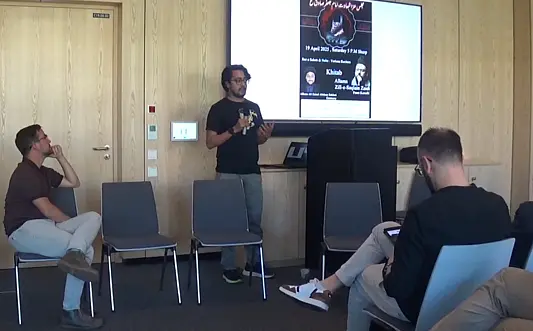
1:00–3:00 PM | Academic Panel – Discussing Muharram: Transregional Perspectives
Opening Address: Prof. Dr. Birgit Schäbler (Director of the Global South Studies Center and Professor of History of West Asia)
Prof. Simon Wolfgang Fuchs (Associate Professor of Islam in South Asia, Hebrew University): Moderation
Panel Presentations:
Dr. Rasool Akbari (Assistant Professor, Ferdowsi University of Mashhad): Muharram in Iran
Dr. Nabeel Jafri (Postdoctoral Fellow, CeMIS, University of Göttingen): Muharram in South Asia
Dr. Epsita Halder (Professor, Department of Comparative Literature, Jadavpur University): Muharram in Bengal
Leyla Jagiella (Independent Scholar, Heidelberg; Author of Among the Eunuchs: Muharram and the South Asian Transgender Khwajasara Communities)
Mr. Numan Mustafa (Publications Director, GNOSA Foundation for Culture and Science, Macedonia): Muharram in the Balkans
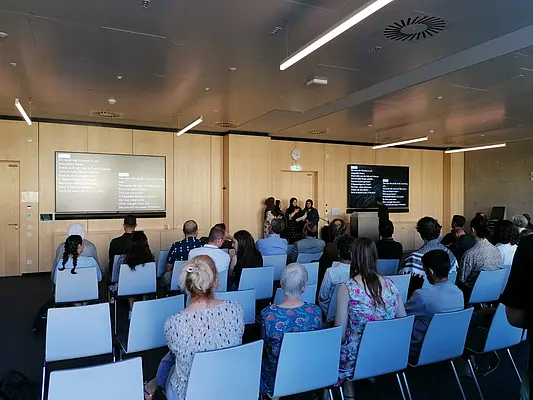
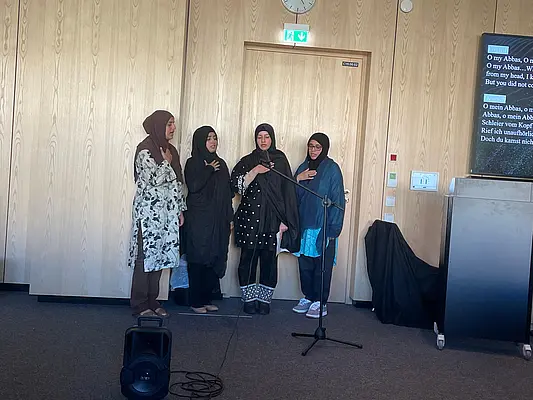
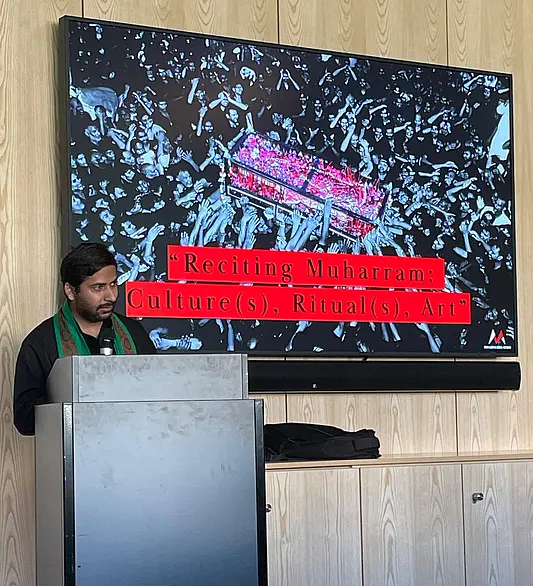
4:00–6:00 PM | Reciting Muharram: Culture(s), Rituals(s), Art
Opening Remarks by Prof. Katharina Waldner, Speaker of Doctoral Program "Glocal Religiosities: Entanglements, Identities, Belongings"
Performances Anchored by South Asian Traditional Nizamat by Ahmad Ali (Research Assistant, Religion & Urbanity Group, Max-Weber-Kolleg):
Arabic Marthiyya by Mulla Abbas Al-Feyli (Leipzig)
Persian Rawda-Khwani by Hajj Farhad Ataei (Erfurt)
Urdu Soaz-Khwani by Anjuman Moin-ul-Aza (Male Choir, Nuremberg)
Urdu Nauha by Anjuman Moin-ul-Aza (Female Choir, Nuremberg)
German Latmiyah (Elegy) by Ali Alayan (Essen)
Global South Movie Night presents:
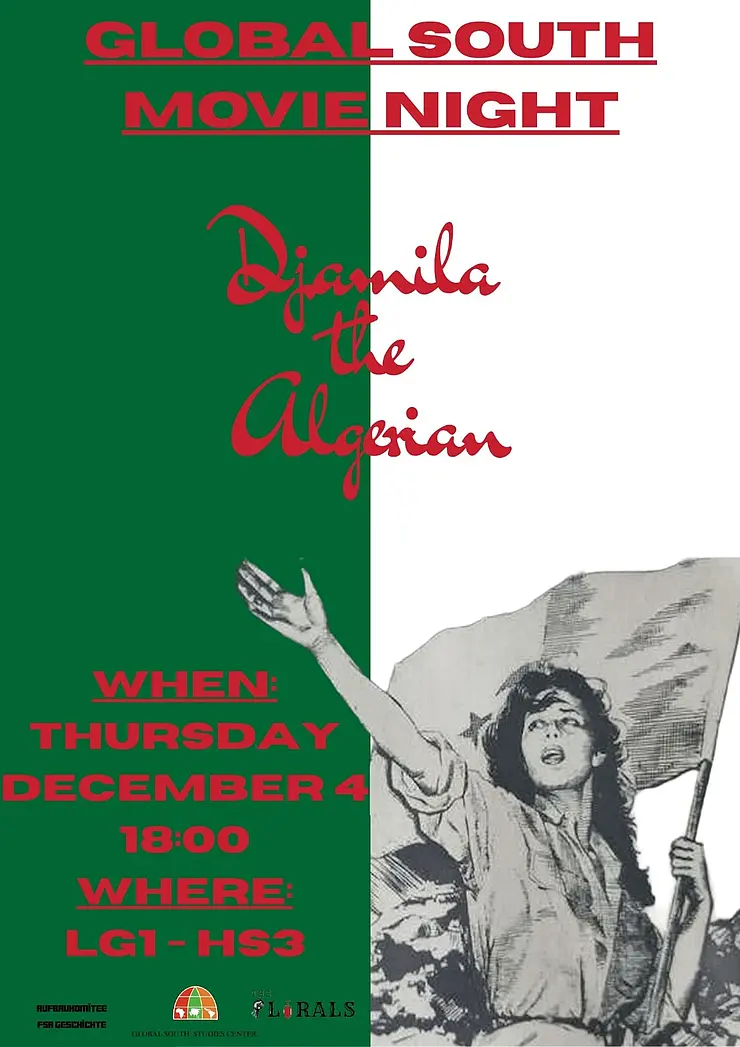
Djamila, the Algerian
When: Thursday December 4th 18:00
Where: LG1 HS 3 Running Time: 120 minutes
What role did women play in the struggles for national liberation?
The 1958 movie “Djamila, the Algerian” helps us answer this question.
Based on the life of Djamila Bouhired , the film tells the real story of a young women’s radicalization and involvement in the armed struggle during the Algerian war of independence. Following her development from a pacifist university student to an urban guerrilla fighter, we learn of the day to day realities of French colonial rule in Algeria, as well as of the lengths Algerians went to in order to resist it. Furthermore, through Djamila, who became a political icon throughout the Arab World, we can see how a revolutionary movement puts into question not only the political domination of colonialism, but also the dynamics of gender oppression in the native societies themselves.
Even though the movie is set in Algeria, it is an Egyptian production right out of the “Golden Age of Egyptian Cinema”. Directed by the acclaimed Youssef Chahine and written by the Arab World’s only Nobel laureate Naguib Mahfouz , what we have here is a testament to Egypt’s cultural production of the time. Naturally, being an Egyptian production gives a whole new side to the movie, enabling us to read it as an insightful example of Egyptian soft power and ideological projection.
Prior to the movie screening, Prof. Dr. Schäbler will deliver an introduction into the historical context of the Algerian war of independence.
This movie night is a cooperation between the Committee to Rebuild the FSR Geschichte, the Global South Studies Center Erfurt and HSG Plurals.
Global South Movie Night presents:
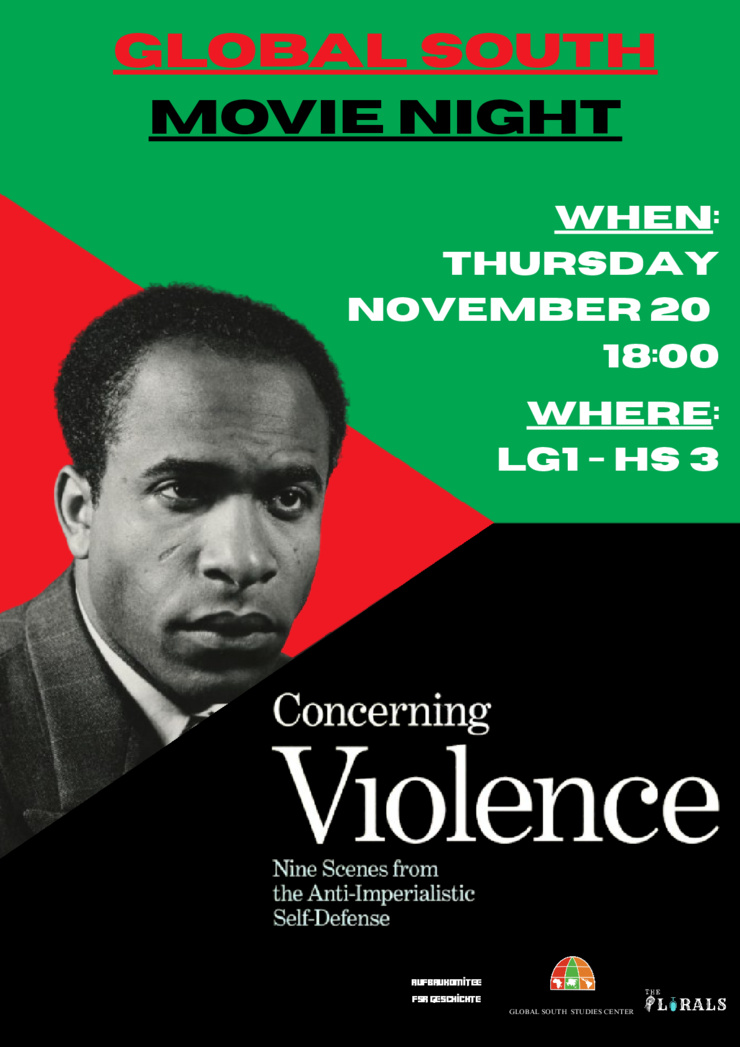
Concerning Violence
When: Thursday November 20th 18:00
Where: LG1 HS 3
Movie Length: 90 minutes
What is the correlation between violence and colonialism?
The 1961 book “The Wretched of the Earth” is today the best known work by Martiniquan Psychologist and Anti-colonial activist Frantz Fanon.
It’s release at the height of the Algerian War of Independence assured that Fanon became influential the world over, from Angola to the European student movement to the Black Panther Party. Especially the first chapter of “The Wretched of the Earth”, titled “Concerning Violence” has been controversially discussed. While some saw in it a tasteless advocacy of violence and terrorism, others more accurately read it as a sober analysis of colonial societies. Speaking as a colonial subject himself, Fanon described Colonialism as “Violence in its natural state” and it is thus no wonder that his words have been used by anti-colonial movements all over the world, in order to understand their plight.
Göran Hugo Olsson’s 2014 movie “Concerning Violence” takes inspiration from Fanon’s essay of the same name. By combining readings of “The Wretched of the Earth” with original video footage of anti-colonial struggles in Africa, the movie manages to visualise Fanon’s ideas and puts them into concrete context. This way it convincingly demonstrates the influence and continuing relevance of Frantz Fanon. Furthermore, this approach makes the movie very approachable and therefore suited for everyone interested in the history and theory of anti-colonialism, even if they’ve never read Fanon before.
Join us for some thought provoking cinema and explore the works of one of the most influential theoreticians of the Global South.
Before starting the movie, Mr. Witzenhausen from the university of Erfurt will give a brief introduction about Fanon and his teaching methods.
This movie night is a cooperation between the Committee to Rebuild the FSR Geschichte, the Global South Studies Center Erfurt and HSG Plurals
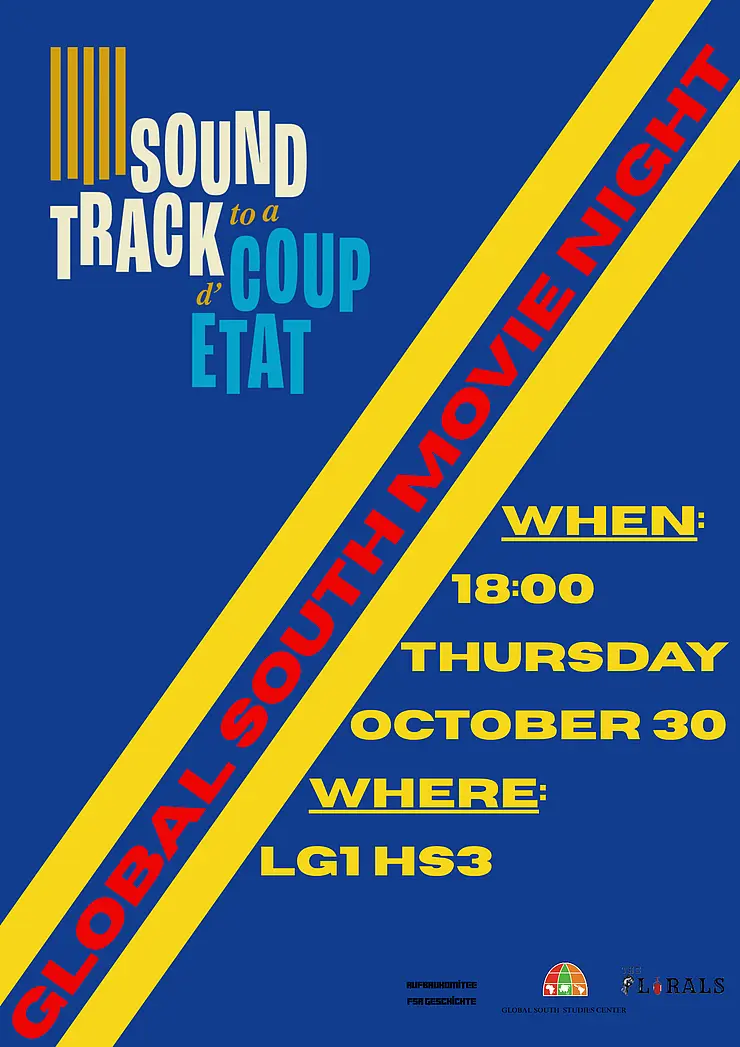
Global South Movie Night presents:
Soundtrack to a Coup d’État
When: Thursday October 30th, 18:15
Where: LG 1 HS 3
January 1961. The first prime minister of the Congo, Patrice Lumumba, is assassinated in the jungle of Katanga. This is the sad conclusion to what has later been called the “Congo Crisis”, one of the most important geopolitical episodes of the 1960s. Since then Lumumba has become a symbol. His murder, which was perpetrated under the direction of the Belgian and American secret services sent shockwaves throughout the decolonizing world and served as a grim example of the neocolonial ambitions, the old colonial powers still had in Africa.
Johan Grimonprez’s award winning documentary “Soundtrack to a Coup d’État” deals with exactly this episode of imperialist violence. The movie however, is not simply your common, run of the mill documentary. Working with invaluable archival footage as well as relying heavily on Jazz music, Grimonprez manages to bring the political actors of the 1960s to life in a way seldom replicated by other documentaries.
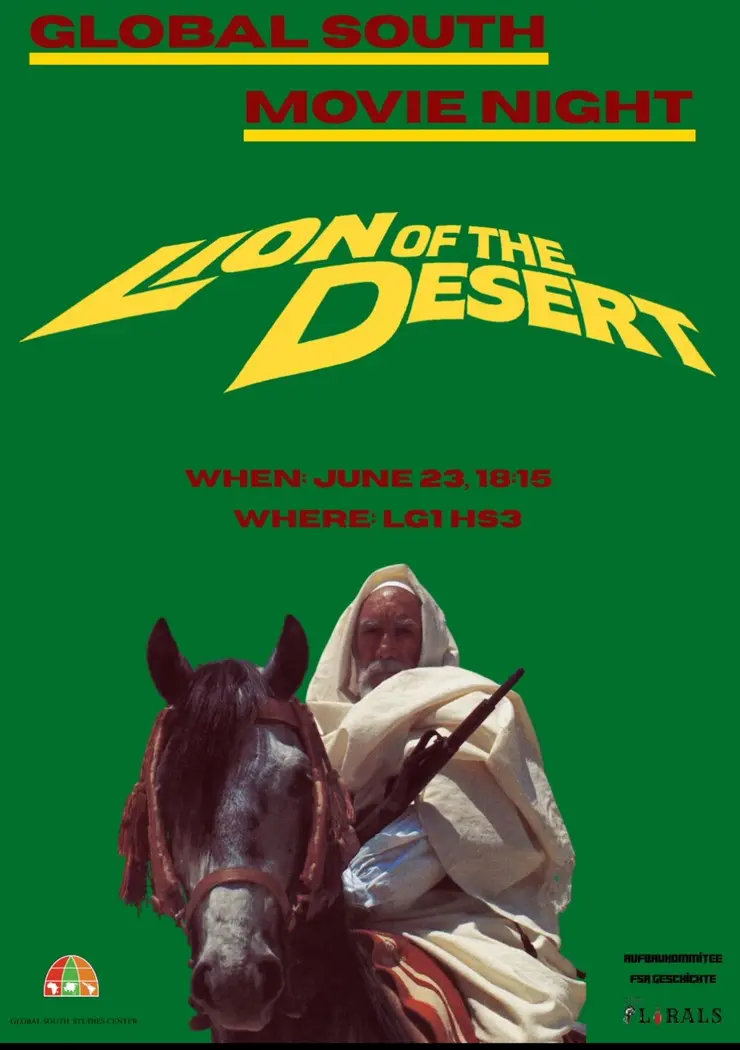
Global South Movie Night presents:
Omar Mukhtar: Lion of the Desert.
When: Monday, June 23rd 18:15.
Where: LG 1 HS 3
Witness the birth of Libya's national hero. When Italy decides to transform Libya into a settler colony, local teacher Omar Mukhtar is forced to become the leader of the Libyan guerrilla resistance. For the next twenty years his guerrillas would lead the fight against Mussolini's far better equipped army, with only their knowledge of the land and the support of the Libyan people on their side.
The movie dives deep into the horrors of colonialism and the harsh reality of resisting it. Exploring topics like settler colonialism, guerrilla warfare, compradore classes, faschism and the ethics of resistance, this movie is not only profound in its messaging but also painfully topical.
Filmed in 1979 in Muammar al-Gaddafi's Libya, the movie additionally serves as an intriguing exploration of the ideology and politics of one of Africa's most controversial political projects. While being universally decried in the West, Gaddafi's Libyan Arab Jamariah is, to this day, seen in a more favourable light by the Global South.
Join us for some thought provoking cinema and learn about Omar Mukhtar, a in the West little known icon of the Global South.
This movie night is a cooperation between the Committee to Rebuild the FSR Geschichte, the Global South Studies Center Erfurt and HSG Plurals.
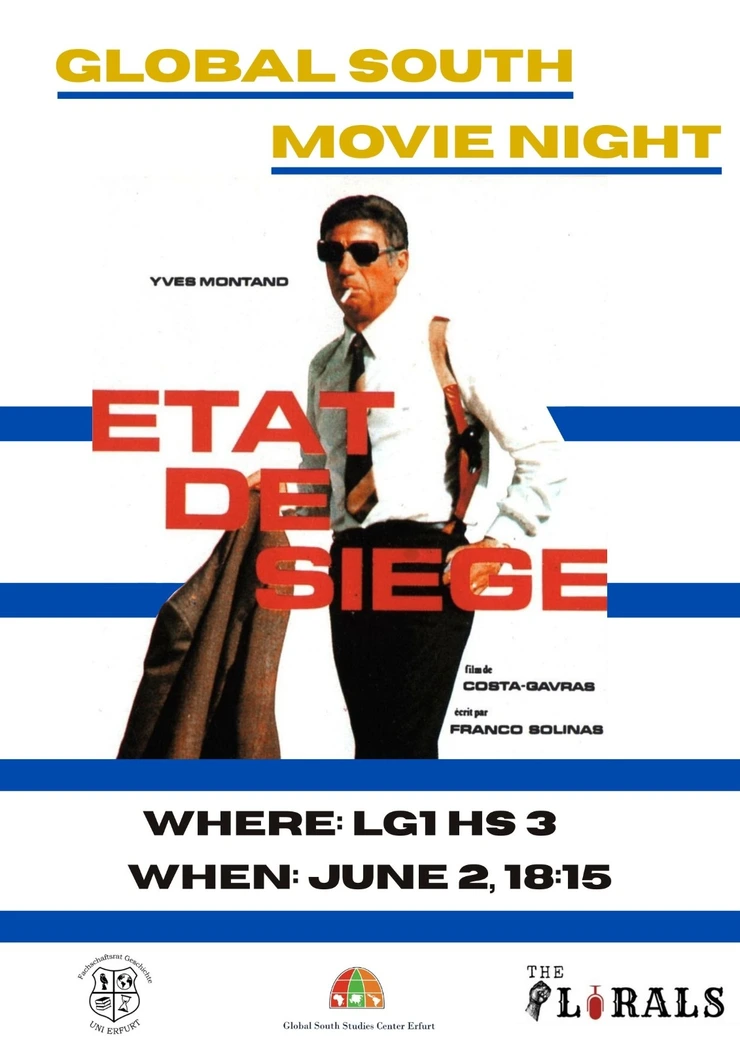
Global South Movie Night presents: État de siège
When: Monday, June 2nd 18:15.
Where: LG 1 HS 3
In the smoke-filled streets of 1970s Uruguay, a disappearance cracks open the myth of benevolent empires. Costa-Gavras' explosive thriller "State of Siege" pulls back the curtain on what really traveled south under the banner of "development" – not textbooks, but torture manuals; not democracy, but death squads.
This is the film that dared to show what happens when an American USAID official falls into the hands of those he was sent to "civilize." Based on the true story of Dan Mitrione's kidnapping, it reveals how the Global South learned the hard way that some aid packages come with hidden strings – and those strings strangle.
Shot in Chile during Allende's last days, the film became a haunting prophecy when the very forces it exposed overthrew Latin America's hope just months later. Today, its warning echoes from Bolivia to Burkina Faso, where empires still dress their violence in velvet gloves.
Join us on for an evening of radical cinema that refuses to let history be written by the winners.
This movie night is a cooperation between the FSR Geschichte, the Global South Studies Center Erfurt and HSG Plurals.

![[Translate to English:] facebook icon](/fileadmin/SocialMediaIcons/iconfinder_06-facebook_white.svg)

![[Translate to English:] instagram icon](/fileadmin/SocialMediaIcons/iconfinder_38-instagram_white.svg)
![[Translate to English:] YouTube icon](/fileadmin/SocialMediaIcons/iconfinder_18-youtube_white.svg)
![[Translate to English:] xing icon](/fileadmin/SocialMediaIcons/iconfinder_xing_white.svg)

University of Erfurt (Campus)
Nordhäuser Str. 63
99089 Erfurt