

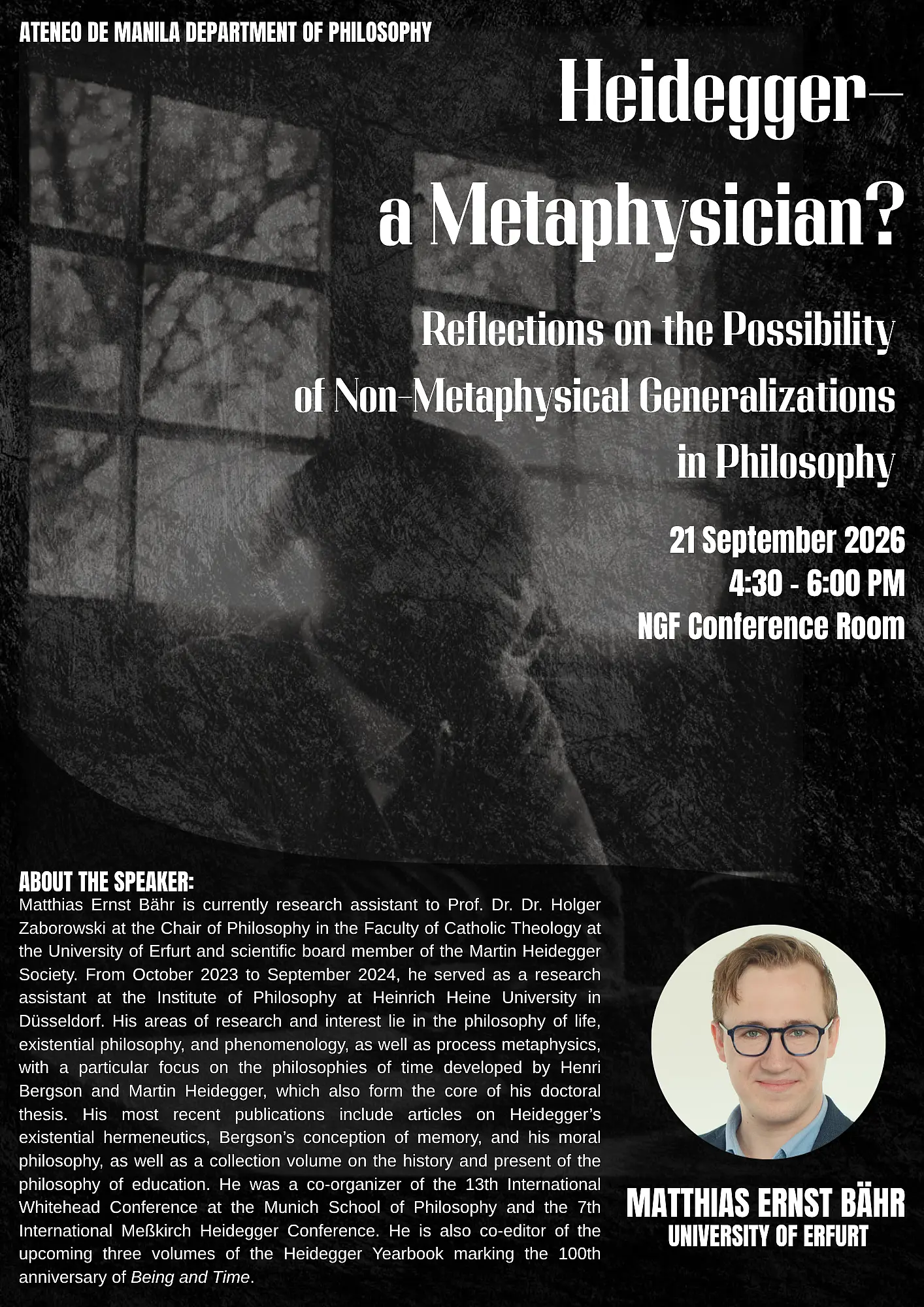
In seinem abstract schreibt er:
In this presentation I want to show that philosophical generalization does not necessarily imply metaphysical generalization, but can also refer to horizontal generality, as it manifests in mood, in life experiences or in the fundamental existential horizons of death, fear, and disgust—rather as an ‘experiential generality’ or a generality of the individual. In this context I will argue against the claim that Heidegger himself is a metaphysician simply because he identifies general structures. This accusation rests on the tacit premise that generality can necessarily serve only one type of generality—the metaphysical—whereas the history of philosophy, as exemplified by Simmel’s concept of life as a self-transcendent movement or Wittgenstein’s concept of family resemblance for example, reveals various types of generality that are not necessarily metaphysical. I want to investigate especially on Simmel’s concept of an ‘Individual-Universal’ in his Lebensanschauung to show that Heidegger makes use of such a form of the individual, non-metaphysical generalization with regard to his basic concepts.