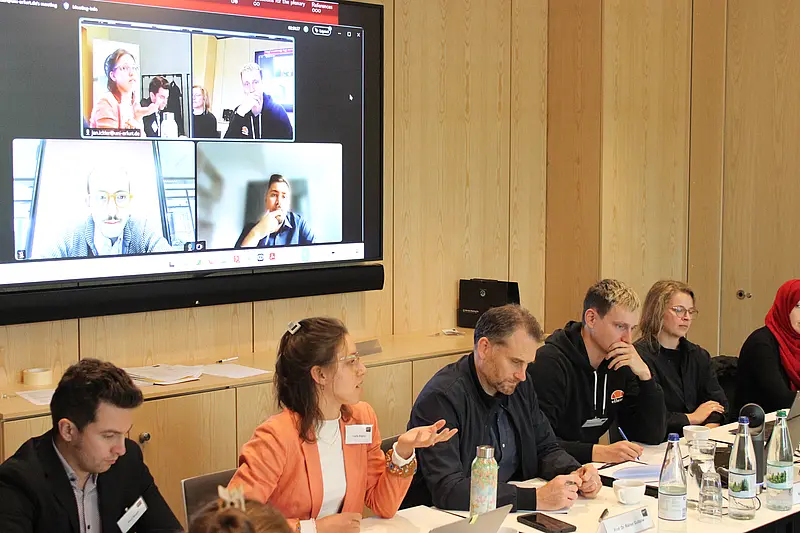
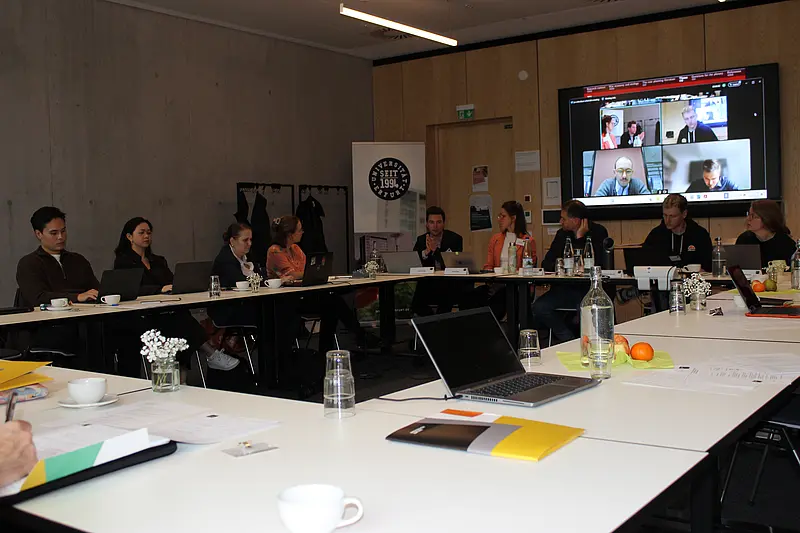
The opening panel on Progress in Geoeconomics featured Professor Sophia Hoffmann, speaker of the UE Doctoral Program on Deglobalization and Global Decoupling (DeGlobE), and Professor Maik Wolf, professor in law at the University of Erfurt, who discussed current debates in competition law, energy regulation and economic intelligence. The conversation, moderated by Jan Ickler of the Erfurt Center for Geoeconomics reviewed where the field stands and which questions remain open, setting the tone for subsequent debates at the Science Forum. The panel was complemented by Dr Jakob Hensing of the Global Public Policy Institute sharing his thoughts on “Techno-economic statecraft in practice: The new politics of state-business relations in Germany and beyond” during a much-acclaimed coffee break intervention.
The first session on Geoeconomics of Energy included paper presentations on geoeconomic scenarios for renewable hydrogen-based industrial production (Dr Laima Eicke, RIFS Potsdam), industrial policy in Germany’s emergence (and potential decline) as the world’s leading green steel hub (Dr Jasper Finkeldey, University of Halle-Wittenberg), as well as risks arising from strategic components and geoeconomic network, using solar inverters as a case study (Jan Ruck, University of Tübingen). A second session on Critical Perspectives on the EU’s Geoeconomic Turn addressed Brandenburg’s data centre boom between digital sovereignty and extractive economics (Dr Axel Anlauf, University of Cottbus-Senftenberg), state-led coordination of raw materials policy in Europe in light of supply shocks (Manon Fitzpatrick, University of Geneva), and a cultural political economy perspective on the EU’s shift from ordoliberalism toward sovereignty in green industrial policy under (Laura Porak, University of Linz). A final paper analyzed how principled pragmatism plays out in practice by looking at contested compliance with the EU’s non-trade policy objectives in EU-ASEAN trade (Dr Loren Bustos, Friedrich-Alexander University Erlangen-Nürnberg).
Specific focus was placed on shaping early-phase doctoral projects of DeGlobE researchers. A PhD roundtable on the green transformation under geopolitical pressure, chaired by Professor Rainer Quitzow of RIFS and Technical University Berlin, saw pitches on ecological transformation amid war, insecurity and political emergency (Maximilian Hauser, University of Duisburg-Essen), the moral perceptions and global responses to the EU Carbon Border Adjustment Mechanism (Carla Kipke, DeGlobE/ University of Erfurt), and the question of whether the geopolitically driven rise in demand for critical transition materials can be translated into developmental leverage (Paul Saupe, DeGlobE/ University of Erfurt). Further pitches highlighted projects contrasting economic statecraft in reconfiguring supply chains for critical minerals (Meike Schulze, DeGlobE/ University of Erfurt) and on network dynamics of critical minerals in a deglobalizing world (Sabrina Zearott, DeGlobE/ University of Erfurt).
A subsequent Book Talk by Dr Cecilia Rikap of University College London and moderated by Thorsten Thiel shared key takeaways from her recent monograph The Rulers: Corporate Power in the Age of AI and Cloud. Her intervention opened up the debate on the growing corporate power of tech companies to not monopolize data and knowledge but also to shape societal narratives. This paved the way for the final panel on Shifting State-Business Relations, which covered business-state configurations during geopoliticization (Denis Anwar, University of Salzburg), Ukrainian defence tech companies and their integration into European multi-level defence governance (Dr Inna Melnykovska, European University Institute/ FU Berlin), and the geopolitical logic of political risk insurance as a form of discretionary statecraft (David Straub, FU Berlin).
At the sidelines, the Research Forum featured a writing workshop for Early Career Researchers, organized in collaboration with the Graduate Center “Center for Political Practices and Orders (C2PO)”, which offered participants space to work on their texts, exchange feedback, and strengthen their publication strategies.
We would like to thank all participants and the C2PO Graduate Center for their dedicated professional exchange and collaboration, and Hans Böckler Foundation and Thüringer Aufbaubank for their generous support.