
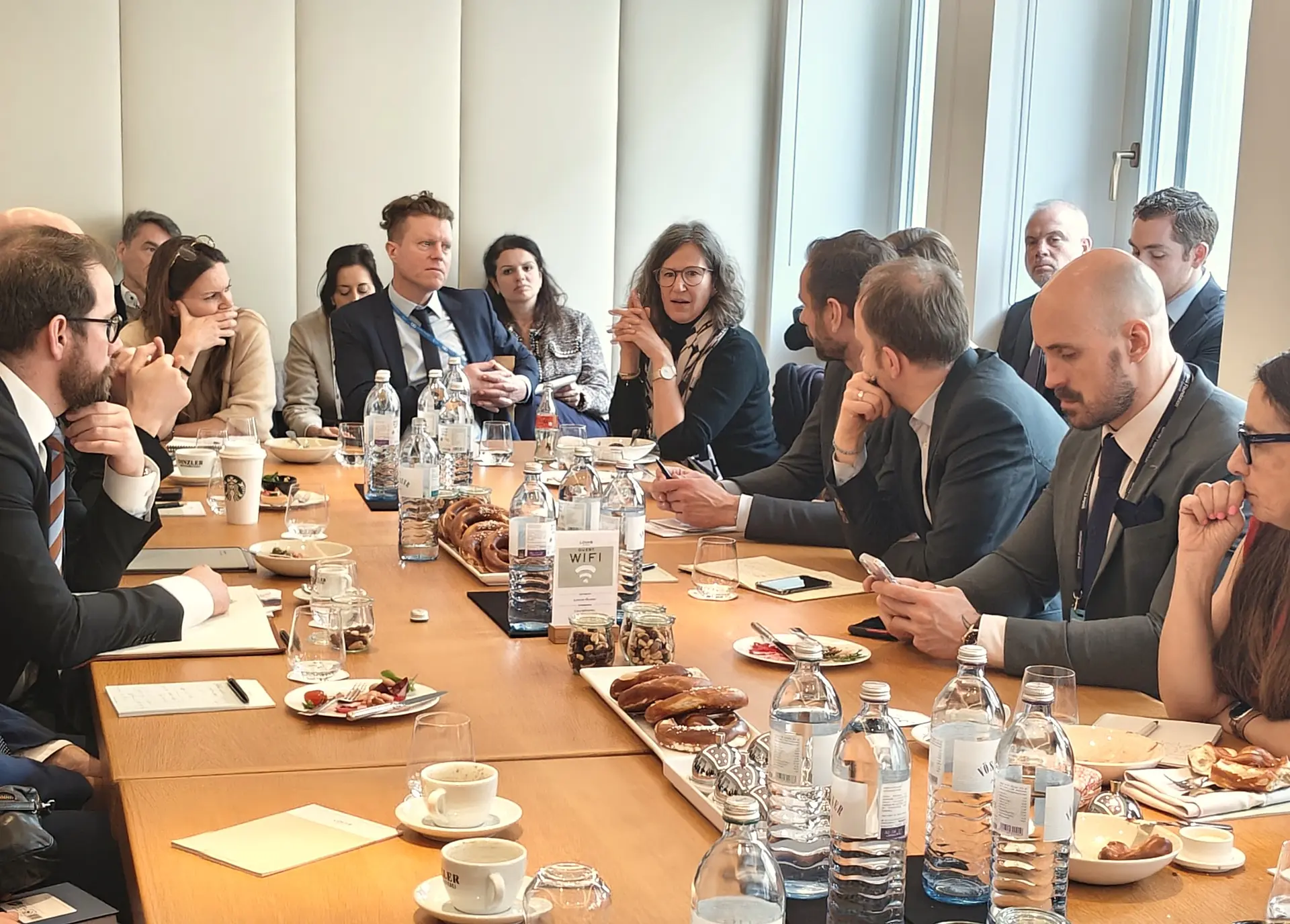
The changing world order, illustrated by the Munich Security Report 2026 titled ‘Under Destruction’, exposes particularly Europe to a number of challenges. The U.S. seek to foster an energy dominance agenda while also weakening the transatlantic relationship. Russia’s threat to undermine Europe’s sovereignty continues to loom over the region. China’s state-led model puts pressure on established industry. The roundtable put these threats right at the centre of the discussion, which was kicked off by the hosts – Henning Gloystein, Eurasia’s Managing Director Energy, Climate and Resources and Andreas Goldthau, Director of the Brandt School – sharing their thoughts on how Europe’s energy and industrial sector is grappling with high energy and electricity prices, the carbon pricing as well as trade and geopolitical uncertainties.
Several key themes emerged in the ensuing, vivid conversation. One was the role of the European Union Emissions Trading System (ETS) in steering industrial transformation. While some voices urged to reassess the current system so as to relieve Europe’s energy-intensive industries from that additional burden, other voices in the room pointed out to the merits of the EU ETS and how several countries are planning to have a similar mechanism in place in the near future. Another key topic of discussion was investment in grid infrastructure. Integrating data centres and using AI to provide demand flexibility will be key to manage a transforming system and keep it cost efficient. A strong case was also made for the value of doing business in Europe. It is Europe’s strong institutions and the capability to drive innovation that will be key for the future of industrial resilience. To make the most of its huge market with a talented workforce and world class companies, policies need to reduce regulatory uncertainty and provide a clear investment roadmap. Robust frameworks will help European industries get back on their feet while also accelerating decarbonization. As one of the speakers noted: “Only he who worries about the future will make it better”, which summarises the spirit driving the conversation at the roundtable.
![[Translate to English:] Facebook Icon](/fileadmin/SocialMediaIcons/iconfinder_06-facebook_104498.svg "Fakebookseite der Staatswissenschaftlichen Fakultät")
![[Translate to English:] Youtube Icon](/fileadmin/SocialMediaIcons/iconfinder_18-youtube_104482.svg)


![[Translate to English:] facebook icon](/fileadmin/SocialMediaIcons/iconfinder_06-facebook_white.svg)

![[Translate to English:] instagram icon](/fileadmin/SocialMediaIcons/iconfinder_38-instagram_white.svg)
![[Translate to English:] YouTube icon](/fileadmin/SocialMediaIcons/iconfinder_18-youtube_white.svg)
![[Translate to English:] xing icon](/fileadmin/SocialMediaIcons/iconfinder_xing_white.svg)
