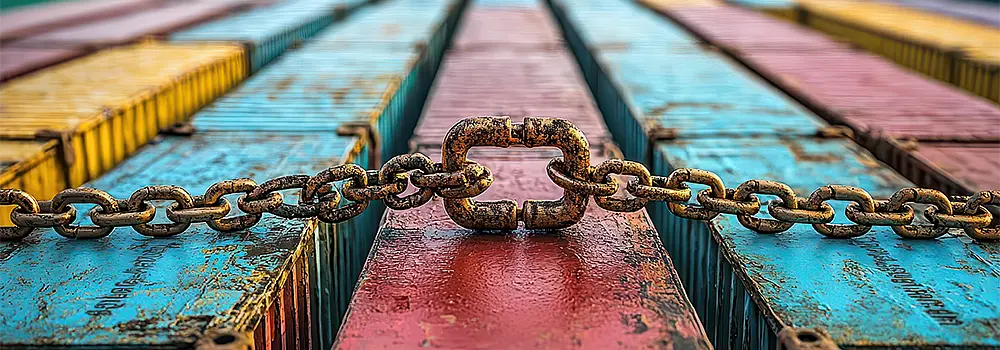
DeGlobE is an interdisciplinary research and doctoral programme that analyses aspects of de-globalisation and global decoupling with four different perspectives:
- Clean Transition and Green Technologies
- Value Creation and Security Apparatuses
- Financial Infrastructure Policy
- Supply Chains, Human Rights and Sustainable Development
We investigate how processes of deglobalization become apparent in the recalibration of the relationship between markets and states through economic paradigms and at regulatory levels. DeGlobE is interested in the developing, but yet specific "post-globalization logics" that characterize four perspectives: Public Policy, Security Politics, Political Economy and Law.
DeGlobE also examines the consequences of deglobalization, decoupling, and global decoupling for normative goals such as social justice, socio-ecological transformation, and the observance of human rights.
More information: About DeGlobE
From 7 to 8 October, the Science Forum will take place under the title
"Perspectives on the global world order -Economy, power and security in times of (de)globalisation and geoeconomics" .
The research forum is aimed at doctoral students and postdocs working on issues of (de)globalisation and geoeconomics. It offers a platform for professional exchange by combining project presentations with targeted impulses and well-founded comments from experienced experts.
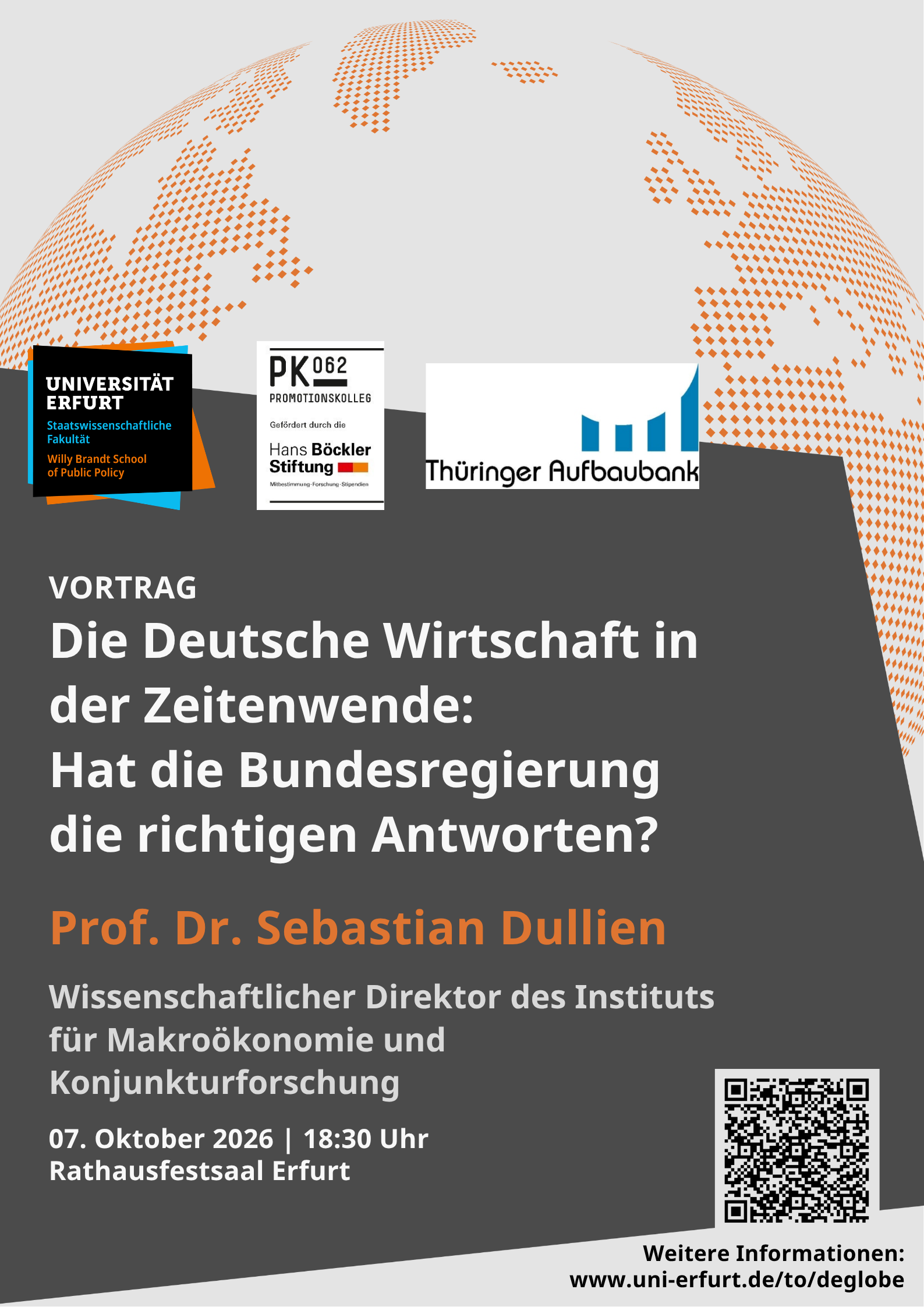
On October 7, Prof. Dr. Sebastian Dullien will deliver the keynote address in the Rathausfestsaal in Erfurt—starting at 6:30 p.m., he will speak on “The German Economy at a Turning Point: Does the Federal Government Have the Right Answers?”
All interested parties are cordially invited!
Events
22.04.2026: Kick-off event - Panel discussion: De-globalisation and global decoupling
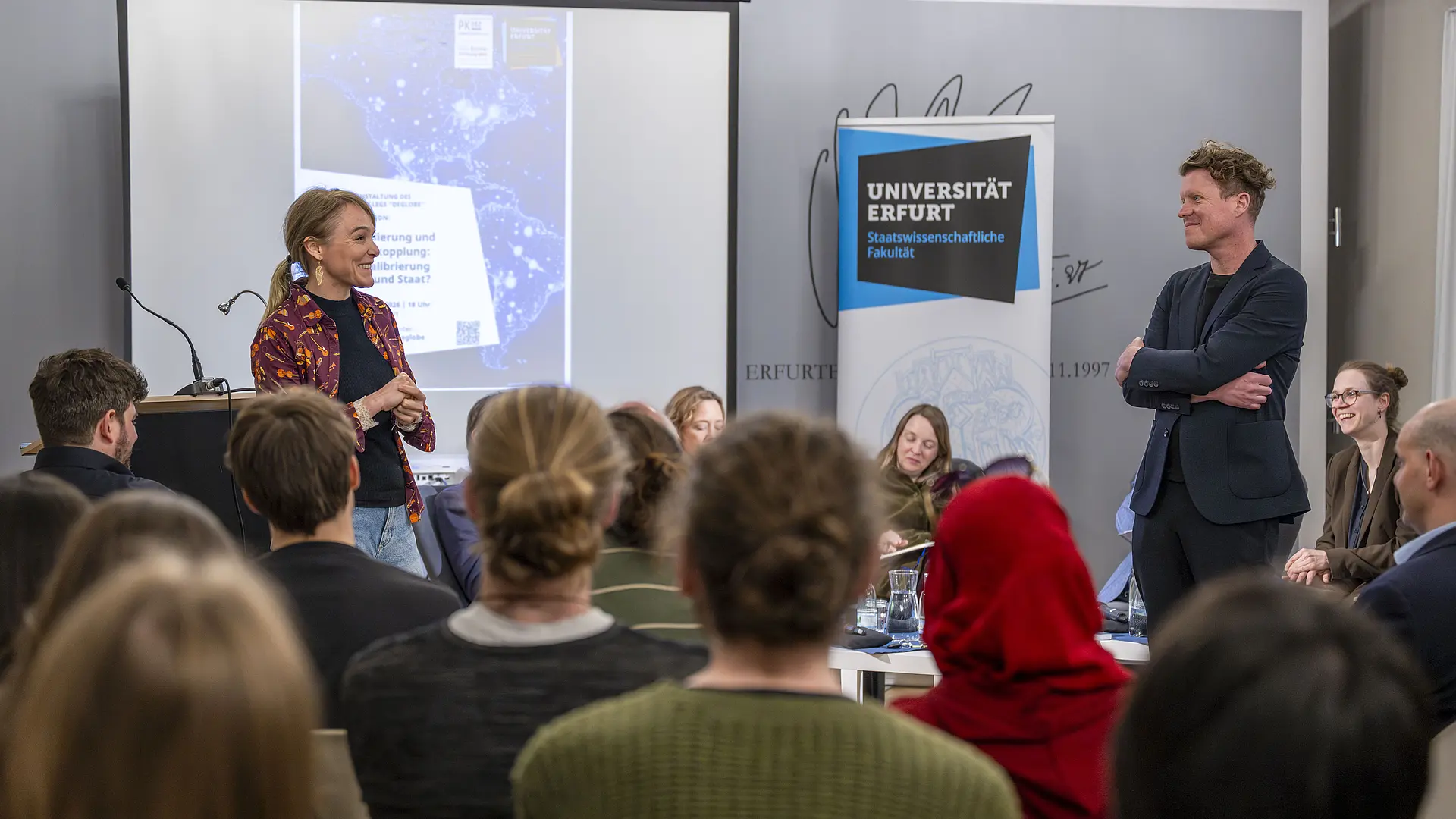
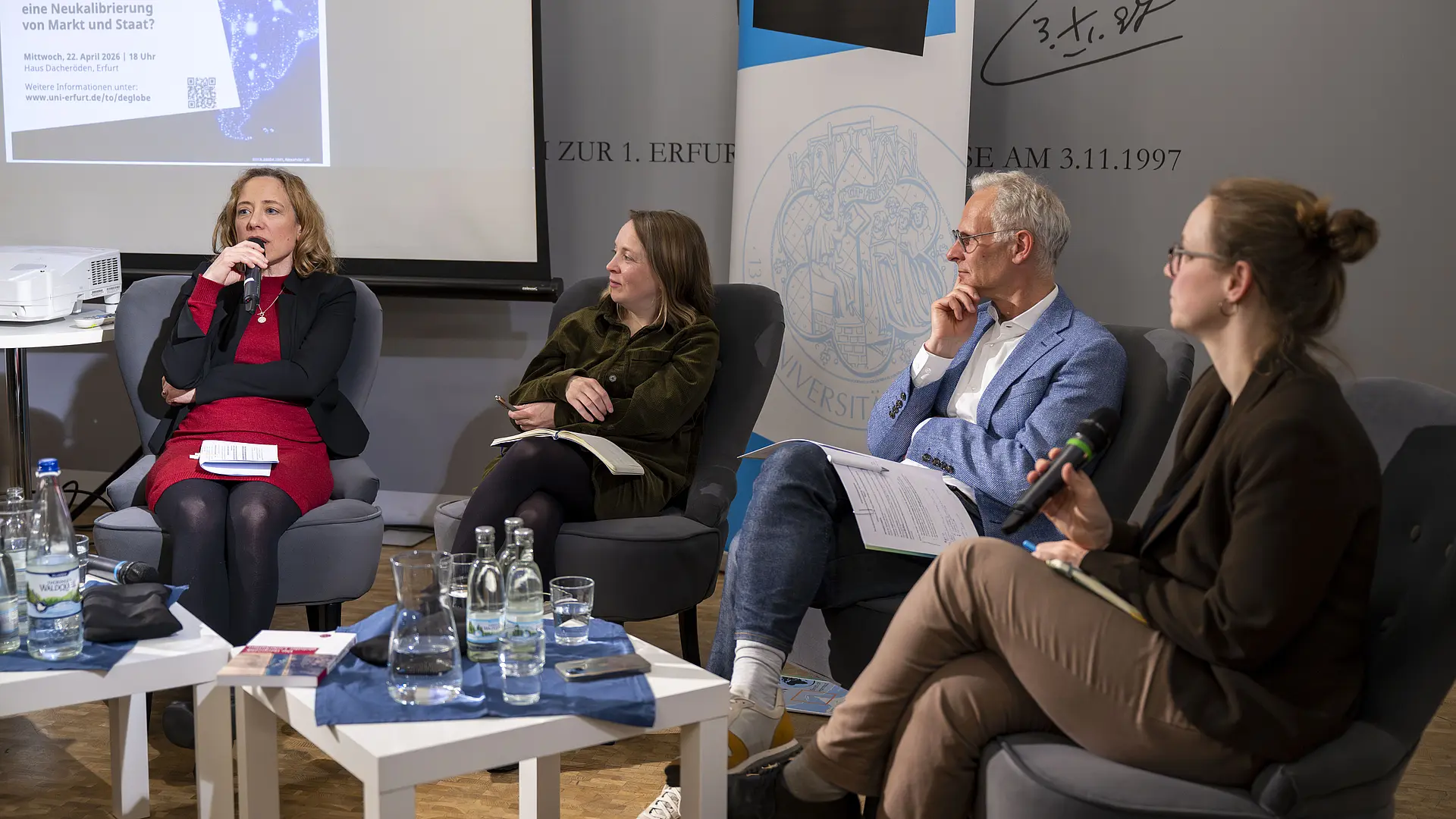
How is the relationship between the market and the state changing in times of possible de-globalisation? The panel discussion at the opening event of the DeGlobE doctoral programme was dedicated to this question.
The event was opened at Haus Dacheröden in Erfurt by Professor Sophia Hoffmann and Professor Goldthau, co-spokespersons of the programme. In his subsequent thematic introduction, Professor Stefan Schmalz (Friedrich Schiller University Jena) explained key developments and areas of tension in the current dynamics of (de)globalisation, leading into the subsequent discussion. In the ensuing exchange, aspects such as geopolitical and geoeconomic factors influencing current globalisation processes, perspectives and conditions of a possible re-globalisation and the role of key players such as China, the USA and Europe in the current global economy were discussed.
The panel included: Professor Stefan Schmalz (Professorship of Labour and Economic Sociology, Friedrich Schiller University Jena), Liv Dizinger (Structural Policy subject area, DGB Hessen-Thüringen), Dr Melanie Müller (Africa and Middle East Research Group, Stiftung Wissenschaft und Politik) and Mark Brehmer (International Team Leader, IHK Erfurt).
We look forward to continuing our joint work and to exchanging ideas with all those who deal with issues of globalisation and its current transformations!


22.04-24.04.2026: Young Scholars Workshop 2026: State–Business Relations and Geoeconomics: Theories, Methods, and Comparative Perspectives
From April 22 to 24, 2026, the University of Erfurt hosted the international workshop for early-career researchers titled “State-Economy Relations and Geoeconomics: Theories, Methods, and Comparative Perspectives.” The event brought together early-career researchers and provided a dynamic platform to discuss current shifts in state-economy relations amid a period of geoeconomic transformation.
In panel discussions on industrial transformation, strategic state intervention, infrastructure, global production networks, and resource policy, participants examined a wide range of empirical case studies and conceptual approaches. The presentations covered virtually all regions of the world and illustrated how geo-economic dynamics unfold in different political and economic contexts.
A defining feature of the workshop was its exceptionally open and constructive culture of discussion. Interdisciplinarity was not merely present but actively practiced: perspectives from political economy, sociology, geography, and technology were combined with diverse methodological approaches. This diversity underscored a central insight: understanding geoeconomics and the changing relationships between the state and the economy requires a fundamentally global and interdisciplinary way of thinking.
21.04.2026: Panel discussion - Navigating China: A Tri-Regional Conversation on Power, Policy, and Partnership (Erfurt Transatlantic Dialogue)
China’s growing global influence continues to reshape the international system and presents both opportunities and strategic challenges for Europe, the United States, and Asia. As part of the Erfurt Transatlantic Dialogue, the Konrad Adenauer Foundation, the Willy Brandt School of Public Policy, and the U.S. Consulate General in Leipzig hosted an open fishbowl discussion to bring these perspectives together.
Further information: LinkedIn of the Willy Brandt School of Public Policy
16.04.2026: Keynotes & World Cafés - What's up with International Politics? Reflecting on current world disorder – a conversation with the StaWi PhDs and Postdocs
What's up with International Politics?
A lot is happening in international politics right now: geopolitical conflicts are on the rise, political alliances are shifting, and differing visions of global order are becoming clear.
On April 16, 2026, members of the C2PO and EIPCC graduate colleges at the University of Erfurt therefore reflected on the current changes in world politics and their impact on their own work, their communities, and the world through keynotes and World Cafés.
In addition to Dr. Ilyas Saliba speaking on academic freedom, contributions from members of the Security Capitalism research group and the doctoral program “De-Globalization and Global Decoupling” provided further insights: Prof. Dr. Andreas C. Goldthau discussed the energy policy implications of the current global unrest, and Madeleine Böhm addressed the Nordic countries’ perspective on the situation surrounding Greenland. The subsequent World Cafés were led by Jan Ickler, Mariana Caldas, Timor Landherr, Jessica Holl, and Dr. Alejandra del Pilar Ortiz-Ayala.
17.03.2026: Workshop - Ohne Zeitenwende: Israels Kriege und die Internationalen Beziehungen in Deutschland II
How do international relations in Germany reflect on their own role in the Middle East conflict?
This question was explored during the workshop “Without a Turning Point II: Israel’s Wars and International Relations in Germany.” The workshop took place on March 17, 2026, at Freie Universität Berlin.
The event was organized by Prof. Dr. Sophia Hoffmann (co-director of the DeGlobE doctoral program, Chair of International Politics and Conflict Studies), together with Dr. Roy Karadag (University of Bremen, InIIs) and Dr. Mariam Salehi (FU Berlin, INTERACT project).
The focus was on three central aspects: the necessity of exposing the intertwining of academia, politics, and social power relations; the examination of the structural conditions that marginalize certain perspectives and expertise in International Relations; and the discipline’s responsibility to address structural violence and human rights issues not only in extreme situations but as a permanent subject of research.
This conference followed up on the event of the same name held in November 2025 and aimed to create space within the German field of International Relations for reflection on the discipline’s role in the Middle East conflict.
05.11.2025: Workshop - Ohne Zeitenwende: Israels Kriege und die Internationalen Beziehungen in Deutschland
This conference was intended to take a self-critical look at the role the German international relations community has played in the discourse on Israel’s wars since October 2023.
Overall, the German international relations community has failed to live up to its responsibilities, both with regard to the Palestinian civilian population as victims of Israeli crimes of violence and with regard to our duty as scholars to inform the political and social discourse in this country. Because we did not communicate our findings early enough, a discursive tolerance toward Israeli war crimes persisted for a long time, regardless of the danger that such tolerance poses to our vision of a rules-based international order. The shift in sentiment toward cautious criticism of Israel’s conduct of war beginning in May 2025 came far too late and, moreover, was not grounded in any scholarly stance. It is rather a response to the Palestinian suffering that can no longer be denied, to international activism, and to humanitarianism.
With this conference, we aim to critically and constructively challenge the prevailing misinterpretations of the Middle East conflict and the Gaza War. We hope that by jointly discussing the underlying causes and pooling our collective expertise, we can lay the groundwork for ensuring that scholarly insights and academic research on international politics and the Middle East conflict are recognized and no longer sidelined in the future.
15.10.2025: Workshop - International Law between Empire and Resistance
This one-day workshop brought together two exploratory sessions aimed at rethinking international law at the intersection of postcolonial critique, aesthetics, and practices of resistance. The project of modernity has long portrayed international law as a universal, impartial, and emancipatory endeavor. Yet postcolonial research in both international law and international relations has revealed how deeply the international (legal) order is intertwined with colonial histories of violence and persistent hierarchies of race, knowledge, and power.
This workshop provided a platform for interdisciplinary exchange among scholars and practitioners who draw on postcolonial sensibilities and employ creative strategies to theorize or resist the colonial international. The aim was to develop a deeper understanding of the post(colonial)
dimension of the politics of international law and to foster an appreciation for the people, approaches, and bottom-up initiatives that seek to practice and reimagine international law differently.
-
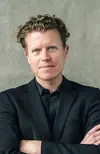
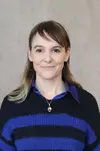
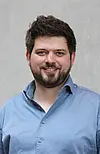
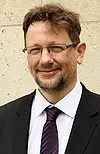
Academic Coordinator DeGlobE (Willy Brandt School of Public Policy)
-
Spokesperson for the doctoral programme "De-Globalisation and Global Decoupling (DeGlobE)" (Willy Brandt School of Public Policy)
-
Spokesperson for the doctoral programme "De-Globalisation and Global Decoupling (DeGlobE)" (Faculty of Economics, Law and Social Sciences)
-
Postdoctoral researcher at the Erfurt Research Centre for Geoeconomics (EFGEo) (Willy Brandt School of Public Policy)
-
Professor for international relations (Faculty of Economics, Law and Social Sciences)
-
Holder of the Professorship of Public Law, International Law and Comparative Law (Faculty of Economics, Law and Social Sciences)
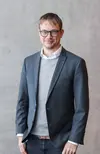
(Kopie 5)
-
Anastasia HelmschrotResearch associate in the ‘Security Capitalism’ research group (Willy Brandt School of Public Policy)
-
Oskar HendriksStudent assistant in the security capitalism research group (Faculty of Economics, Law and Social Sciences)
-
Caterina MeravigliaStudent assistant to the Security Capitalism research group (Faculty of Economics, Law and Social Sciences)
![[Translate to English:] Facebook Icon](/fileadmin/SocialMediaIcons/iconfinder_06-facebook_104498.svg "Fakebookseite der Staatswissenschaftlichen Fakultät")
![[Translate to English:] Youtube Icon](/fileadmin/SocialMediaIcons/iconfinder_18-youtube_104482.svg)


![[Translate to English:] facebook icon](/fileadmin/SocialMediaIcons/iconfinder_06-facebook_white.svg)

![[Translate to English:] instagram icon](/fileadmin/SocialMediaIcons/iconfinder_38-instagram_white.svg)
![[Translate to English:] YouTube icon](/fileadmin/SocialMediaIcons/iconfinder_18-youtube_white.svg)
![[Translate to English:] xing icon](/fileadmin/SocialMediaIcons/iconfinder_xing_white.svg)