
Current Academic Schedule (Winter semester 2026/27)

This page presents an overview of the courses offered within the Master of Public Policy Program in the upcoming semester. To achieve your MPP degree, you'll have to complete mandatory courses, (core) elective courses, language courses and participate in a capstone course (winter semesters only).
Please note that this information is subject to change!
First year students
Core Modules
Students need to register for and participate in the following courses:
Fundamentals of Public Policy*

Lecturer: Prof. Dr. Andreas Goldthau
Time (location) : Thursdays, 10–12h (18-LG 4 | 03.10)
Module: M Pub 2026 C1 FPP #01 / M Pub 2020 101 IPP#01
Moodle: You will be enrolled by us.
Course description: This course introduces students to theories, concepts, terms, and methodologies of public policy. It provides an overview on the basic procedures and areas of policy analysis and discusses key incentives and constraints characterizing the policy process. By the end of this course students will be able to perform policy analyses based on a thorough knowledge and understanding of key theoretical approaches and policy debates. They will be familiar with pluralist and rational choice-based approaches to the study of public policy; have acquired the analytical tools to analyze actors and their strategic behavior in the policy process; and have gained some experience in analyzing the policy process from the inception of a new public policy issue to its implementation and review.
Further details about this course can be found here.
Academic Writing for Public Policy*

Lecturer: Priscilla Boatemaa Appiah
Time (location):
- Mondays, 14–16h (C07 | 131)
- Tuesdays, 08–10h (C07 | 131)
Module: M Pub 2026 C1 FPP#02 / M Pub 2020 101IPP#02
Moodle: You will be enrolled by us.
Course description: Academic Writing for Public Policy is designed to develop the critical reading, research, argumentation, and scholarly writing skills required for master’s-level study in public policy. The course approaches academic writing as participation in scholarly conversations and guides students progressively from identifying research problems and formulating focused research questions to critically engaging with literature, synthesising evidence, constructing persuasive academic arguments, and producing coherent scholarly texts. Students develop practical competencies in literature searching and organisation, effective use of evidence, academic paper structure, academic integrity and referencing, revision and peer review, developing their academic voice, and translating research into policy briefs for decision-making audiences. The course also introduces students to university library resources and develops critical AI literacy for the responsible and transparent use of generative AI in academic research and writing. Through seminars, guided independent writing drills, peer engagement, and formative feedback, students apply and strengthen these skills throughout the semester.
Further details about this course can be found here.
Core Electives
During their studies, students need to choose two core electives. The ones listed below are on offer this semester. There will be different courses on offer in the next semester.
Public Administration and Finance*

Lecturer: Prof. Dr. Achim Kemmerling
Time (location) : Mondays, 10–12h (C01-AMG | 0007)
Module code: M Pub 2026 CE2 PAd#01 / M Pub 2020 103 PAF#01
Moodle: You will be enrolled by us.
Course description: This course introduces students to theories, concepts, terms, and methodologies of public policy. It provides an overview on the basic procedures and areas of policy analysis and discusses key incentives and constraints characterizing the policy process. By the end of this course students will be able to perform policy analyses based on a thorough knowledge and understanding of key theoretical approaches and policy debates. They will be familiar with pluralist and rational choice-based approaches to the study of public policy; have acquired the analytical tools to analyze actors and their strategic behavior in the policy process; and have gained some experience in analyzing the policy process from the inception of a new public policy issue to its implementation and review.
Further details about this course can be found here.
Economic Policies*

Lecturer: Evans Tindana Awuni, Ph.D.
Time (location) : Tuesdays, 12–14h (C03-LG1 | 110)
Module code: M Pub 2026 CE3 Eco#01 / M Pub 2020 102 EPA#01
Moodle: You will be enrolled by us.
Course description: The objective of this course is to provide students with the economic tools to conduct policy analysis. Rather than presenting Economics as a scientific mathematical field of study, students are encouraged to see Economics like a new language that policy professionals must speak. Having said that, the course then deals with the basic grammar of Economics, such supply and demand and the way markets work in the real world. Policies then are analyzed by the effects they have on the markets, identifying winners and losers. Here Economics interacts with politics, interest groups, lobby, regulation and so on. That is, students should not look only at the economic aspects of the phenomena studied, but within the context of a country or region where people lived. Moreover, students of public policy also need to be able critically assess the limits of an economic perspective.
Important note: Depending on their previous knowledge of Economics, students choose one out of two lectures, "Economic Policy Analysis" or "Microeconomics: Game Theory", and complete a module examination.
Further details about this course can be found here.
Microeconomics: Game Theory*

Lecturer: Prof. Dr. Manfred Königstein
Time (location): Wednesdays, 12–14h (C01-AMG | 0007)
Tutorial (location): Thursdays, 08–10h (C01-AMG | 0007)
Module code: M Pub 2026 CE3 Eco#01 / M Pub 2020 102 EPA#01
Moodle: Please use the University's enrolment key.
Course description: (Lecture + Exercise) The course conrpises a lexture and exercise sessions.The lecture introduces the basic concepts of non-cooperative game theory using examples and applications from the fields of economics, political and social sciences. Students should have a basic background in mathematics and statistics. Exercise: every Thursday from 08:00 to 10:00.
Important note: Depending on their previous knowledge of Economics, students choose one out of two lectures, "Economic Policy Analysis" or "Microeconomics: Game Theory", and complete a module examination.
Further details about this course can be found here.
Methods & Skills
During their studies, students need to complete the Academic Methods and the Professional Skills modules: you need to take for each module one seminar at least, followed by the lecture or a 2nd seminar. The ones listed below are on offer this semester. There will be different courses on offer in the next semester.
Professional Skills / Seminar : Co-Creating Future Solutions: Foresight and Design Thinking***
Lecturers: Sarah Bressan & Katharina Göring
Time (location) :
- Friday, October 23, 2026, 10–12h (C19.00.02)
- Thursday, November 26, 2026, 14–20h (C19.00.03)
- Friday, November 27, 2026, 10–15h (C19.00.03)
- Thursday, January 28, 2027, 14-19h (C19.00.03)
- Friday, January 29, 2027, 10-15h (C19.00.03)
Module code: M Pub 2026 C2 Skl#01
Moodle: Please use the Brandt School's enrollment key.
Course description: The course “Co-Creating Future Solutions: Foresight and Design Thinking” enables MPP students to learn and apply innovative approaches to thinking, helping them to view the future as a space for creative shaping. Creativity and ‘out-of-the-box’ thinking are encouraged in order to develop innovative solutions. Students learn how these approaches empower them to take action and enable them to create scenarios and prototypes. The course places particular emphasis on developing future-oriented solutions in uncertain environments.
Further details about this course can be found here.
Professional Skills / Seminar : International Negotiations**

Lecturer: Marcus Delacor
Time (location) :
- Friday, October 23, 2026, 10–12h (C19.00.02)
- Thursday, November 26, 2026, 14–19h (C07-LG 2 | 123)
- Friday, November 27, 2026, 10–13h (C07-LG 2 | 123)
- Thursday, December 10, 2026, 14–19h (C07 | 213)
- Friday, December 11, 2026, 10–13h (C07 | 308)
- Thursday, January 21, 2026, 14–19h (C07 | 213)
- Friday, January 22, 2026, 10–13h (C07 | 308)
Module code: M Pub 2026 C2 Skl#01 / M Pub 2020 602 SPGPP#02
Moodle: Please use the Brandt School's enrollment key.
Course description: Through the course, participants shall become familiar with the most known negotiations concepts: Integrative / principled approaches (Harvard), the FBI-concept, distributive and tactical approaches. Two-thirds of the course consist of role-play, which is based on practical cases and will be played by all participants. Students will learn to develop own negotiation strategies, the dynamics of negotiation processes and their momentums, building on the differences of positions and interests, communicating appropriately, and developing useful approaches to deal-making.
Further details about this course can be found here.
Professional Skills / Seminar: Prompt Engineering & Agentic AI***
Lecturer: Ludwig Lorenz
Time (location) :
- Friday, October 23, 2026, 10–12h (C19.00.02)
- Friday, November 20, 2026, 10–14h (C19.00.04)
- Wednesday, December 09, 2026, 14–17h (C19.00.04)
- Friday, December 18, 2026, 10–14h (C19.00.04)
Module code: M Pub 2026 C2 Skl#01 / M Pub 2020 602 SPGPP#02
Moodle: Please use the Brandt School's enrollment key.
Course description: t.b.a.
Further details about this course can be found here.
Academic Methods / Seminar : Qualitative Methods**

Lecturer: Prof. Dr. Heike Grimm
Time (location):
- Wednesday, October 21, 2026, 16-18h (C03-LG 1 | 104)
- Friday, November 6, 2026, 10–16h (C18-LG 4 | 03.03)
- Wednesday, November 25, 14-16h (C19.03.39)
- Friday, December 4, 2026, 10–16h (C18-LG 4 | 03.03)
- Friday, December 4, 2026, 16–18h (C18-LG 4 | 03.03)
Module code: M Pub 2026 C3 Mth#02 / M Pub 2020 601 SPNPM#02
Moodle: Please use the Brandt School's enrollment key.
Course description: This course introduces field research as part of the broader research process. The course focuses on the comparative method, qualitative approaches, and the use of fieldwork and empirical data in students’ own research.
Goals and Learning Outcomes:
- Understand the role of field research in developing empirical research.
- Understand the comparative method and the role of qualitative approaches.
- Connect research questions, fieldwork, and empirical evidence.
- Apply appropriate statistical tools and techniques to analyse and evaluate their own fieldwork data.
- Interpret and critically reflect on their own empirical findings and methodological limitations.
- Undertake a focused fieldwork assignment and present their results.
- Develop skills applicable to future academic and professional research.
Further details about this course can be found here.
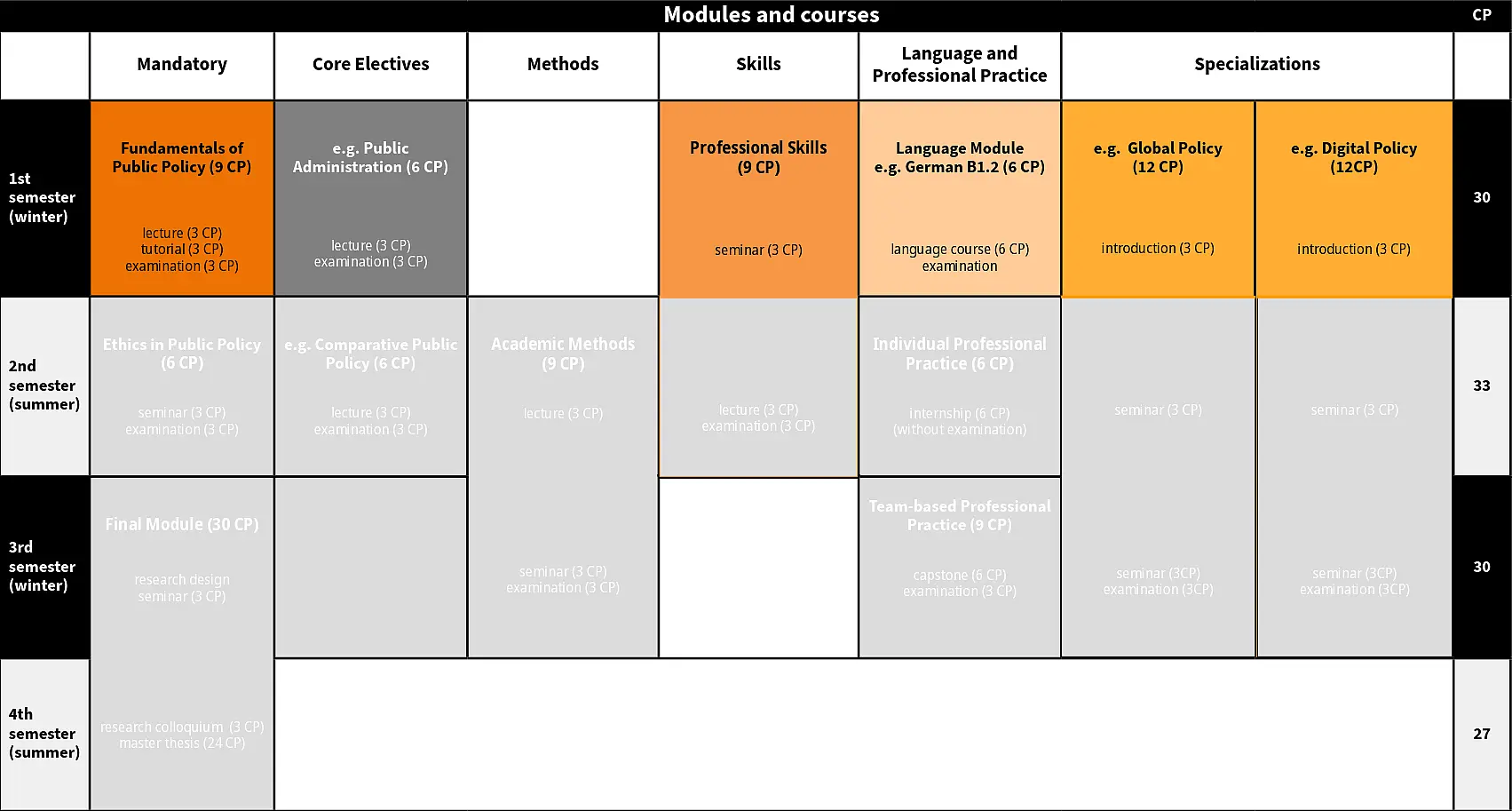
Master of Public Policy Model Study Plan for First-Year Students (first semester highlighted)
Second year students
All second-year students need to register for and participate in the following courses:
Advanced Methods*
Lecturer: Prof. Dr. Achim Kemmerling
Time (location) : Mondays, 14-16h (C19.00.03)
Module: M Pub 2020 301 AM#01
Moodle: You will be enrolled by us.
Course description: Both in academic and policy research, questions of research design and methodology are fundamental starting points. Without a proper research design (i.e. linking the theoretical-conceptual part of the research with empirical research) a lot of data collections end-up being difficult or impossible to use. Without a proper methodology (i.e. the art of choosing the right method) a lot of questions cannot be answered or are answered the wrong way. This course gives a practical overview over research design and methodology, and it will allow students to develop their thesis proposal along the way. We will revisit important questions of research design (research question, theory, hypotheses, concepts, literature reviews). The course will also briefly introduce different (qualitative and quantitative) methods used for policy analysis (ranging from case studies to large N analysis).
Further details about this course can be found here.
Ethics in the Public Sector*

Lecturers: Markus Pins & Justus Lenz
Time (location) :
- Thursday, November 5 from 14-18:30h (C07-LG 2 | 123)
- Thursday, November 19 from 14-18:30h (C07-LG 2 | 123)
- Thursday, December 3 from 14-18:30h (C07-LG 2 | 123)
- Thursday, January 14 from 14-18:30h (C07-LG 2 | 123)
- Thursday, January 28 from 14-18:30h (C07-LG 2 | 123)
Module: M Pub 2020 302 EPS#01
Moodle: You will be enrolled by us.

Course description: Politics is supposed to provide public goods. The very structure of these specific goods combined with individual interest in their consumption requires institutions which we conventionally term political and which are controlled by the struggle for power. But is there more to politics? Are there any specific ethical or moral constraints on politics? Do people have particular moral expectations when it comes to politics? The seminar discusses a set of modern attempts to answer these questions. It analyses the scope of these problems and it ventures a new perspective: the perspective of moral goods.
Further details about this course can be found here.
Capstone courses (Project groups)
During their third semester, MPP students implement a capstone – the Project Group – under the supervision of an academic staff member. As part of their Project Group, students work in teams to address a tangible public policy problem for an external ‘client’, thus engaging with them in an entrepreneurial and professional way. The following projects are on offer. You will have the chance to visit the introductory session in the first week of lectures. You’ll need to submit your preferences on moodle. The submission deadline for your preferences will be announced at a later date. We will notify you of your assignment.
GFA in the Security–Development Nexus: Strategic Positioning in a Changing European Funding Landscape

Lecturer: Alejandra Ortiz-Ayala, PhD
Time (location) : Mondays, 08-10h (C19.03.39)
Introduction on Oct. 12 at 8:15am in C19.03.39
Module code: M Pub 2020 402PTII#01
Moodle: Please the Brandt School's enrollment key.
Course description: In many European countries, rising investments in security, defence, resilience, and geopolitical stability are increasingly being prioritised, sometimes at the expense of traditional development cooperation budgets. As a result, funding streams that have historically been central to GFA’s work - one of the leading European consulting firms active in the development cooperation sector - are coming under growing pressure. This creates both risks and opportunities for GFA Consulting Group. GFA does not engage in military activities, defence procurement, or arms-related work. However, many emerging donor priorities are closely linked to areas in which GFA already has relevant experience, including governance in fragile contexts, peacebuilding, civilian crisis management, local dialogue mechanisms, Women, Peace and Security, International Humanitarian Law, institutional capacity development, social cohesion, and security sector governance. The proposed capstone project would examine how GFA can strategically position itself in this changing environment while remaining aligned with its development mandate, values, and existing expertise.
Further details about this course can be found here.
The Economic Costs of Cybersecurity Regulatory Fragmentation
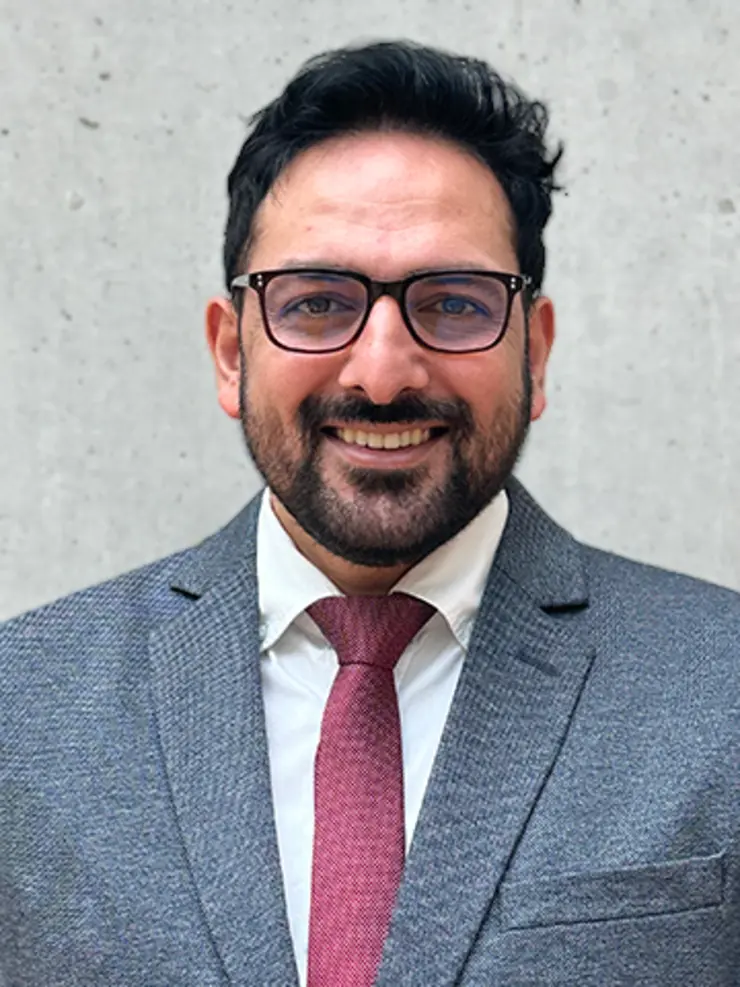
Lecturer: Dr. Hasnain Bokhari
Time (location) : Mondays, 16–18h (C19.02.46)
Introduction on Oct. 12 at 4pm sharp in C19.03.39
Module: M Pub 2020 402PTII#01
Moodle: Please the Brandt School's enrollment key.
Course description:
Quantifying the cybersecurity threat landscape, intended and unintended cyber incidents, and the adequacy of cybersecurity policies and capabilities is challenging. Estimates of the financial damage caused by cybersecurity incidents vary from hundreds of billions to trillions of US dollars, putting into sharp relief the differences and difficulties inherent in the measurement of cybersecurity. At the same time, there is a widely shared perception that cybersecurity incidents have been increasing in both frequency and severity, and that the costs are associated with a rise in the fragmentation of cybersecurity regulations across jurisdictions, especially for small and medium-sized enterprises (SMEs). To support the evidence base for coherent cybersecurity regulation, it is critical to better assess empirically the costs of cybersecurity policy fragmentation across countries.
This policy capstone, conducted with OECD, examines the economic costs of cybersecurity regulatory fragmentation across jurisdictions, drawing on a range of possible analytical approaches. This work would contribute to work on cybersecurity measurement (via the OECD Working Party on Digital Economics, Measurement and Analysis) and the cybersecurity policy (via the OECD Working Party on Digital Security).
Further details about this course can be found here.
Successfully governing the circular economy? Criteria for Good Governance in Extended Producer Responsibility
Lecturer: Prof. Dr. Achim Kemmerling
Time (location) : Mondays, 16–18h (C19.03.39)
Introduction on Oct. 12 at 5:15pm in C19.03.39
Module code: M Pub 2020 402PTII#01
Moodle: Please the Brandt School's enrollment key.
Course description: This project group will work in cooperation with Prevent Waste Alliance, which serves as a platform for exchange and international cooperation. Organisations from the private sector, academia, civil society, and public institutions jointly engage for a circular economy. The project group will deliver a series of short case studies investigating best practices and criteria of success for implementing EPR measures in lower- and middle-income countries. The focus of the analysis will lie on governance issues such as stakeholder inclusion in the process leading to EPR regulation as well as its implementation, as well as important background factors strengthening or weakening effective governance affecting the circular economy on such contexts.
Further details about this course can be found here.
From Global Hubs to Local Roots: Global Citizenship, Local Leadership & Social Innovation
Lecturer: Prof. Dr. Heike Grimm
Time (location) : Wednesdays, 16–18h (C19.03.39)
Introduction on Oct. 14 at 4:15pm in C19.03.39
Module: M Pub 2020 402PTII#01
Moodle: Please the Brandt School's enrollment key.
Course description: This capstone brings together students, practitioners, and civic partners to co-develop a joint white paper, a concept paper grounded equally in theory and field research. A previous student cohort diagnosed how difficult it is to capture social impact in a program like the Melton Foundation's. This course treats that diagnosis as its starting point and pushes further into both concept-building and field-based verification, aiming to produce a rigorous account of how global citizenship education, place-based social innovation and democratic resilience relate to one another. Theoretical grounding and field-based practical insight carry equal weight in this course and are designed to reinforce one another rather than one serving the other. The Jena/Erfurt/Gotha case is a full field engagement partner, not an illustration for the theory: stakeholder conversations, ecosystem mapping and direct contact with local social entrepreneurs and civic actors sit alongside a genuine engagement with the social innovation literature. The white paper is expected to earn its conclusions from both. The other hubs (Accra, Bengaluru, Temuco) serve as comparative, theory-testing reference points, accessible primarily through Melton Foundation documentation and fellow interviews. The course adopts a staggered research Approach, investigating three connected aspects that build on each other analytically: (1) Rethinking Social Impact, (2) Hub-to-Ecosystem Connectivity and the Comparative Dimension and (3) Local Leadership and Democratic Resilience. Beyond the seminar deliverable, the white paper (and in particular its theory chapter) is conceived as having a life beyond the Course, as academic paper and/or marketing and visibility tool for the Partners.
Further details about this course can be found here.
Fostering energy resilience during geopolitically induced crises. Evidence from non-industrial economies
Lecturer: Prof. Dr. Andreas Goldthau
Time (location) : Wednesday, 16–18h (C19.02.46)
Introduction on Oct. 14 at 5:15pm in C19.03.39
Module: M Pub 2020 402PTII#01
Moodle: Please the Brandt School's enrollment key.
Course description: Within only four years, the world has witnessed two major energy crises centrally involving fossil fuel markets. Against the backdrop of a geopolitically charged global market environment in which energy security is hardly delivered by markets alone, the question arises what lessons can be drawn from country cases with limited financial firepower facing a strong imperative for policy innovation in times of energy emergencies. The present Capstone project will empirically assess and analyze distinct sets of policy mixes responding to energy crises focusing on evidence beyond industrialized nations. The project will adopt a comparative case-study design, focusing on 3–4 non-OECD economies across distinct regions to analyze contrasting policy choices under fiscal constraints. It will seek to identify cases of best practice aimed at informing German and EU policy action, whilst bearing in mind the limitations of international policy transfer. Special attention will be placed on short-term market intervention (e.g., fuel subsidies, price caps) versus structural measures, highlighting the trade-offs between immediate socio-economic mitigation and long-term energy resilience. The Capstone will synthesize the findings in the shape of a number of clear-cut policy recommendations for the client.
The client of this Capstone project is the Division "Energy Security” within the German Federal Ministry for Economic Affairs and Energy.
Further details about this course can be found here.
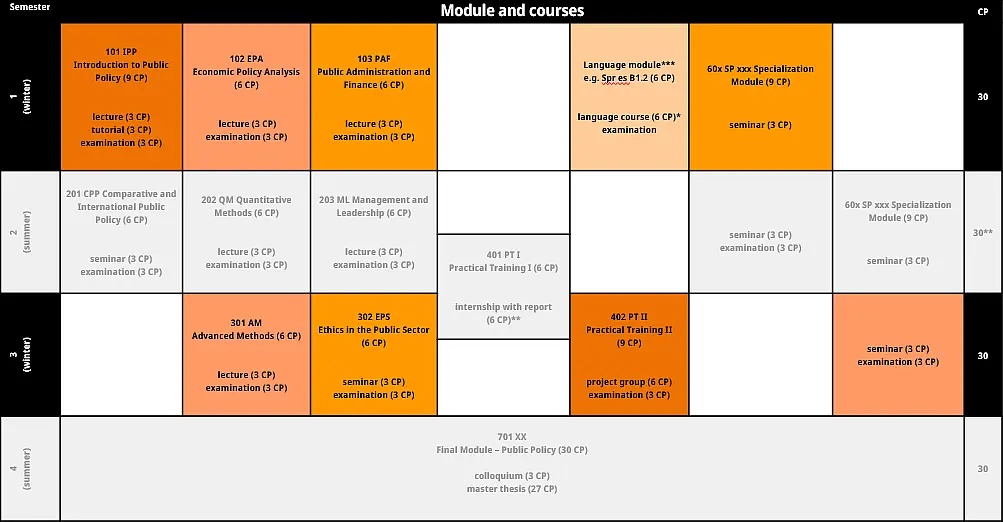
Master of Public Policy Model Study Plan for Second-Year Students (winter semesters highlighted)
Practical Training
Internship
The Public Policy degree program (MPP) includes a mandatory internship as one requirement for completing the degree.
- Primary purposes of the internship are the opportunity to apply the knowledge and skills from the classroom in a work setting, to give students a practical perspective on policy analysis and public management and to help them compare their abilities and interests with requirements in particular fields of public policy.
- Internships may be conducted in government agencies, international organizations, NGOs, or other non-profit or for-profit organizations. The job description must show that the work assigned to the intern will be relevant to public policy analysis and/or management.
- Internships must comprise at least 180 hours, 5 of which may be used for writing the internship report. Typically, the internship will be conducted during the summer break between the second and the third semester (mid-July to mid-October). The hosting agency must name an individual person, responsible for supervising the intern and for communicating with the Brandt School if needed. In order to receive credits for their internship, students have to submit an internship report of 4-5 pages via moodle, no later than 30 days after the last day of the internship.
For further information, please consult the internship regulations on Moodle and contact the Brandt School’s internship coordinator Florian Heintze (florian.heintze@uni-erfurt.de).
Language Training
Your study rules (first years) /study rules (second years) require that, during your studies, you collect a total of 6 credits and a grade in the language module.
- This means that you can either take one course with 6 credits, or two courses with 3 credits each (3+3=6). Should you decide to take two courses, these must be conducted in the same language, advancing you (at least) one proficiency level in one language.
- Either way, you will have to do one module exam, providing you with a grade. You may take more courses in the language module, if you like.
Students with no or little knowledge of German take German classes up until level A2.1 (CEFR)
German as a foreign language A1:

Lecturer: Tomiwa Japhet Adeyemo
Time (location): Tuesdays, Thursdays & Fridays 16-18h (online)
First Session on Tuesday, October 13 from 16-18h.
Module: ZS ENi 2020 SprdeA1#02
Moodle: You will be enrolled by us.
Course description: As per the study and exam regulations (M Pub 2020, section 5, paragraph 3), Master of Public Policy students need to complete the language module in German, reaching at least proficiency level “A2” as one requirement for graduation. These courses, offered specifically for Brandt School students, are the major offer to get you there. After “A1” in winter semesters, “A2” is offered in summer semesters. Course content: Grammar, vocabulary, conversation for beginners.
Further details about this course can be found here.
Students with A2 or higher-level knowledge of German
… continue improving their German language skills (if applicable)
… or opt for another foreign language on offer (e.g. Arabic, Chinese, English, French, Russian, Spanish), offered by the University’s Language Center (Sprachenzentrum). The list of offers is on their website or on E.L.V.I.S. (Winter Semester 26 > (ZS) > ZS Acquisition of a langue level 2020).
Important notes
- Please check for schedule clashes with (mandatory) MPP courses, before signing up for a particular class (see sign-up procedure)!
- Some classes require a placement test beforehand; for the test dates see here.
In addition to courses, the Language Center also offers proficiency exams (Niveaustufenprüfungen) in several languages that you can take (regardless of whether you have taken a course or not) at the end of the lecture period, providing you with a certificate of your level. For current information, please check the Language Center’s websites for the respective languages.
Elective courses (Specializations)
Currently, Brandt School is offering five specializations, based on the research areas of our core academic staff.
- Out of the five specializations offered, you will need to have completed two at the end of your study period.
- To complete a specialization, you need to visit the introductory seminar and two seminars and do one module exam in one of the courses visited (new batch).
- You may do more seminars, but mind the workload.
- Depending on your study regulations, please look at the module codes ("M Pub 2026" refers to the new study regulations, effective starting with batch 2026-28; “M Pub 2020” refers to the old study regulations, for previous batches).
- While we cannot guarantee that a course will be offered again in future, we can say whether it was offered before. Courses that have been taught in the previous winter semester are marked with one asterisk (*). Courses that have been taught in an earlier semester are marked with two asterisks (**). New courses are marked with three asterisks (***).
Social Entrepreneurship and Innovation Management
Introductory Seminar: Social Entrepreneurship*
Lecturer: Prof. Dr. Heike Grimm
Time (location): Wednesdays, 10–12h (C03-LG 1 | 333)
Module: M Pub 2026 E1 SIM#01 / M Pub 2020 601 SP NPM#02
Moodle: Please use Brandt School's enrolment key.
To first-year students: this course is the mandatory “Introduction to Social Entrepreneurship and Innovation Management” seminar to take part in this specialization.
Course description: Social entrepreneurs are entrepreneurs with a social mission; the generation of profits is not the primary goal of the social entrepreneur. Reversed, this does not mean that the social entrepreneur considers the generating of income as being of no value or interest. The social entrepreneur differs fundamentally from the traditional, purely altruistically acting philanthropist because generating income for the financial security of a socially motivated project is regarded as an important means to an end. Because the field of social entrepreneurship is interdisciplinary and in its infancy, the course will be introductory putting emphasis on developing practical skills. We will develop a better understanding of the meaning and various forms of social entrepreneurship through lectures, case studies, and working on a selfdesigned project. Students will be expected to develop a business model canvas for a (fictional) social enterprise. At the end of the course, students can expect to have gained an understanding of the field of social entrepreneurship and to have grasped many of the opportunities, challenges, and issues facing social entrepreneurs. By developing a business model canvas for an own (fictional) social enterprise, students will gain a thorough understanding on how to apply new knowledge into practice.
Further details about this course can be found here.
Strategic Management: Behavioral Strategy**

Lecturer: Prof. Dr. Miriam Zschoche
Time (location): Mondays, 14–16h (C03-LG 1 | 319)
Module: M Pub 2026 E1 SIM#01 / M Pub 2020 601 SP NPM#02
Moodle: Please use the University's enrollment key.
Course description: In this course students gain an in-depth understanding of latest developments in research on strategic management, especially in behavioral aspects of strategic decision making. Students will analyze recent research papers and will apply them within own experiments. This course is not consecutive to the course Strategic Management I. Students can take this course without having accomplished Strategic Management I.
Further details about this course can be found here.
Global Policy
Introductory Seminar: Global Energy Policy**
Lecturer: Prof. Dr. Andreas Goldthau
Time: Thursdays, 12–14h (C03-LG 1 | 120)
Module: M Pub 2026 E2 GPo#01 / M Pub 2020 602SPGPP#02
Moodle: Please use Brandt School's enrolment key.
To first-year students: this course is the mandatory “Introduction to Global Policy” seminar to take part in this specialization.
Course description: The course provides students with a global perspective on energy policy, i.e. focuses on energy policy issues of transnational scale. It introduces students to the global dimensions of energy policy; discusses shifting agendas; and assesses key themes and aspects of the global energy challenge. These include conceptual approaches to global energy, energy as an international security issue, institutions and regimes in global energy, energy poverty and development, and the low carbon energy transition.
Further details about this course can be found here.
The Rise of Geoeconomics**
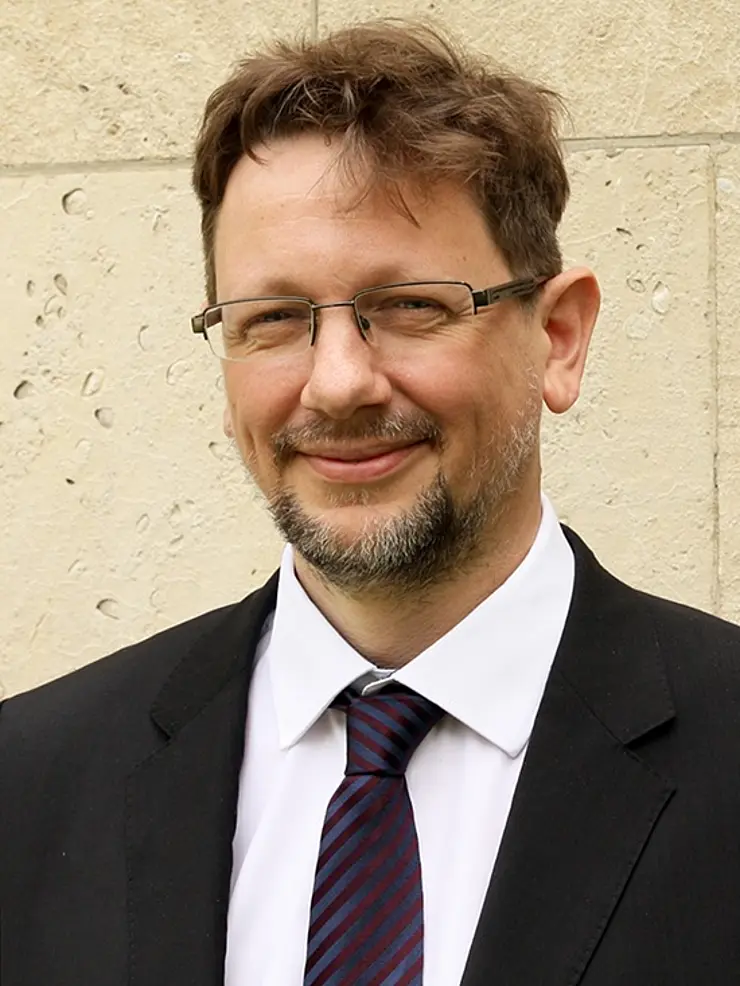
Lecturer: Prof. Dr. Oliver Kessler
Time: Thursdays, 14–16h (C03-LG 1 | 326)
Moodle: Please use the University's enrollment key.
Module: M Pub 2026 E2 GPo#02 / M Pub 2020 602SPGPP#02
Course description: The age of globalization is coming to an end. The idea of further global integration of markets and neoliberal practices is giving way to de-risking, friendly-shoring and industrial policies. This seminar explores the current dynamics and practices of geoeconomics. After a brief introduction to the definitions and explorations in geoeconomics, this seminar offers the possibility for students to explore their own project. Based on the method of problem based learning, students develop their own project and thereby sharpen their own approach to geoeconomics.
Further details about this course can be found here.
Sustainable and Inclusive Development
Introductory Seminar: Political Economy of Development*
Lecturer: Evans Awuni Tindana, PhD
Time (location) : Tuesdays, 14–16h (C03-LG 1 | 110)
Module: M Pub 2026 E3 SID#01 / M Pub 2020 603 SP SEP#02
Moodle: Please use Brandt School's enrollment key.
To first-year students: this course is the mandatory “Introduction to Sustainable and Inclusive Development” seminar to take part in this specialization.
Course description: Intriguing scholarly debates surround the various strategies that propel development even as the terminology of development itself remain inherently ambiguous, complex and theoretically contentious. Beyond conceptualization and theoretical perspectives this seminar examines classic topics and critically evaluates development strategies from a political economy perspective. Why are there vast development gaps within and among countries? What role do the strategies adopted by countries play in their progress or tragedy? How do different political actors influence development decisions? In this seminar, we examine specific propositions, paying particular attention to the advantages and trade-offs of various development strategies and programs. Among other topics, we delve deeper into strategies to promote agriculture, industry, trade, financial market access, foreign direct investments, as well as the role of government, the private sector, non-governmental organisations (NGOs), and political institutions in both local and international context. We draw from some of the most vigorous debates from leading scholars and practitioners and traverse essential themes that provide insights into the core strategies, policies and practices employed to promote development domestically and internationally, principally in the global south.
Further details about this course can be found here.
Financial Crises, Theory, Empirics and History*

Lecturer: Prof. Dr. Dominik Maltritz
Time (location) : Thursdays, 12–14h (C07-LG 2 | 115)
Module: M Pub 2026 E3 SID#02 / M Pub 2020 603 SP SEP#03
Moodle: Please use the University's enrollment key.
Course description: The course considers the various aspects of Financial Crises with a special focus of Crisis in developing countries. We consider different aspects: Description of observed crises Theoretical models of crises Empirical work on crises, esp. causes and forecasting.
Further details about this course can be found here.
Peace and Conflict
Introductory Seminar: Introduction to Peace and Conflict**
Lecturer: Alejandra Ortiz-Ayala, PhD
Time (location) : Mondays, 12–14h (C03-LG 1 | 333)
Module: M Pub 2026 E4 PaC#01 / M Pub 2020 604 SP CSM#02
Moodle: Please use Brandt School's enrolment key.
To first-year students: this course is the mandatory “Introduction to Peace and Conflict” seminar to take part in this specialization.
Course description: Introduction to Peace and Conflict links scholarship to practice and challenges students to develop their knowledge into critical ways of thinking and behaving as potential policy designers and advisers in the field. Students who join this introductory seminar will gain useful lenses for analyzing and understanding current events, global issues and policy decisions. This course aims to provide a postgraduate-level introduction to the main theoretical frameworks, approaches and methods employed within the field of conflict studies and management as they relate to violent conflict within, between, and across states. Despite that the course is focusing mostly on direct violence in conflict zones, often located in the so called “global south” countries. The lecturer would bring questions and discussions about others forms of violence beyond those contexts. Specifically, the course explores diverse theories explaining how conflicts erupt, also addresses major issues of international conflict management: mediation, conflict prevention, implementation of peace agreements, international intervention, conflict legacies, “post-conflict” policies, reconciliation, climate change, conflict, and implications for peacebuilding. The course will be taught from a variety of perspectives, including social psychology, sociology, political science, anthropology, and international relations, and will expose students to the interdisciplinary approach needed in the research of conflicts studies and management. In addition to a theoretical understanding of the conflict resolution discipline, we will discuss specific conflicts, and look at different and competing approaches for understanding, analyzing and reflecting about potential ways of management and resolve them.
Further details about this course can be found here.
Democracy & Human Rights During & After the Arab Uprisings***
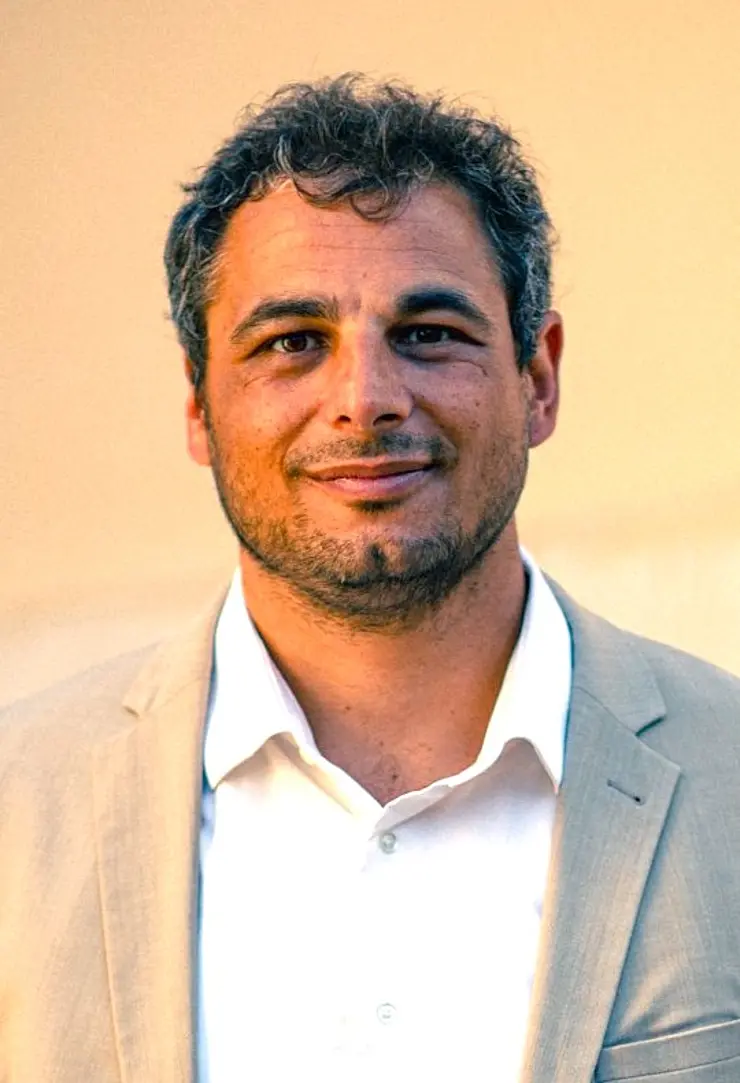
Lecturer: Dr. Ilyas Saliba
Time (location) :
- Friday, October 16, 2026, 16–17:30h (online)
- Friday, January 8, 2027, 14–20h (C03-LG 1 | 128)
- Saturday, January 9, 2027, 09–20h (C03-LG 1 | 128)
- Friday, January 22, 2027, 14–20h (C03-LG 1 | 128)
- Saturday, January 23, 2027, 09–20h (C03-LG 1 | 128)
Module: M Pub 2026 E4 PaC#01 / M Pub 2020 604 SP CSM#02
Moodle: Please use the University's enrollment key.
Course description: Many states and societies across the so-called Arab World witnessed protests, upheavals, and political violence during 2011 and since. In this seminar we compare various protest movements and how the authoritarian regimes reacted and evolved across the region since 2011. Therefore, we start by introducing concepts and methods for analyzing contentious politics in authoritarian regimes in the first sessions. In the second part we then look into the effects of the uprisings on democratization and human rights in several countries affected by the protests during 2011. We will discuss in depth the transition trajectories of cases of: Tunisia, Egypt, Yemen, Syria, Bahrain, Morocco and Jordan. In the third part we then compare the consequences of different transition trajectories during the Arab Uprisings for democracy, civic space and the human rights situation in the region. After the seminar students will be able to compare and explain trajectories and outcomes of the Arab Uprisings and conduct independent empirical analysis on human rights and governance.
Further details about this course can be found here.
Digital Policy and Artificial Intelligence
Introductory Seminar: Fundamentals of Digital Government***
Lecturer: Dr. Hasnain Bokhari
Time (location) : Tuesdays, 10–12h (C03-LG 1 | 110)
Module: M Pub 2020 602SPGPP#02 / M Pub 2026 E5DiP#01
Moodle: Please the Brandt School's enrollment key.
To first-year students: this course is the mandatory “Introduction to Peace and Conflict” seminar to take part in this specialization.
Course description: Governments today run on code as much as on policy. As states deliver public services, regulate emerging technologies, and protect critical infrastructure through digital systems, understanding the architecture of the "tech state" is essential for anyone working in or with government. This course examines how digital public infrastructure, algorithmic governance, data policy, and cybersecurity are reshaping the public sector. Students will explore core themes including digital identity and tech sovereignty, AI regulation, data governance, cyber resilience, and digital inclusion. The course draws on comparative perspectives from the OECD, EU, African Union and ASEAN, and features guest lectures and case discussions with practitioners from institutions such as the European Commission. Through a mix of lectures, film analysis, and an interactive policy lab, students will develop the analytical and practical skills to evaluate, design, and critique digital government policy in an era of rapid technological change.
Further details about this course can be found here.
Foundations of Data Analytics for Public Policy with Python (Independent Study Unit)*
Lecturer: Dr. Hasnain Bokhari
Time (location) :
- Independent Study on Moodle
- Introductory Session on Thu, October 22, 2026, from 14-16h in C19.03.39
Modules: M Pub 2026 E5 DiP#03 / M Pub 2026 C3 Mth#02
M Pub 2020 601SPNPM#03 / M Pub 2020 602SPGPP#03 / M Pub 2020 603SPSEP#03 / M Pub 2020 604SPCSM#03
Moodle: Please the Brandt School's enrollment key.
Course description: Data is now part of the policy toolkit. As governments and international organizations collect more and more data, policy professionals who can question it, analyze it, and draw their own conclusions have a real edge.
Python has become the default language for working with data, from government agencies to international NGOs. This course teaches data analytics using Python to public policy students with absolutely no coding background. You'll learn to filter and analyse data, and build visualisations like histograms, bar plots, and scatterplots, starting from zero. The course is built around policy scenarios, not programming for its own sake. Using a real multi-country dataset on development aid, students investigate whether aid reduces infant mortality and how that depends on factors like regime stability. By the end, you'll move from foundational concepts in algorithmic thinking to hands-on data analysis, always anchored in real policy questions, and produce a short policy report combining code, analysis, and recommendations.
Further details about this course can be found here.
Foundations of Data Analytics for Public Policy with R (Independent Study Unit)**
Lecturer: Dr. Hasnain Bokhari
Time (location) :
- Independent Study on Moodle
- Introductory Session on Thu, October 22, 2026, from 14-16h in C19.03.39
Module: M Pub 2026 E5 DiP#03 / M Pub 2026 C3 Mth#02
M Pub 2020 601SPNPM#03 / M Pub 2020 602SPGPP#03 / M Pub 2020 603SPSEP#03 / M Pub 2020 604SPCSM#03
Moodle: Please the Brandt School's enrollment key.
Course description: Data is now part of the policy toolkit. As governments and international organizations collect more and more data, policy professionals who can question it, analyze it, and draw their own conclusions have a real edge.
Long before data science had a name, R was the language of statisticians. It's now the language behind much of the research that shapes policy today. This course teaches data analytics using R to public policy students with absolutely no coding background. You'll learn to filter and analyse data, and build visualisations like histograms, bar plots, and scatterplots, starting from zero. The course is built around policy scenarios, not programming for its own sake. Using a real multi-country dataset on development aid, students investigate whether aid reduces infant mortality and how that depends on factors like regime stability. By the end, you'll move from foundational concepts in algorithmic thinking to hands-on data analysis, always anchored in real policy questions, and produce a short policy report combining code, analysis, and recommendations.
Further details about this course can be found here.
Cross-Specializations
Independent Study Unit*
Module:
M Pub 2026 E1 SIM#03 / M Pub 2026 E2 GPo#03 / M Pub 2026 E3 SID#03 / M Pub 2026 E4 PaC#03 / M Pub 2026 E5 DiP#03
M Pub 2020 601 SP NPM#03 / M Pub 2020 602 SP GPP#03 / M Pub 2020 603 SP SEP#03 / M Pub 2020 604 SP CSM#03
Course description: Independent Study Units (ISUs) aim at deepening the students’ knowledge in a field of public policy, at an individual pace and are geared to pursuing individual interests. They may also serve as a means of allowing students to equalize differing levels of prior knowledge. If you are interested in registering for an Independent Study Unit, please discuss its contents and how it fits into your study plan with your academic mentor and contact MPP Program Coordinator Christian Tischmeyer for more details regarding registration and the study agreement. Subject to approval by the academic mentor, the Brandt School’s academic staff as well as faculty members or professors of the Faculty of Economics, Law and Social Sciences or other faculties of the University may be approached as supervisors for an ISU.
According to Section 5, paragraph 3 of the framework regulations of Master programs at the University of Erfurt (M-RPO 2019), an independent study agreement must be signed by both the student and the instructor at the beginning of the semester (within the course registration deadline) to receive credit points for an ISU. In this independent study agreement, the student pledges to work on an agreed topic and corresponding questions regularly and independently as well as to spend the necessary amount of time to reach the learning goals within a given time frame. To check the learning progress and to give the instructor an overview of the working status, specific assignments are given and regular meetings should be agreed upon.
Further details about this course can be found here.
Important Note
- It is not possible to substitute credits earned in one module for credits earned in another module.
- It is also not possible to re-take a module exam that you have already passed (with a grade of 4.0 or better). Check the Examination and Study Rules (2020 Regulations / 2026 Regulations) for more detailed and legally binding information regarding the structure of the MPP program. For easy reference, an unofficial English translation (2020 Regulations / 2026 Regulations) of this document is also available.
- At the beginning of each semester, an official course registration for all the courses taken during the semester is required via E.L.V.I.S.. Please make sure to enroll within the given deadlines. Further information will be provided through the Information Desk announcement channels.
Do you need...

further information?

![[Translate to English:] Facebook Icon](/fileadmin/SocialMediaIcons/iconfinder_06-facebook_104498.svg "Fakebookseite der Staatswissenschaftlichen Fakultät")
![[Translate to English:] Youtube Icon](/fileadmin/SocialMediaIcons/iconfinder_18-youtube_104482.svg)



![[Translate to English:] facebook icon](/fileadmin/SocialMediaIcons/iconfinder_06-facebook_white.svg)

![[Translate to English:] instagram icon](/fileadmin/SocialMediaIcons/iconfinder_38-instagram_white.svg)
![[Translate to English:] YouTube icon](/fileadmin/SocialMediaIcons/iconfinder_18-youtube_white.svg)
![[Translate to English:] xing icon](/fileadmin/SocialMediaIcons/iconfinder_xing_white.svg)
