
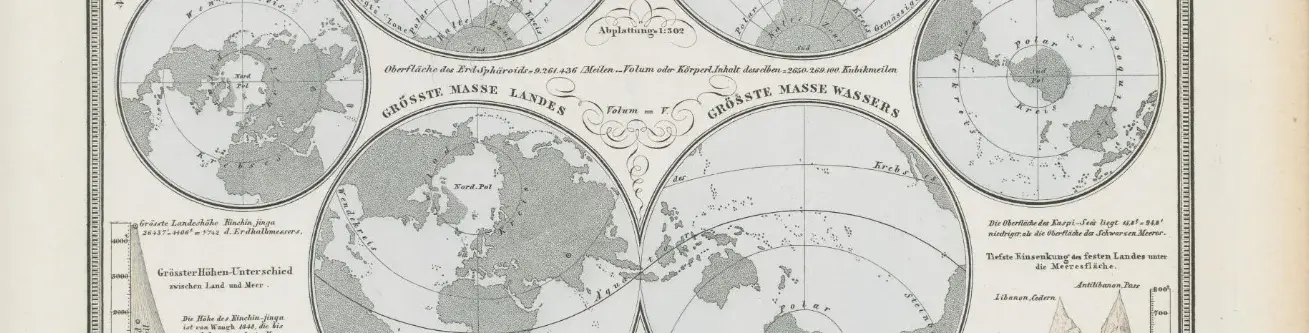
Global history refers to a growing field of research that includes diverse topics as well as methodological debates and theoretical positions. Interest is initially focused on interconnections and transfers between world regions, the history of certain phenomena in their different contexts and global references, as well as processes of globalisation and representations of globality. The various approaches are often united by the attempt to overcome older Eurocentric forms of world historiography and to focus historiographically on the significance of non-European regions – also for the history of Europe – as part of a newly conceived "general history".
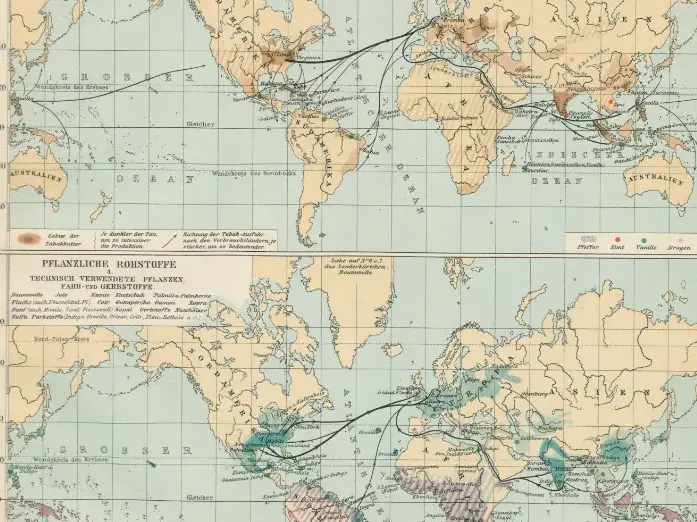
In close co-operation and exchange with representatives of Area Histories, our research focuses on the recent history of science and knowledge, on imperial and colonial history and on international history, which we seek to approach from a global-historical perspective. Methodologically, we are interested in questions of praxeology, the history of space and cartography, visual history and historical scale.
Events and teaching in the winter semester 2025/2026
The Research Centre for Transcultural Studies is starting the winter semester 2025/2026 with its new programme. All interested parties are cordially invited to take part in the Tuesday Talks and the Mappings research seminar. Please register for this at the following e-mail address: fkts.gotha@uni-erfurt.de
Tuesday Talks programme | Mappings programme
The new teaching programme for the winter semester 2025/2026 can be viewed in the course catalogue on E.L.V.I.S.. The individual courses of the Professorship of Global History can also be found here here.
Blog "Mapping Africa and Asia"
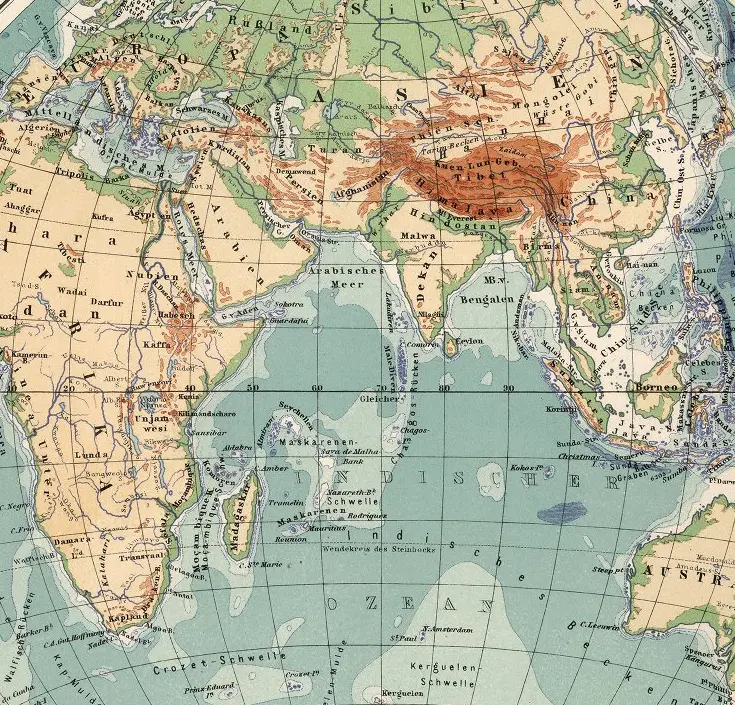
To accompany the research and digitisation project "Cartographies of Africa and Asia (KarAfAs)" (2021-2023), a project blog was launched under the direction of Dr Claudia Berger to document outstanding finds and initial results of the digitisation. The project and digitisation were successfully completed at the beginning of 2023. However, research into the Gotha Perthes Collection's maps of Africa and Asia will continue. In order to make this work visible, the blog has been continued since 2024 under the new editorship of Albert Feierabend and Florian Balbiani at the Centre for Transcultural Studies.
To the blog "Mapping Africa and Asia"
Latest contributions:
- Müller, Sara, The Black Triangle. German Colonialism in Oceania and the Hunt for Gutta-Percha, in: Mapping Africa and Asia, 18.08.2025, https://karafas.hypotheses.org/8553.
- Feierabend, Albert, Workshop: "The Ethiopian Pillow" - Towards a New Cultural Mapping of Headrests, in: Mapping Africa and Asia, 07.08.2025, https://doi.org/10.58079/14aon.
- Nauheim, Tobit, From Fieldwork in Japan to Print: The Reciprocal Relationship between Johannes Justus Rein and the Perthes Publishing House, in: Mapping Africa and Asia, 01.07.2025, https://doi.org/10.58079/148zf.
Ongoing research projects
Voluntariness, Decolonisation, Gender. Women's Movement and Citizenship in (post-)colonial Ghana
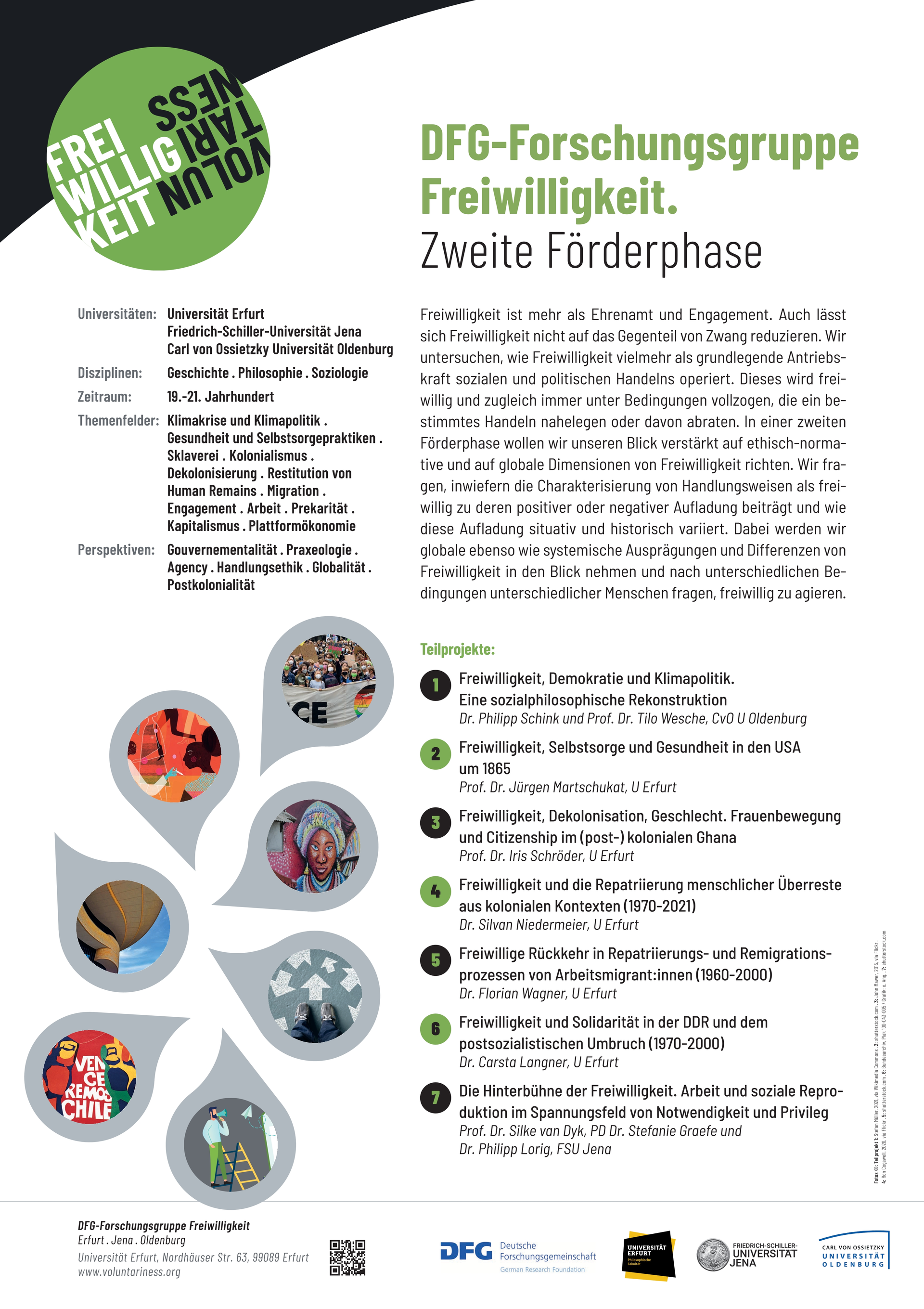
The German Research Foundation (DFG ) will continue to support the Research Unit "Voluntariness" in a second funding phase. Since 2020, the group's researchers have been investigating voluntarism as a political practice in the past and present across spatial and epochal boundaries.
Professor Dr Iris Schröder and the chair for Global History will also be represented in the second funding phase with a new subproject in the field of historical African research: Under the title "Voluntarism, Decolonisation, Gender. Women's Movement and Citizenship in (post-)colonial Ghana" (Freiwilligkeit, Dekolonisation, Geschlecht. Frauenbewegung und Citizenship im (post-)kolonialen Ghana), one of the aims is to shed light on how voluntary action and cooperation were conceptualised in terms of gender during the transition from the late colonial Indirect Rule to the post-colony. The project thus specifically examines the participation and voluntary involvement of women and gendered practices during this period of transformation. It is currently in preparation.
News item: Research group "Voluntariness" enters 2nd funding phase
Geography and Politics between North Africa and Europe. Ego-Documents as an approach to a relational history of knowledge
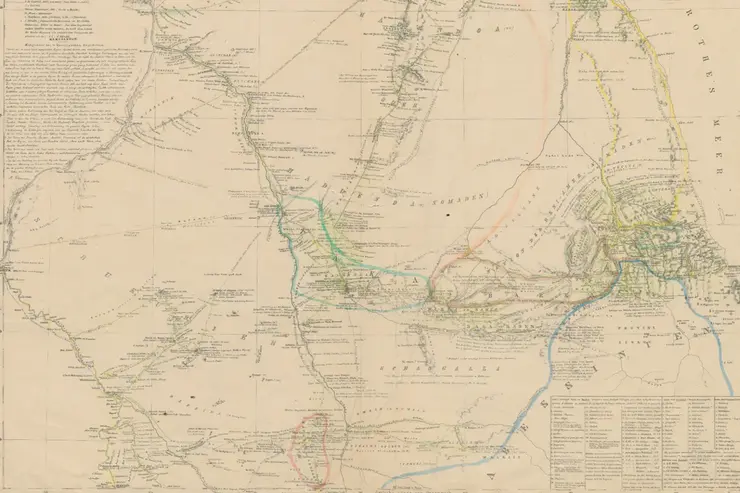
The research project focuses on journeys from Europe to Northeast Africa before colonial land appropriation. It examines natural-scientific-geographical and political spatial knowledge based on selected texts produced during travels and explores different actors, forms, and contents of collaborative knowledge production, thereby investigating the genealogies of social and political spaces on-site. The project relies on notes, diaries, reports, letters, and cartographic works preserved in the Perthes Collection (Research Library Gotha), which originated from the region and made their way to Gotha. It combines globally informed, knowledge-historical approaches with self-testimonial research... more
Picture: © August Petermann, Draft of a map. East Africa between Chartúm & the Red Sea to Sauakin & Massua, 1:1,000,000, Gotha 1860/61, SPK 40.19.01 C (01), Gotha Perthes Collection of the Gotha Research Library
Insights into ongoing research
Workshop & Lecture with Dr Takele Merid Afessa (Addis Ababa University)
From June 22 to 29, 2025, we welcomed Dr Takele Merid Afessa, Director of the Institute of Ethiopian Studies at Addis Ababa University , to the University of Erfurt.
On June 24 2025, a workshop and an evening lecture with Takele Merid Afessa took place at the Centre for Transcultural Studies.The workshop, which took place in cooperation with SCIFA Science Facilitation and the collaborative project "Kulturtechniken des Sammelns", was dedicated to the topic "The Ethiopian Pillow: Towards a New Cultural Mapping of Headrests - An Interventionist Approach".
In his lecture "Rethinking the Ethnological Collection of the Institute of Ethiopian Studies: Questions, Challenges and Suggestions", Takele Merid Afessa addressed the ethnographic collections of the Institute of Ethiopian Studies in Addis Ababa. He discussed not only the historical and cultural dimensions of these collections, but also the challenges associated with their preservation and presentation. In this context, he also raised the question of possible approaches and new ways of dealing with the collections.
The event was organised in cooperation with SCIFA Science Facilitation (Berlin-Gotha), KOLUMBA, the Art Museum of the Archdiocese of Cologne and the cooperation project "Kulturtechniken des Sammelns" (Erfurt-Gotha).
13th Map History Colloquium
The 13th Colloquium on the History of Cartography took place on May 9 and 10 2025 at the Centre for Transcultural Studies in Gotha. The regularly held event offers academics, especially those in the qualification phase, a forum to present projects on cultural-historical cartography from the Middle Ages to contemporary history and to discuss methodological concepts of ongoing work. The two-day, interdisciplinary and transepochal colloquium included discussions and a visit to the Gotha Perthes Collection (Gotha Research Library). The event was organised by Ingrid Baumgärtner (Kassel), Christoph Mauntel (Osnabrück), Ute Schneider (Essen), Martina Stercken (Zurich) and Iris Schröder (Erfurt).
The event was sponsored by the Freundeskreis der Forschungsbibliothek Gotha e.V. and the Research and Graduate Services Department of the University of Erfurt.
Workshop "Unmapping Africa"
From March 5 to 7, 2025, a workshop on "Trust and Distrust in the Un/Mapping of Africa" took place at the Centre for Transcultural Studies. The workshop brought together international scholars to critically scrutinise and reassess the European practice of "unmapping" the African continent. A visit to the Gotha Perthes Collection was also planned, whose valuable holdings of letters, sketches and hand-drawn maps were to be integrated into the discussion. These materials were meant to help to better define historical mapping practices and their connection to "unmapping". Scholars from various disciplines and institutions discussed the role of authentication and credibility practices in the context of the "unmapping" of Africa. The aim of the workshop was to initiate a dialogue between European and African researchers.
The workshop was organised by Iris Schröder (University of Erfurt), Dominic Keyßner (University of Erfurt) and Petter Hellström (University of Uppsala). It was supported by the Riksbankens Jubileumsfond for the promotion of the humanities and social sciences and by Professor Michael Wildt, who promotes academic exchange between African and European researchers, in particular between the University of Erfurt and the University of Mekelle.
New publications
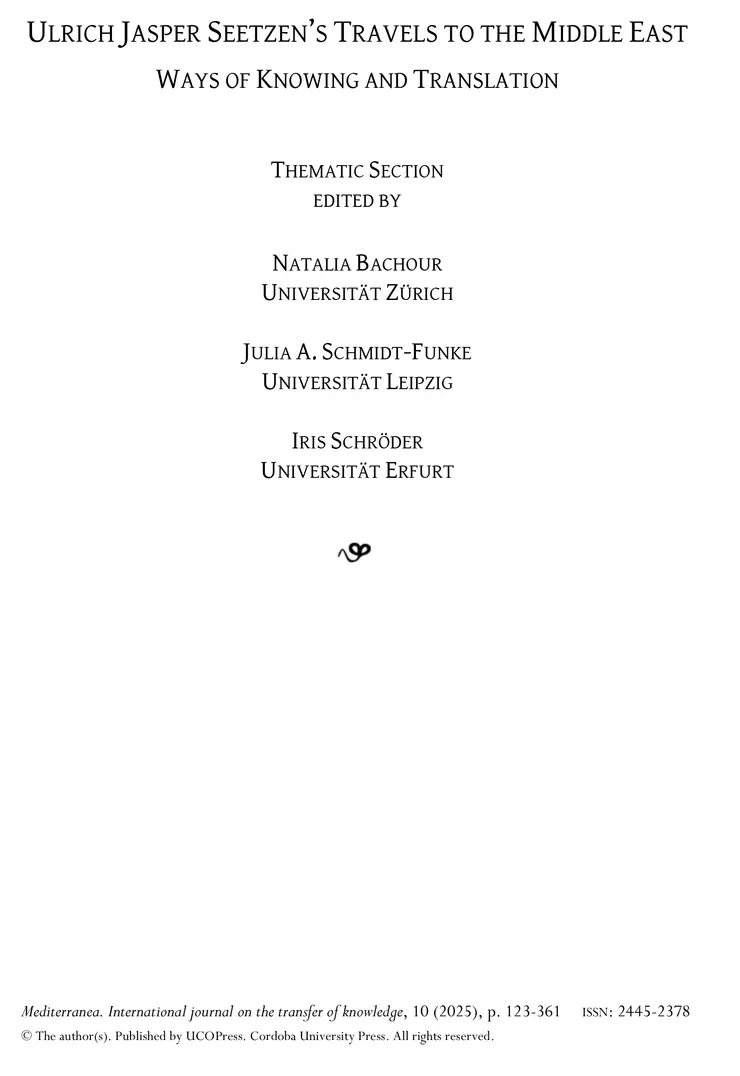
Schröder, Iris/Bachour, Natalia/Schmidt-Funke, Julia (eds.), Thematic Section: Ulrich Jasper Seetzen's Travels to the Middle East: Ways of Knowing and Translation, in: Mediterranea. International Journal on the Transfer of Knowledge 10 (2025), pp. 123-361.
This thematic section explores Ulrich Jasper Seetzen's (1767-1811) travels through the Middle East, framing him as a knowledge broker between Europe and the Ottoman world. Drawing on his diaries and collections, the contributions examine Seetzen's observations of local physicians, religious groups, and cultural practices, as well as his role in collecting manuscripts, artefacts, and linguistic data. By analysing his encounters with Ottoman society - from medical traditions to renegades and Bedouin communities - the articles highlight Seetzen's efforts to document and translate knowledge across cultural boundaries. The section challenges simplistic Orientalist narratives, instead emphasising the complexities of cross-cultural exchange, the limits of European understanding, and Seetzen's position as an intermediary in a transnational network of scholarship. It invites a critical reassessment of how knowledge about the Middle East was produced, circulated, and contested during the early nineteenth century.
This thematic section was published in April 2025 in Mediterranea. International Journal on the Transfer of Knowledge.
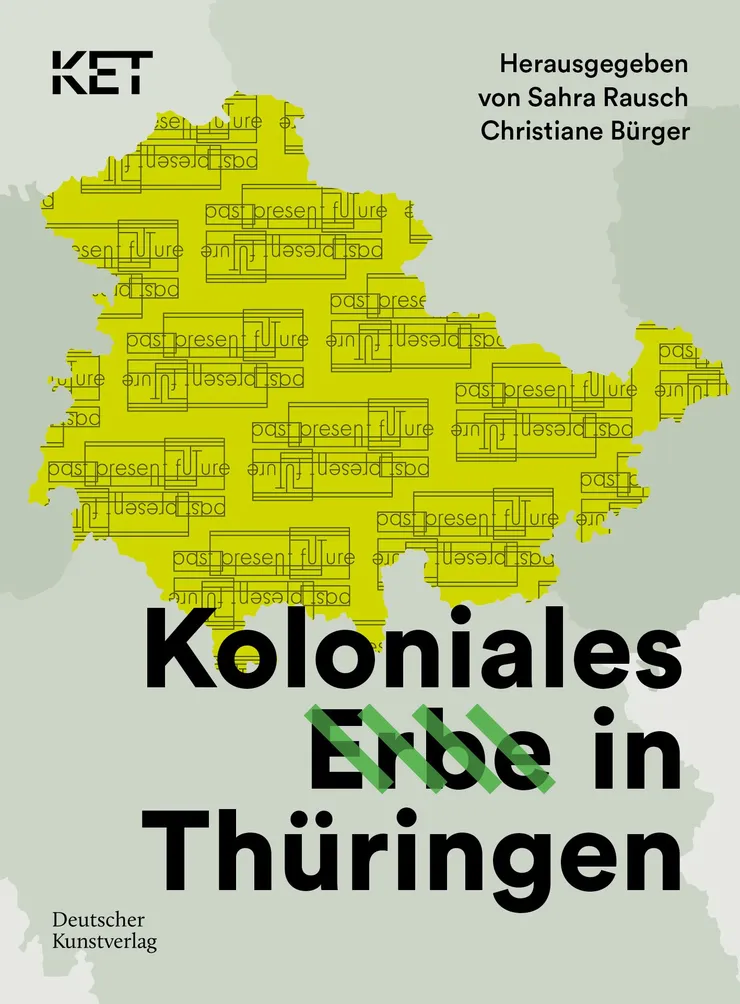
Rausch, Sahra/ Bürger, Christiane (ed.), Koloniales Erbe in Thüringen, Berlin 2025.
The significance of the colonial past for the present is currently moving public debates like hardly any other topic. Increasingly, the regions far away from the metropolises are coming under scrutiny, as the colonial lines of communication reached as far as colonial goods shops in small villages. This anthology examines the traces of the colonial past at a local level and also traces Thuringia's involvement in colonial structures at a global level. The contributions range from the early modern period to the transformational period from 1990 onwards. The book takes stock of current research initiatives at Thuringian universities and also presents the socio-political perspectives of decolonial initiatives and artists. The volume was created in collaboration with the artist Patricia Vester. Her graphic novel and illustrations, designed especially for this publication, provide inspiration for addressing the colonial past in schools and extracurricular activities.
"Koloniales Erbe in Thüringen" will be published in January 2025 by Deutschen Kunstverlag (DKV) in January 2025.
![[Translate to English:] facebook icon](/fileadmin/SocialMediaIcons/iconfinder_06-facebook_white.svg)

![[Translate to English:] instagram icon](/fileadmin/SocialMediaIcons/iconfinder_38-instagram_white.svg)
![[Translate to English:] YouTube icon](/fileadmin/SocialMediaIcons/iconfinder_18-youtube_white.svg)
![[Translate to English:] xing icon](/fileadmin/SocialMediaIcons/iconfinder_xing_white.svg)
