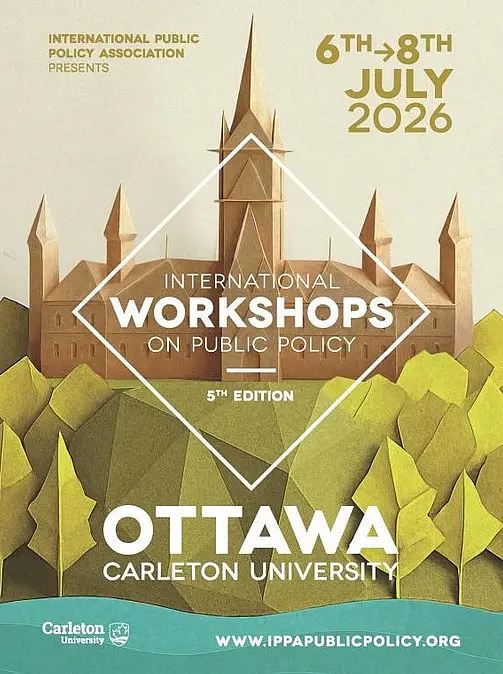
Higher education institutions are no longer merely spaces for transferring knowledge. At the 5th International Workshop on Public Policy (IWPP), organised by the International Public Policy Association (IPPA) at Carleton University, the KLIMA-N collaborative project brought this transformation into the global spotlight – with a three-day panel entitled ‘Governing Sustainability Transitions: Higher Education Institutions as Policy Actors in ESD Implementation’.
The panel were led by Dr Hasnain Bokhari from the Willy Brandt School of Public Policy of the University of Erfurt and adjunct Professor Bettina Hollstein from the Max-Weber-Kolleg, and brought together international scholars to examine how universities translate international sustainability frameworks (such as UN SDG 4.7 and national action plans) into concrete governance and pedagogical practices. The session was organized under the umbrella of KLIMA-N’s Education for Sustainable Development (ESD) sub-project at the Max-Weber-Kolleg, supported by the Federal Ministry of Research, Technology and Space (Bundesministerium für Forschung, Technologie und Raumfahrt). At its core, the panel sought to bridge a critical theoretical gap: while universities are increasingly adopting progressive sustainability initiatives, public policy scholarship has under-theorized how these institutions function as governance actors.
In her paper, Bettina Hollstein examined how higher education institutions (HEIs) serve as organizational blueprints for socio-ecological transformation. Drawing on concrete case research, she applied the Whole Institution Approach (WIA), which embeds sustainability across research, governance, campus operations, curricula, and transfer/community engagement, to map out both the operational barriers HEIs face and practical governance solutions to overcome them. Complementing this institutional focus, Hasnain Bokhari examined direct policy outputs generated by students. Focusing on capstone projects at the Willy Brandt School of Public Policy as a model of service-learning, he demonstrated how student-led, experiential policy research extends beyond campus boundaries and directly enters governmental decision-making processes once delivered to public partners.
Other papers presented during the panel expanded on these themes by exploring how universities navigate sustainability governance across various geographical and operational contexts. Scholars examined the role of Green Offices as strategic intermediaries, showing how these dedicated units translate global commitments into local university strategy while balancing managerial efficiency with transformative learning. Moving to regions facing extreme adversity, another study analyzed Ukrainian public universities to show how HEIs maintain their sustainability mandates during acute socio-economic and security crises, using collaborative partnerships to align financial survival with social reconstruction. Finally, research focusing on the Common Turkic Higher Education Space, including Kazakhstan and Turkey, investigated international policy transfer and evaluated how university-level structures influence national sustainability agendas across borders.
Thuringian Innovation with International Impact
Together, these diverse contributions achieved the panel's central objective. They demonstrated that whether through student capstones, grassroots Green Offices, or crisis-driven adaptation, higher education institutions function as vital multi-level governance hubs that actively shape sustainability outcomes in both the Global North and Global South.
The Ottawa workshop directly mirrors the core mission of KLIMA-N (Netzwerk für mehr Nachhaltigkeit in Thüringen). By taking its findings to the IWPP, the project KLIMA-N demonstrated that regional approaches developed in Thuringia can offer actionable insights for international public policy. As global climate imperatives accelerate, the outcomes of the Ottawa workshop underscore a vital takeaway: universities are essential engines not just for educating future decision-makers, but for prototyping the very public policies that will govern a sustainable future.
You are in the news section of the Willy Brandt School of Public Policy.
Further news, press releases and current topics can be found on the "News" pages of the University of Erfurt.
Willy Brandt School
of Public Policy
at the University of Erfurt
Get to know us

![[Translate to English:] facebook icon](/fileadmin/SocialMediaIcons/iconfinder_06-facebook_white.svg)

![[Translate to English:] instagram icon](/fileadmin/SocialMediaIcons/iconfinder_38-instagram_white.svg)
![[Translate to English:] YouTube icon](/fileadmin/SocialMediaIcons/iconfinder_18-youtube_white.svg)
![[Translate to English:] xing icon](/fileadmin/SocialMediaIcons/iconfinder_xing_white.svg)

University of Erfurt (Campus)
Nordhäuser Str. 63
99089 Erfurt

![[Translate to English:] Facebook Icon](/fileadmin/SocialMediaIcons/iconfinder_06-facebook_104498.svg "Fakebookseite der Staatswissenschaftlichen Fakultät")
![[Translate to English:] Youtube Icon](/fileadmin/SocialMediaIcons/iconfinder_18-youtube_104482.svg)


