
Abbildung: Wien, Österreichische Nationalbibliothek, Cod. Ser. n. 2652, fol. 4v
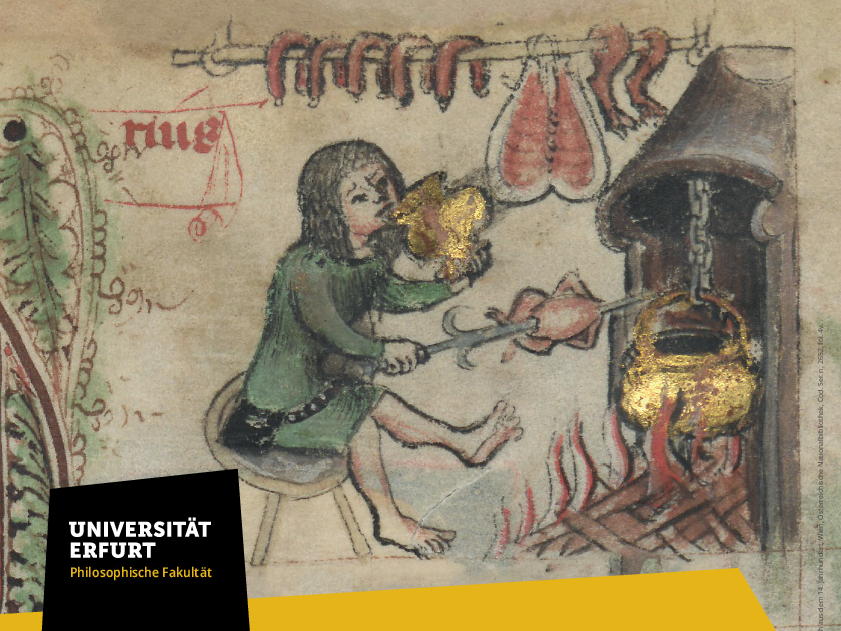
Abbildung: Wien, Österreichische Nationalbibliothek, Cod. Ser. n. 2652, fol. 4v
Research projects relating to nutrition are often labelled as food studies. This is generally understood to mean an analysis of nutrition and its interrelationships in science and society in the past, present and future. In medieval studies, food history is not regarded as an independent sub-discipline, but as part of everyday and environmental history (with close links to social and economic history). Historical studies, and German Studies in particular, have excelled in researching medieval food culture by working out the networks of the transmission of dietary and culinary knowledge and examining the culinary culture of the era itself. Of course, the importance of religion for medieval culinary culture and European identity has also been emphasised. Interdisciplinary approaches, which brought together archaeological and archaeobotanical findings with historical science, were able to sharpen the picture of the food situation in the Middle Ages. Today, digital source corpora such as CoReMA allow the computer-aided analysis of German-language cookery recipes from the Middle Ages.
It is time to bring together different approaches and disciplines and discuss together what constitutes food studies in medieval studies. The conference will therefore discuss examples and approaches that address current research projects and their approaches as well as theoretical and methodological proposals for the delimitation of a pre-modern food history and thus sharpen the concept of food studies.
Please notice: The event will be held in German. Information about the programme can be found in the German version of this page.
If you are interested in participating, please register by 03.11.2025 by e-mail to julia.seeberger@uni-erfurt.de

![[Translate to English:] facebook icon](/fileadmin/SocialMediaIcons/iconfinder_06-facebook_white.svg)

![[Translate to English:] instagram icon](/fileadmin/SocialMediaIcons/iconfinder_38-instagram_white.svg)
![[Translate to English:] YouTube icon](/fileadmin/SocialMediaIcons/iconfinder_18-youtube_white.svg)
![[Translate to English:] xing icon](/fileadmin/SocialMediaIcons/iconfinder_xing_white.svg)

University of Erfurt (Campus)
Nordhäuser Str. 63
99089 Erfurt