Many people in Kahla, Thuringia, still remember the floods of 1994 and 2013. The town on the River Saale is working on its climate adaptation measures and plans, amongst other things, to restore a stream to its natural state. As part of the ‘Empirical Methods’ seminar (Prof. Dr. Cornelia Betsch / Dr. Sabine Best) on the Master’s programme in Health Communication, students divided into four research groups to investigate how people in Kahla and beyond view flooding, flood preparedness and nature-based flood protection.
To this end, the students spoke to members of Kahla Town Council, residents who had themselves been affected by the floods, and farmers. In addition, they carried out nationwide online surveys on the acceptance of renaturation and on why people sometimes prefer to avoid information about flood risks. The results show, amongst other things, that the public broadly supports renaturation overall, regardless of whether it is presented as a climate protection measure or not. Those affected have already invested heavily in their own protection since 2013. Farmers, whose land is often directly affected by renaturation, are more cautious about it and, above all, wish to be involved at an early stage.
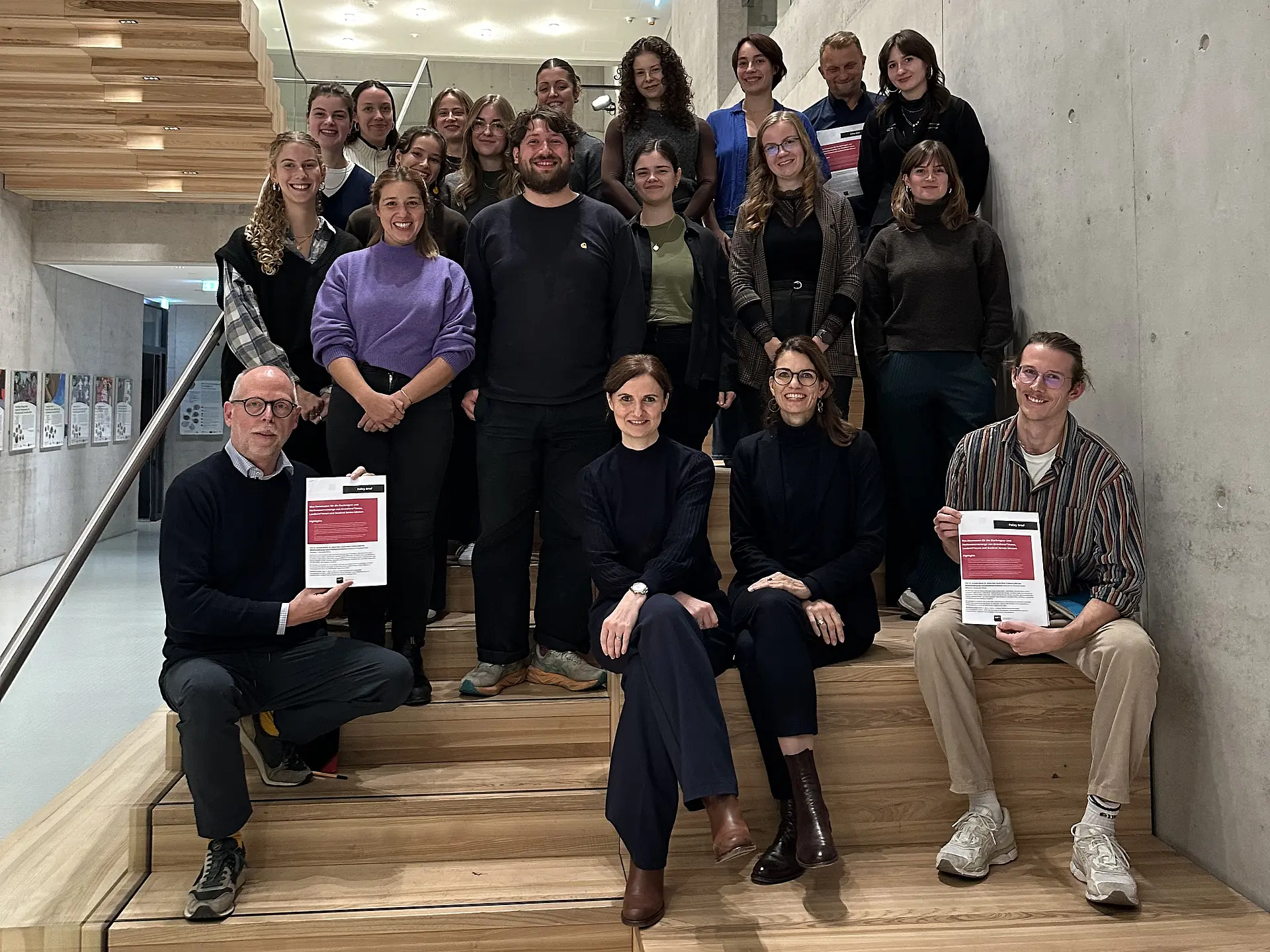
The Master’s students presented the findings at an event on October 26, 2026 at the University of Erfurt, where the Health Communication degree programme also welcomed its new cohort. The policy brief was received by Karsten Schmidt, Climate Adaptation Manager for the town of Kahla, as well as Jan Rosenbaum (town of Kahla), Andreas Jäger and Michel Kuttenkeuler from LEG Thüringen (Action Alliance for City Centres with a Future). The findings are to be incorporated into further planning for climate adaptation in Kahla and into the renaturation project.
We are delighted that our students were able to conduct research on a real-world issue from the region and feed their findings back to where they are needed. We would like to thank the town of Kahla and all participants for their support.
The final version of the policy brief will shortly be made publicly available under the ‘IPB Policy Briefs’ category on the Institute for Planetary Health Behaviour’s website.