With the Treaty of Versailles and the establishment of Poland, the eastern border of Germany underwent significant changes. Politicians and scholars from both the Second Polish Republic and the Weimar Republic questioned these borders and sought to expand their influence. The dissertation project aims to illuminate the overlapping national and imperial rhetorics in their contemporary interconnections, contradictions, and mutual perceptions. By doing so, it seeks to broaden the conventional, nationally-oriented perspectives on German and Polish spatial imaginaries.
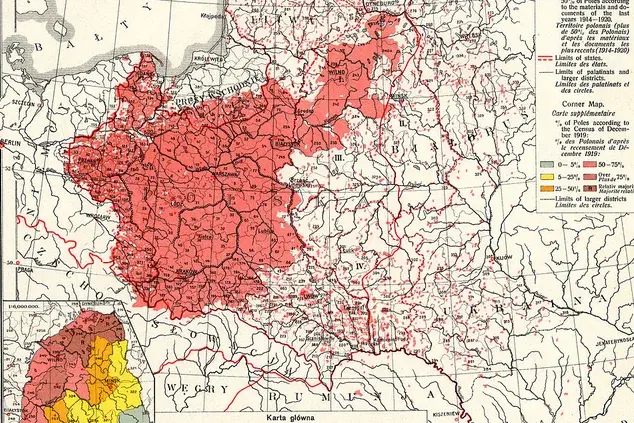
The study investigates how geographers, cartographers, and ethnologists constructed ostensibly homogeneous spaces and popularized them as political statements. The focus is on the production of knowledge related to thematic maps and ethnographic objects by German and Polish publishers, museums, and institutions. Despite their opposing positions, the scientists were not unfamiliar with each other; they had been acquainted since the imperial era and engaged in reciprocal reception within the transnational scientific community.
Image: Plate XI "Polacy B" from the atlas "Geograficzno-Statystyczny Atlas Polski" by Dr Eugenjusz Romer, published in Lwow in 1921. © Wikimedia Commons, Maproom.

![[Translate to English:] facebook icon](/fileadmin/SocialMediaIcons/iconfinder_06-facebook_white.svg)

![[Translate to English:] instagram icon](/fileadmin/SocialMediaIcons/iconfinder_38-instagram_white.svg)
![[Translate to English:] YouTube icon](/fileadmin/SocialMediaIcons/iconfinder_18-youtube_white.svg)
![[Translate to English:] xing icon](/fileadmin/SocialMediaIcons/iconfinder_xing_white.svg)

University of Erfurt (Campus)
Nordhäuser Str. 63
99089 Erfurt