This project analyzed voluntariness during a period of decolonisation, thereby focusing on an often-overlooked political principle of (post) colonial governance By drawing on the example of the British Gold Coast/Ghana, it explores the ways in which voluntary practices shaped the political and social order during the transition from late colonial "indirect rule" to independence. In doing so, the project also explores the changing significance of voluntariness as a norm and resource in this particular period.
It examines the appeal to participate actively as citizens in the making of a new Ghana and a new Africa. In particular, it focuses on changes to employment schemes and the reliance on labour brigades such as the Builder's Brigade in shaping new post-colonial subjects and citizens. These employment schemes were designed to realize important development projects, but also proved instrumental in shaping and disciplining citizens in newly independent Ghana. In this sense, the project explores the way that notions of work and occupation contributed to self-mobilization in a postcolonial regime that claimed to rule for and by the people.
The project investigates the colonial histories of organized forms of voluntary practices, as well as their many linkages with pan-African movements on the one hand, and the many newly founded socialist states on the other, focusing mainly on the German Democratic Republic. While focusing on the close ties between decolonisation and voluntariness, the project makes a significant contribution to the research group's aim of decoupling voluntariness from its generally assumed liberal genealogy in the Western world.
The project draws on governmentality studies by asking how humans are governed by voluntariness, as well as how they are shaped as future political subjects through a means of extrinsic and intrinsic incentives and regulation. It sets out to examine how ideas and practices of management and self-management were implemented in a postcolonial setting. Taking up contemporary studies in social anthropology, the project explores the ways in which voluntariness and work became objects of social scientific inquiry in the 1950s and 60s. Against this backdrop, it investigates whether these studies also contributed to reshaping political practices.
Funding: Deutsche Forschungsgemeinschaft (DFG)
The research project is a sub-project of the research group "Voluntariness".
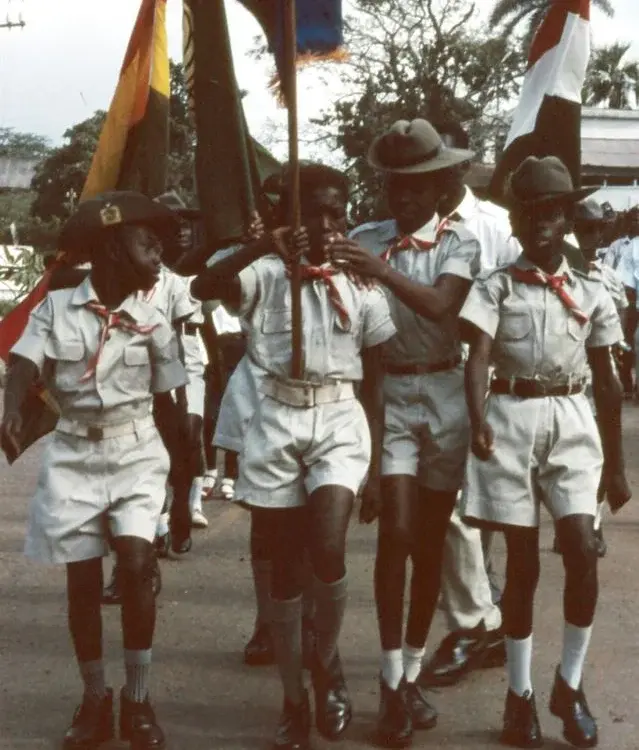
Image: A formation of the "Ghana Young Pioneers" near Aburi/Ghana with both flags, 23 October 1964 © Wikimedia Commons/Wieland Koerbel

![[Translate to English:] facebook icon](/fileadmin/SocialMediaIcons/iconfinder_06-facebook_white.svg)

![[Translate to English:] instagram icon](/fileadmin/SocialMediaIcons/iconfinder_38-instagram_white.svg)
![[Translate to English:] YouTube icon](/fileadmin/SocialMediaIcons/iconfinder_18-youtube_white.svg)
![[Translate to English:] xing icon](/fileadmin/SocialMediaIcons/iconfinder_xing_white.svg)

University of Erfurt (Campus)
Nordhäuser Str. 63
99089 Erfurt