Article 2/4 of the UN Charter prohibits states from taking any aggressive action against the territorial integrity of other states. However, the Security Council, which was actually responsible for punishing violations of this article, was mostly characterised by a mutual blockade during the Cold War. Nevertheless, the principle of territorial integrity proved to be surprisingly effective in the Cold War era. In order to explain this relative stability, the way in which international politics dealt with annexations and secessions is analysed.
The focus of interest is on the role played by the states that gained independence after the Second World War. Decolonisation led to a rapid change in the world of states in the second half of the 20th century. The entry of post-colonial states into international politics led to new majorities and power relations in the United Nations and changed the rules of the Cold War. This focus is intended to contribute to research into the influence of the “Third World” on the international order. So far, interest in this area has focussed primarily on the successful advancement of an anti-imperialist agenda or the unsuccessful demands for a fairer world economic order. The aim of this project is to show that the influence of the post-colonial states went beyond these points and that they also contributed to the consolidation of a system of sovereign states with inviolable borders.
Funding: Fritz Thyssen Foundation(October 2018 to September 2021)
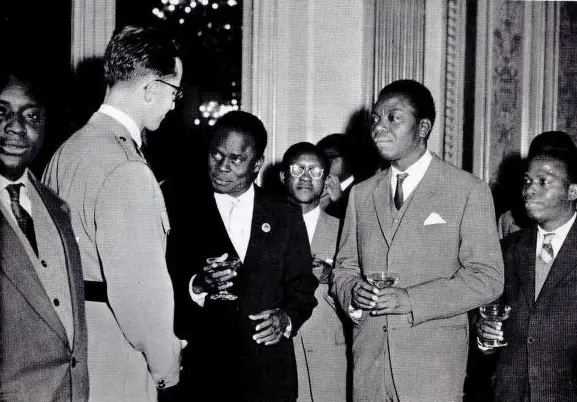
Image: Baudouin I speaking with Moise Tshombe at a reception following the first session of the Belgo-Congolese Round Table.
![[Translate to English:] facebook icon](/fileadmin/SocialMediaIcons/iconfinder_06-facebook_white.svg)

![[Translate to English:] instagram icon](/fileadmin/SocialMediaIcons/iconfinder_38-instagram_white.svg)
![[Translate to English:] YouTube icon](/fileadmin/SocialMediaIcons/iconfinder_18-youtube_white.svg)
![[Translate to English:] xing icon](/fileadmin/SocialMediaIcons/iconfinder_xing_white.svg)

University of Erfurt (Campus)
Nordhäuser Str. 63
99089 Erfurt