
Current Academic Schedule (Winter semester 2025/26)

This page presents an overview of the courses offered within the Master of Public Policy Program in the current/upcoming semester. To achieve your MPP degree, you'll have to complete mandatory courses, elective courses, language courses and participate in a project group (winter semesters only).
Please note that this information is subject to change!
Mandatory courses
All first-year students need to register for and participate in the following courses:
Introduction to Public Policy*
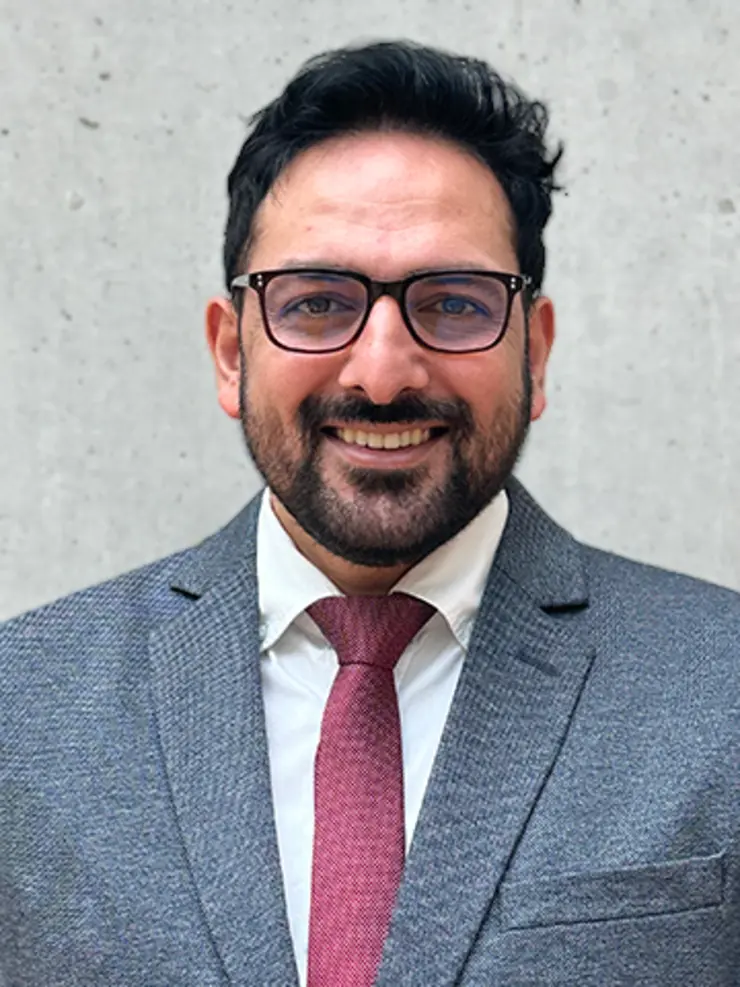
Lecturer: Dr. Hasnain Bokhari
Time (location) : Tuesdays, 12-14h (C07-LG 2 | HS 6)
Module: M Pub 2020 101IPP#01
Moodle: You will be enrolled by us
Course description: This course introduces students to theories, concepts, terms, and methodologies of public policy. It provides an overview on the basic procedures and areas of policy analysis and discusses key incentives and constraints characterizing the policy process. By the end of this course students will be able to perform policy analyses based on a thorough knowledge and understanding of key theoretical approaches and policy debates. They will be familiar with pluralist and rational choice-based approaches to the study of public policy; have acquired the analytical tools to analyze actors and their strategic behavior in the policy process; and have gained some experience in analyzing the policy process from the inception of a new public policy issue to its implementation and review.
Further details about this course can be found here.
Academic Writing for Public Policy*

Lecturer: Almut Mohr
Time (location):
- Thu, October 23, 14-19h (C18-LG 4 | 03.03)
- Fri, October 24, 10-16h (C18-LG 4 | 03.03)
- Thu, October 30, 14-18h (C18-LG 4 | 03.03)
- Sat, November 15, 10-15h (Bad Sulza; details t.b.a)
- Thu, November 20, 14-19h (C18-LG 4 | 03.03) - Group A only
- Fri, November 21, 10-16h (C18-LG 4 | 03.03) - Group B only
- Thu, December 4, 14-19h (C18-LG 4 | 03.03) - Group B only
- Fri, December 5, 10-16h (C18-LG 4 | 03.03) - Group A only
Module: M Pub 2020 101IPP#02
Moodle: You will be enrolled by us
Course description: This workshop is part of the “Introduction to Public Policy” module and it is mandatory for all first-year students of the Master of Public Policy at the Willy Brandt School of Public Policy. The main goal of this workshop is learning how to write professional public policy and academic texts. By the end of the course, students will be able to identify and select different text genres, improve their critical reading skills, develop their own writing process from the formulation of ideas to the completion of a final draft, efficiently conduct literature reviews, and prepare effective presentations for different audiences. Over the course, special attention will be given to useful tools and the standards of academic publication, such as proper reference citation. Students are expected to actively participate in class and submit the coursework in time to pass the course.
Further details about this course can be found here.
Economic Policy Analysis*

Lecturer: Evans Tindana Awuni, PhD
Time (location): Wednesdays, 10-12h (C18-LG 4 | 03.03)
Module: M Pub 2020 102EPA#01
Moodle: You will be enrolled by us
Course description: The objective of this course is to provide students with the economic tools to conduct policy analysis. Rather than presenting Economics as a scientific mathematical field of study, students are encouraged to see Economics like a new language that policy professionals must speak. Having said that, the course then deals with the basic grammar of Economics, such supply and demand and the way markets work in the real world. Policies then are analyzed by the effects they have on the markets, identifying winners and losers. Here Economics interacts with politics, interest groups, lobby, regulation and so on. That is, students should not look only at the economic aspects of the phenomena studied, but within the context of a country or region where people lived. Moreover, students of public policy also need to be able critically assess the limits of an economic perspective.
Important note: Depending on their previous knowledge of Economics, students choose one out of two lectures, "Economic Policy Analysis" or "Microeconomics I: Game Theory", and complete a module examination.
Further details about this course can be found here.
Microeconomics I: Game Theory*

Lecturer: Prof. Dr. Manfred Königstein
Time (location): Wednesdays, 12-14h (Online)
Tutorial (location): Thursdays, 08-10h (Online)
Module: M Pub 2020 102 EPA#01
Moodle: Please use the University's enrolment key
Course description: (Lecture + Exercise) The course conrpises a lexture and exercise sessions.The lecture introduces the basic concepts of non-cooperative game theory using examples and applications from the fields of economics, political and social sciences. Students should have a basic background in mathematics and statistics.
Important note: Depending on their previous knowledge of Economics, students choose one out of two lectures, "Economic Policy Analysis" or "Microeconomics I: Game Theory", and complete a module examination.
Further details about this course can be found here.
Public Administration and Finance*

Lecturer: Prof. Dr. Achim Kemmerling
Time (location): Mondays, 10-12h (C18-LG 4 | 03.03)
Module: M Pub 2020 103PAF#01
Moodle: You will be enrolled by us
Course description: The objectives of this course are to provide students with: (a) the analytical tools to analyze the public finances of governments: revenues, expenditures, ways to finance deficits and the institutions involved; and (b) a normative framework to conduct political analysis of the difficult financial decisions governments need to take. The course will use a combination of lectures, Harvard cases and an Oxford-style debate in order to learn about standard economic theory, apply it in real life situations, and simulate a public debate where students will play the role of financial ministers making budgetary decisions. Students are encouraged to review the financial situation of their own countries and to learn from the EU experience in class. Special focus will be given to the current financial crisis.
Further details about this course can be found here.
All second-year students need to register for and participate in the following courses:
Advanced Methods*
Lecturer: Prof. Dr. Achim Kemmerling
Time (location) : Mondays, 14-16h (in C19.00.02-03; on Oct. 27 and Jan. 26 in C18-LG 4 | 03.03)
Module: M Pub 2020 301 AM#01
Moodle: You will be enrolled by us
Course description: Both in academic and policy research, questions of research design and methodology are fundamental starting points. Without a proper research design (i.e. linking the theoretical-conceptual part of the research with empirical research) a lot of data collections end-up being difficult or impossible to use. Without a proper methodology (i.e. the art of choosing the right method) a lot of questions cannot be answered or are answered the wrong way. This course gives a practical overview over research design and methodology, and it will allow students to develop their thesis proposal along the way. We will revisit important questions of research design (research question, theory, hypotheses, concepts, literature reviews). The course will also briefly introduce different (qualitative and quantitative) methods used for policy analysis (ranging from case studies to large N analysis).
Further details about this course can be found here.
Ethics in the Public Sector*

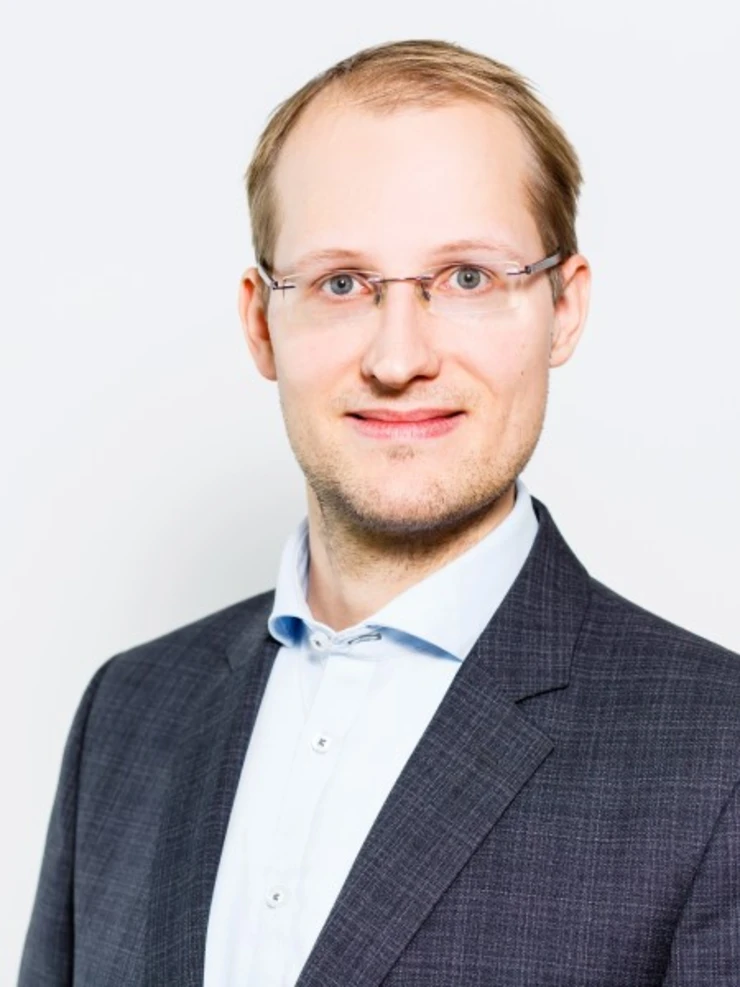
Lecturer: Markus Pins & Justus Lenz
Time (location) :
- Thursday, October 16 from 14-19h (C07-LG 2 | 123)
- Thursday, November 13 from 14-19h (C07-LG 2 | 123)
- Thursday, November 27 from 14-19h (C07-LG 2 | 123)
- Thursday, December 11 from 14-19h (C07-LG 2 | 123)
- Thursday, Jaunary 22 from 14-19h (C07-LG 2 | 123)
Module: M Pub 2020 302 EPS#01
Moodle: You will be enrolled by us
Course description: Politics is supposed to provide public goods. The very structure of these specific goods combined with individual interest in their consumption requires institutions which we conventionally term political and which are controlled by the struggle for power. But is there more to politics? Are there any specific ethical or moral constraints on politics? Do people have particular moral expectations when it comes to politics? The seminar discusses a set of modern attempts to answer these questions. It analyses the scope of these problems and it ventures a new perspective: the perspective of moral goods.
Further details about this course can be found here.
Project Groups
All second-year students need to register for and participate in one of the project groups:
Open Data Strategy for Thuringia
Lecturer: Dr. Hasnain Bokhari
Time (location): Mondays, 10-12h (C19.03.39)
Module: M Pub 2020 402PTII#01
Moodle: Please use Brandt School's enrolment key
Course description: The accelerating pace of artificial intelligence and digital transformation has positioned open data as a cornerstone of evidence-based policy development. In this context, public administration plays crucial role in the development of open data. Public sector agencies collect large amounts of data within the existing legal framework and thereby have a huge data pool at their disposal. Within the context of European Union, according to the EU’s directive on open data and the reuse of public sector information (Directive (EU) 2019/1024), data is considered “open” if it “can be freely used, re-used and shared by anyone for any purpose”. This capstone project invites MPP students to formulate policy recommendations for Digitalagentur Thüringen GmbH for Thuringia on how to become a “data sharing state,” based on analyses of regulatory frameworks, strategic positioning, and technical infrastructure, drawing on best practices from other federal states and countries to ensure compatibility with EU data portals and GovData. Digitalagentur Thüringen GmbH (DAT) is based in Erfurt and serves as a strategic advisor to the State of Thuringia, providing expert guidance to ministries and public authorities across several key areas in the digitalisation sector.
Further details about this course can be found here.
Measure2Transform: Designing an Impact Measurement Framework for the Melton Foundation’s Global Solvers Accelerator

Lecturer: Prof. Dr. Heike Grimm
Time (location) : Wednesdays, 14-16h (C19.03.39)
Module: M Pub 2020 402PTII#01
Moodle: Please use Brandt School's enrolment key
Course description: The Melton Foundation has long been committed to fostering global citizenship, social innovation, and meaningful collaboration across cultures and world regions. At the heart of its mission lies the belief that deep and lasting impact is not limited to individual growth or project success, but rather emerges through an intentional combination of transformation at three levels: the personal, the project-based, and the collective.
This capstone assignment invites you to engage critically and creatively with this transformative ambition. Drawing on real-world data from the Foundation's activities. By including curriculum material, project documentation, cohort feedback, and participant journeys, you will assess how the Melton Fellowship program fosters long-term impact, and how this impact can be better measured, sustained, and communicated.
The central challenge is to move beyond short-term outputs and explore how to hone and deepen the program's transformative potential over time. What markers of transformation can be identified at the personal level (in terms of mindset, leadership style, civic engagement, etc.)? How do participants' social innovation projects evolve beyond the program context? And how do the relationships within and across cohorts contribute to building a resilient, collaborative, and values-driven community?
Further details about this course can be found here.
Pathways to Peace and Resilience in the Arctic: Nordic Strategies Amid Climate and Geopolitical Disruptions

Lecturer: Alejandra Ortiz-Ayala, PhD
Time (location): Mondays, 12-14h (C19.03.39)
Module: M Pub 2020 402PTII#01
Moodle: Please use Brandt School's enrolment key
Course description: This project group offers students an opportunity to work with the Eurasia Group on a cutting-edge policy challenge at the intersection of climate change, Arctic geopolitics and energy resilience. Students will produce a policy brief using professional intelligence analysis techniques developed by the Eurasia Group, conduct stakeholder interviews and explore how Arctic and near-Arctic states respond to supply risks, security tensions and emerging trade dynamics. The course is ideal for those interested in international security, geopolitics, energy policy, climate diplmoacy and peacebuilding.
Further details about this course can be found here.
Academic Freedom at Risk: Empirical Insights and Best-Practice Guidelines for the Social Sciences

Lecturer: Prof. Dr. Mariana Llanos
Time (location): Mondays, 16-18h (C03-LG 1 | 214)
Module: M Pub 2020 402PTII#01
Moodle: Please use Brandt School's enrolment key
Course description: Scholars and higher education institutions are facing increasing threats around the world. The 2024 report Free to Think (July 2023–June 2024) documented 391 attacks in 51 countries and territories. These not only included major attacks, such as the intentional destruction of higher education infrastructure during armed conflicts, but also the suppression of dissent, arrests, the passing of new illiberal laws, restrictions on university autonomy, acts of intimidation and violent attacks against individuals. Authoritarian regimes in Russia, China, Iran, and Nicaragua have intensified repression of scholars and academics who criticize government policies. But academic freedom is also under threat in some democracies, where criticism of certain governments has led to job losses, canceled events, or lecture bans. Remarkably, in the United States, the Trump administration’s policies—including funding cuts to agencies like NSF and NIH, politicization of grants, and suppression of research in fields like climate change—have driven many scholars to initiate protests and resistance actions, and even to seek “scientific asylum” in other places, such as Canada or France.
What about Europe? The existing indices and monitors of academic freedom and academic literature suggest that there are legitimate concerns about the state of academic freedom in this region as well, even in established democracies like Germany. Broader preoccupations include the increasing influence of populist politics and societal polarization, which are impacting research-based knowledge and scholarly independence, and potentially compromising institutional autonomy and the scientists’ integrity. Also, increased budgetary pressure and financial cuts seem to be affecting the fair distribution of third-party grants, university autonomy, and increasing job precariousness.
There are several projects analysing and collecting data on this problem (see links below). However, this is an incipient field of research on a changing global political scenario. Thus, more information is needed, for example, to catalogue different and emerging forms of scholars’ harassment and intimidation. Better information would allow us to develop better policies to protect the scientific community. In addition, we still lack a common understanding within academia, research and teaching institutions, and society, of what academic freedom is, why it is important, and how we would protect it.
Further details about this course can be found here.
Navigating Expectations in the Migration Journey of Care Workers
Lecturer: Prof. Dr. Achim Kemmerling
Time (location): Mondays, 16-18h (C19.03.39)
Module: M Pub 2020 402PTII#01
Moodle: Please use Brandt School's enrolment key
Course description: Germany's elderly care sector faces a severage shortage with projections estimating a need for around 140,000 additional caregivers by 2030 and up to half a million by the mid´-2030s. Thuringia, where more than the three-quarters of healthcare vacancies remain unfilled for over a year, is particularly affected. While international recruitment has been promoted in the last years, the migration of care workers remains complicated by political, legal and economic barriers. Bilateral agreements often fail to protect workers and intermediaries frequently prioritize profit over worker welfare, leading to precarious conditions. This project, in collabroation with Dr. Pau Palop-García from the German Center for Integration and Migration Research (DeZIM Institute), examines evidence from different sending countries and the lied experiences of migrant care workers in Germany with a focus on Thuringia. The goal of the project is to develop solutions that support prospective migrants and employers in navigating the expectations shaped by programs designed to facilitate the migration of care workers. Students will learn to design and manage a consultancy-style project, engage with key stakeholders and contribute to developing more sustainable and humane policy solutions in one of Germany's most pressing social challenges.
Further details about this course can be found here.
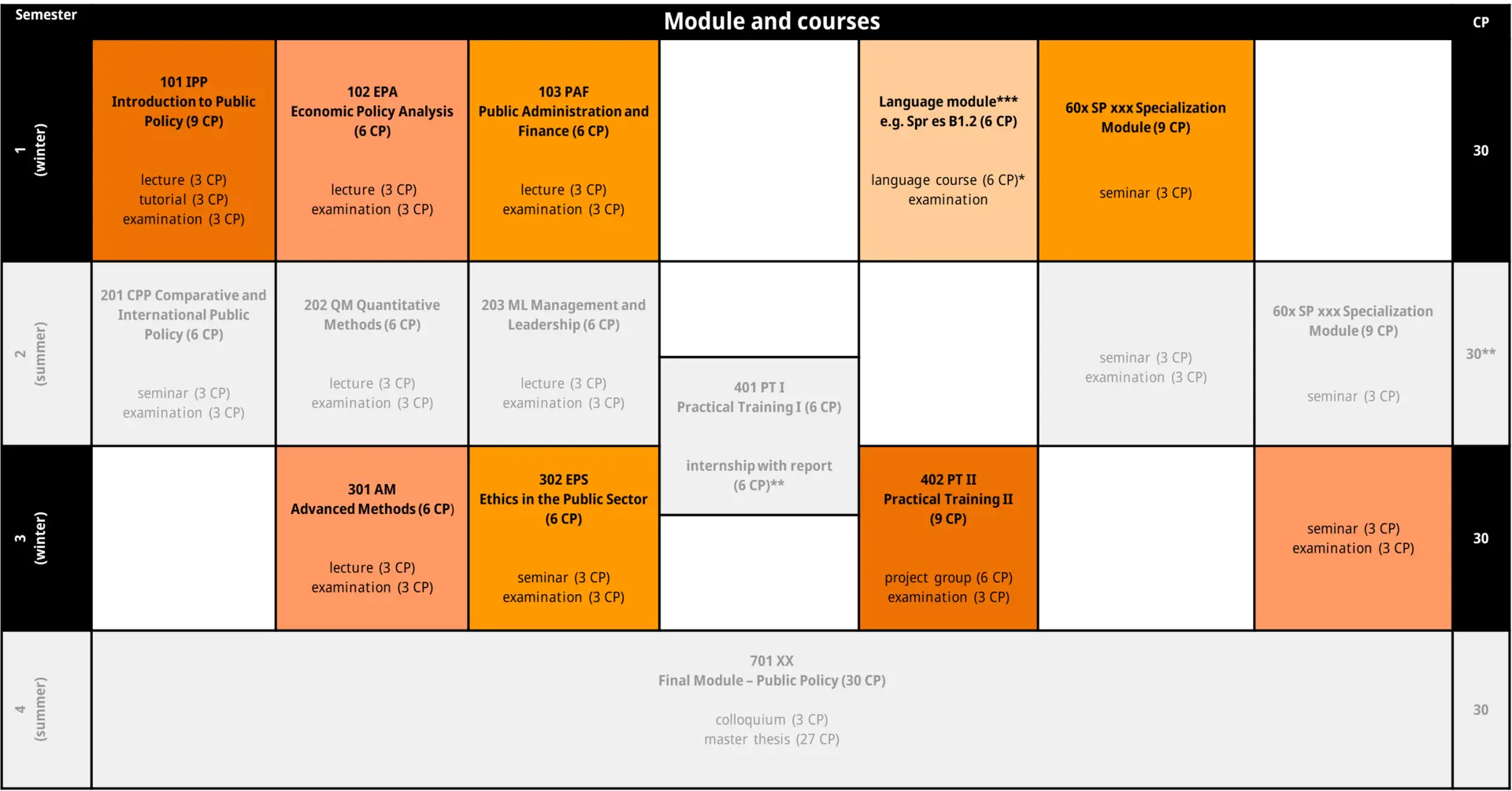
Master of Public Policy Model Study Plan (winter semesters highlighted)
Practical Training
Internship
The Public Policy degree program (MPP) includes a mandatory internship as one requirement for completing the degree.
- Primary purposes of the internship are the opportunity to apply the knowledge and skills from the classroom in a work setting, to give students a practical perspective on policy analysis and public management and to help them compare their abilities and interests with requirements in particular fields of public policy.
- Internships may be conducted in government agencies, international organizations, NGOs, or other non-profit or for-profit organizations. The job description must show that the work assigned to the intern will be relevant to public policy analysis and/or management.
- Internships must comprise at least 180 hours, 5 of which may be used for writing the internship report. Typically, the internship will be conducted during the summer break between the second and the third semester (mid-July to mid-October). The hosting agency must name an individual person, responsible for supervising the intern and for communicating with the Brandt School if needed. In order to receive credits for their internship, students have to submit an internship report of 4-5 pages via moodle, no later than 30 days after the last day of the internship.
For further information, please consult the internship regulations on Moodle and contact the Brandt School’s internship coordinator Florian Heintze (florian.heintze@uni-erfurt.de).
Language Training
Your study rules (“Studien- und Prüfungsordnung”) require that, during your studies, you collect a total of 6 credits and a grade in the language module.
- This means that you can either take one course with 6 credits, or two courses with 3 credits each (3+3=6). Should you decide to take two courses, these must be conducted in the same language, advancing you (at least) one proficiency level in one language.
- Either way, you will have to do one module exam, providing you with a grade. You may take more courses in the language module, if you like.
Students with no or little knowledge of German take German classes up until level A2.1 (CEFR)
Students who are not yet proficient in German (level “A2”) must take the German language module. Therefore, the Brandt School offers special German beginners' classes for international MPP students.

Lecturer: Tomiwa Japhet Adeyemo
Time (location): Mondays, Thursdays & Fridays 8-10h (C03-LG 1 | 135)
First Session on Thursday, October 16 at 8am.
Module: ZS ENi 2020 SprdeA1#02
Moodle: You will be enrolled by us
Course description: As per the study and exam regulations (M Pub 2020, section 5, paragraph 3), Master of Public Policy students need to complete the language module in German, reaching at least proficiency level “A2” as one requirement for graduation. These courses, offered specifically for Brandt School students, are the major offer to get you there. After “A1” in winter semesters, “A2” is offered in summer semesters. Course content: Grammar, vocabulary, conversation for beginners.
Further details about this course can be found here.
Students with A2 or higher-level knowledge of German
… continue improving their German language skills (if applicable)
… or opt for another foreign language on offer (e.g. Arabic, Chinese, English, French, Russian, Spanish), offered by the University’s Language Center (Sprachenzentrum). The list of offers is on their website or on E.L.V.I.S. (Summer Semester 25 > (ZS) > ZS Acquisition of a langue level 2020).
Important notes
- Please check for schedule clashes with (mandatory) MPP courses, before signing up for a particular class (see sign-up procedure)!
- Some classes require a placement test beforehand; for the test dates see here.
In addition to courses, the Language Center also offers proficiency exams (Niveaustufenprüfungen) in several languages that you can take (regardless of whether you have taken a course or not) at the end of the lecture period, providing you with a certificate of your level. For current information, please check the Language Center’s websites for the respective languages.
Elective courses (Specializations)
Currently, Brandt School is offering four specializations, based on the research areas of our core academic staff.
- Out of the four specializations offered, you will need to have completed two at the end of your study period
- To complete a specialization, you need to visit two seminars and do one module exam in one of the courses visited
- You may do more seminars, but mind the workload
- While we cannot guarantee that a course will be offered again in future, we can say whether it was offered before. Courses that have been taught in the previous winter semester are marked with one asterisk (*). Courses that have been taught in an earlier semester are marked with two asterisks (**). New courses are marked with three asterisks (***).
Non-Profit Management and Entrepreneurship
Understanding Corruption and Promoting Anti-Corruption Efforts*
Lecturer: Prof. Dr. Heike Grimm
Time (location): Thursdays (B-week), 10-14h (C03-LG 1 | 104)
Module: M Pub 2020 601SPNPM#02
Moodle: Please use Brandt School's enrolment key
Course description: Corruption represents a complex and pervasive phenomenon, posing considerable challenges to governance, economies, and societies across the globe. The objective of this Spring School is to provide Master of Public Policy (MPP) students with a comprehensive understanding of the multifaceted nature of corruption, exploring a broad spectrum of anti-corruption strategies and their impacts. By examining the full range of theoretical and practical approaches, students will gain a deeper insight into the origins and consequences of corruption and its critical relationship with sustainable development. The course features guest speakers who are experts in the field, offering a range of perspectives and insights into the roles and effectiveness of anti-corruption agencies (ACAs) and civil society organisations (CSOs) in practice. Furthermore, students will be afforded the opportunity to present their own research and ideas, thereby fostering a collaborative learning environment. The course will facilitate theoretical discussions and practical analyses aimed at exploring the impact of corruption on democratic institutions, economic stability, and the achievement of development goals. Furthermore, the course will provide students with the practical skills necessary for the design, implementation, and evaluation of anti-corruption campaigns. Through interactive discussions and hands-on exercises, students will gain the tools required to address real-world challenges and contribute to more transparent, accountable, and resilient societies. By the conclusion of the course, participants will be equipped with the ability to critically assess anti-corruption frameworks and develop innovative solutions as researchers and advocates in combating corruption effectively.
Further details about this course can be found here.
Social Entrepreneurship*
Lecturer: Prof. Dr. Heike Grimm
Time (location): Thursdays (A-week), 10-14h (C03-LG 1 | 104)
Module: M Pub 2020 601SPNPM#02
Moodle: Please use Brandt School's enrolment key
Course description: Social entrepreneurs are entrepreneurs with a social mission; the generation of profits is not the primary goal of the social entrepreneur. Reversed, this does not mean that the social entrepreneur considers the generating of income as being of no value or interest. The social entrepreneur differs fundamentally from the traditional, purely altruistically acting philanthropist because generating income for the financial security of a socially motivated project is regarded as an important means to an end. Because the field of social entrepreneurship is interdisciplinary and in its infancy, the course will be introductory putting emphasis on developing practical skills. We will develop a better understanding of the meaning and various forms of social entrepreneurship through lectures, case studies, and working on a selfdesigned project. Students will be expected to develop a business model canvas for a (fictional) social enterprise. At the end of the course, students can expect to have gained an understanding of the field of social entrepreneurship and to have grasped many of the opportunities, challenges, and issues facing social entrepreneurs. By developing a business model canvas for an own (fictional) social enterprise, students will gain a thorough understanding on how to apply new knowledge into practice.
Further details about this course can be found here.
International and Global Public Policy
Big Tech and Platform Policy***

Lecturer: Viddy Ranawijaya
Time (location):
- Tuesdays, 16-18h (C03-LG 1 | 102)
- Tuesday, October 14, 16-18h (online)
- Friday, November 28, 10-12 (C07-LG 2 | 112)
- Friday, December 12, 10-12 (C07-LG 2 | 112)
Module: M Pub 2020 602 SP GPP#02 / M Pub 2020 603 SP SEP#02
Moodle: Please use Brandt School's enrolment key
Course description: Digitalization and technological advancement have profoundly reshaped people’s lives. While Big Tech companies promise that their innovations will enhance efficiency and provide valuable assistance to human life, these developments have not come without risks. Critical questions emerge from the business models of platforms such as ride-hailing apps (like Uber or Grab), which often deny workers access to basic rights such as social security. Meanwhile, the rise of surveillance capitalism allows tech companies to extract and monetise without consent or adequate accountability freely. This course examines the political economy of Big Tech’s innovation race and the ways public policy can mitigate the social, economic, and democratic consequences of digital transformation. Throughout the course, we will explore practical policy responses and case studies from highly industrialised economies and the Global South. Key domains include platform (tech companies) governance, data protection and surveillance, intellectual property, digital labour and employment, entrepreneurship, and the environmental sustainability of tech infrastructure. The course will involve in-person sessions on Tuesdays, 4.11.2025 - 3.2.2026 at 16:00 - 18:00 (excluding Christmas break 23.12. & 30.12.2025), two extra sessions on Fridays (28.11. & 12.12.2025 at 10:00 - 12:00), and one online introductory session (14.10.2025 at 16:00 - 18:00, https://uni-erfurt.webex.com/meet/viddy.ranawijaya). Students can take this class for passing only (3 credits, presence and presentation) or additional graded credits (extra 3 credits) with a paper assignment.
Further details about this course can be found here.
Changing Dynamics of Conflict and Security in the Middle East***

Lecturer: Nagapushpa Devendra
Time (location) : Tuesdays, 14-16h (C03-LG 1 | 333)
Module: M Pub 2020 602 SP GPP#02 / M Pub 2020 604 SP CSM#02
Moodle: Please use Brandt School's enrolment key
Course description: This course explores the evolving landscape of conflict and security in the Middle East, analyzing the historical roots, contemporary challenges, and future trajectories of regional stability. It examines key conflicts, including the Arab-Israeli dispute, the Iran-Saudi rivalry, the Syrian and Yemeni civil wars, and the role of non-state actors such as Hezbollah, Hamas, and ISIS. The course also assesses the influence of global powers—including the United States, Russia, and China—on Middle Eastern security, alongside the shifting alliances and emerging regional security frameworks.Key themes include the impact of sectarianism, proxy wars, energy geopolitics, and arms proliferation, as well as cybersecurity, drone warfare, and artificial intelligence in modern conflicts. The course integrates qualitative and quantitative methodologies to provide a comprehensive understanding of how security threats in the Middle East have transformed over time and how regional and international actors shape the strategic environment. Students will engage in critical discussions, case studies, and policy analysis to assess the challenges and opportunities for achieving long-term peace and stability in the region.
Further details about this course can be found here.
Development and Socio-Economic Policies
Financial Crises, Theory, Empirics and History*

Lecturer: Prof. Dr. Dominik Maltritz
Time (location) : Thursdays, 12-14h (C07-LG 2 | 115)
Module: M Pub 2020 603 SP SEP#02
Moodle: Please use the University's enrolment key
Course description: The course considers the various aspects of Financial Crises with a special focus of Crisis in developing countries. We consider different aspects: Description of observed crises Theoretical models of crises Empirical work on crises, esp. causes and forecasting.
Further details about this course can be found here.
Political Economy of Development*
Lecturer: Evans Awuni Tindana, PhD
Time (location) : Tuesdays, 16-18h (C03-LG 1 | 215)
Module: M Pub 2020 603 SP SEP#02
Moodle: Please use Brandt School's enrolment key
Course description: Intriguing scholarly debates surround the various strategies that propel development even as the terminology of development itself remain inherently ambiguous, complex and theoretically contentious. Beyond conceptualization and theoretical perspectives this seminar examines classic topics and critically evaluates development strategies from a political economy perspective. Why are there vast development gaps within and among countries? What role do the strategies adopted by countries play in their progress or tragedy? How do different political actors influence development decisions? In this seminar, we examine specific propositions, paying particular attention to the advantages and trade-offs of various development strategies and programs. Among other topics, we delve deeper into strategies to promote agriculture, industry, trade, financial market access, foreign direct investments, as well as the role of government, the private sector, non-governmental organisations (NGOs), and political institutions in both local and international context. We draw from some of the most vigorous debates from leading scholars and practitioners and traverse essential themes that provide insights into the core strategies, policies and practices employed to promote development domestically and internationally, principally in the global south.
Further details about this course can be found here.
Big Tech and Platform Policy***
Lecturer: Viddy Ranawijaya
Time (location):
- Tuesdays, 16-18h (C03-LG 1 | 102)
- Tuesday, October 14, 16-18h (online)
- Friday, November 28, 10-12 (C07-LG 2 | 112)
- Friday, December 12, 10-12 (C07-LG 2 | 112)
Module: M Pub 2020 603 SP SEP#02 /M Pub 2020 602 SP GPP#02
Moodle: Please use Brandt School's enrolment key
Course description: Digitalization and technological advancement have profoundly reshaped people’s lives. While Big Tech companies promise that their innovations will enhance efficiency and provide valuable assistance to human life, these developments have not come without risks. Critical questions emerge from the business models of platforms such as ride-hailing apps (like Uber or Grab), which often deny workers access to basic rights such as social security. Meanwhile, the rise of surveillance capitalism allows tech companies to extract and monetise without consent or adequate accountability freely. This course examines the political economy of Big Tech’s innovation race and the ways public policy can mitigate the social, economic, and democratic consequences of digital transformation. Throughout the course, we will explore practical policy responses and case studies from highly industrialised economies and the Global South. Key domains include platform (tech companies) governance, data protection and surveillance, intellectual property, digital labour and employment, entrepreneurship, and the environmental sustainability of tech infrastructure. The course will involve in-person sessions on Tuesdays, 4.11.2025 - 3.2.2026 at 16:00 - 18:00 (excluding Christmas break 23.12. & 30.12.2025), two extra sessions on Fridays (28.11. & 12.12.2025 at 10:00 - 12:00), and one online introductory session (14.10.2025 at 16:00 - 18:00, https://uni-erfurt.webex.com/meet/viddy.ranawijaya). Students can take this class for passing only (3 credits, presence and presentation) or additional graded credits (extra 3 credits) with a paper assignment.
Further details about this course can be found here.
Conflict Studies and Management
Postcolonial Perspectives on Development, Peace, and Conflict: Democracy and Civil Society in Action***
Lecturer: Alejandra Ortiz-Ayala, PhD
Time (location) : Wednesdays, 8-10h
This course takes place on the campus of “Fachhochschule Erfurt” (University of Applied Sciences) at Altonaer Straße 25, 99085 Erfurt
Room: A-04 4.E.02 (A25)
Module: M Pub 2020 604 SP CSM#02
Moodle: Please use Brandt School's enrolment key
Course description: This intensive winter course explores postcolonial critiques of peacebuilding, development, and democratization through the lense of in-depth case studies from the Middle East, North Africa, Central America, and South America. Students will engage with critical debates on the role of international interventions in state-building and democratic consolidation, examining the influence of international organizations, foreign aid, and civil society actors with a specific focus on the effects on the practice of humanitarian aid work on the ground. Key questions include: Why is it so difficult to overcome cycles of violence, inequality, and authoritarianism? What are the limits and contradictions of external support for peace and democracy? What are the answers given to these challenges from international professions like humanitarian aid work, international social work and international development? The MA course is designed as a collaborative, experiential learning environment that brings together international students from the Willy Brandt School and students of Master of Arts in International Social Work from the Fachhochschule Erfurt. This unique joint course offers a valuable opportunity for intercultural exchange and mutual learning, fostering critical engagement with contemporary global challenges and the complexities of local and international actors involved in peace and development processes.
Further details about this course can be found here.
Changing dynamics of Conflict and Security in the Middle East***
Lecturer: Nagapushpa Devendra
Time (location) : Tuesdays, 14-16h (C03-LG 1 | 333)
Module: M Pub 2020 604 SP CSM#02
Moodle: Please use the University's enrolment key
Course description: This course explores the evolving landscape of conflict and security in the Middle East, analyzing the historical roots, contemporary challenges, and future trajectories of regional stability. It examines key conflicts, including the Arab-Israeli dispute, the Iran-Saudi rivalry, the Syrian and Yemeni civil wars, and the role of non-state actors such as Hezbollah, Hamas, and ISIS. The course also assesses the influence of global powers—including the United States, Russia, and China—on Middle Eastern security, alongside the shifting alliances and emerging regional security frameworks.Key themes include the impact of sectarianism, proxy wars, energy geopolitics, and arms proliferation, as well as cybersecurity, drone warfare, and artificial intelligence in modern conflicts. The course integrates qualitative and quantitative methodologies to provide a comprehensive understanding of how security threats in the Middle East have transformed over time and how regional and international actors shape the strategic environment. Students will engage in critical discussions, case studies, and policy analysis to assess the challenges and opportunities for achieving long-term peace and stability in the region.
Further details about this course can be found here.
Cross-Specializations
Introduction to data analytics with R and generative AI***
Lecturer: Dr. Hasnain Bokhari
Time (location): Wednesday, 16-18h (C03-LG 1 | 219)
First Session on October 22
Module: M Pub 2020 601 SP NPM#02 / M Pub 2020 602 SP GPP#02 / M Pub 2020 603 SP SEP#02 / M Pub 2020 604 SP CSM#02
Moodle: Please use Brandt School's enrolment key
Course description: t.b.a.
Further details about this course can be found here.
Social Network Analysis***

Lecturer: Priscilla Boatemaa Appiah
Time (location): Tuesdays, 10-12h (C19.03.39)
Module: M Pub 2020 601 SP NPM#02 / M Pub 2020 602 SP GPP#02 / M Pub 2020 603 SP SEP#02 / M Pub 2020 604 SP CSM#02
Moodle: Please use Brandt School's enrolment key
Course description: How do networks of people, organizations, and ideas shape the way policies are made and implemented? This course introduces Social Network Analysis (SNA) as a dynamic lens for uncovering patterns of power, influence, and collaboration in public policy. Students will move from foundations to practice; learning how to frame policy problems as network questions, collect and manage data responsibly, and apply key measures such as centrality, cohesion, and community detection. Drawing on both established research and my own ongoing work with SNA, this course is designed as a shared learning journey: I will guide you through core concepts and tools while also applying them in real time to my doctoral work. By the end of the semester, you will not only have hands-on competence with SNA tools but also be able to analyze and visualize networks, identify key actors and coalitions, and communicate insights effectively to academic and policy audiences - skills that are directly transferable to research, consultancy, and policy practice.
Further details about this course can be found here.
Advanced Data Analytics** (Independent Study Unit)
Lecturer: Dr. Hasnain Bokhari
Time (location): n.a.
Module: M Pub 2020 601 SP NPM#03 / M Pub 2020 602 SP GPP#03 / M Pub 2020 603 SP SEP#03 / M Pub 2020 604 SP CSM#03
Moodle: Please use Brandt School's enrolment key
Course description: With data at the core of decision-making today, analysis and interpretation are essential for influencing policy choices. This course is designed to equip public policy students with advanced data analytics skills using Python, preparing them for data-driven decision-making in the public sector. Students will explore a wide range of analytical methods utilizing Python libraries such as pandas, NumPy, and Matplotlib, applying these methods to real-world policy questions with publicly available datasets from global institutions like the IMF and EU. Additionally, the course will introduce the use of APIs (Application Programming Interfaces) to access and retrieve data from online databases. By connecting with APIs, students will learn to automate data extraction and integrate it into their analytical workflows. Students will also work on a simulated social science problem as a case study, applying Python programming and data analytics techniques to address real-world policy issues, reinforcing their Python skills throughout the process. This course is part of a broader project at the Brandt School titled Computational Social Science for Public Policy, led by Dr. Bokhari as its Principal Investigator. The course offers self-paced learning modules on Moodle.
Further details about this course can be found here.
Data Analytics for Public Policy* (Independent Study Unit)
Lecturer: Dr. Hasnain Bokhari
Time (location): t.b.a.
Module: M Pub 2020 601 SP NPM#03 / M Pub 2020 602 SP GPP#03 / M Pub 2020 603 SP SEP#03 / M Pub 2020 604 SP CSM#03
Moodle: Please use Brandt School's enrolment key
Course description: In today's data-driven world, the effective analysis and interpretation of data play a crucial role in shaping public policy decisions. However, the field of data analytics can be quite challenging for social science and non-technical students. This course is specifically designed for students of the Brandt School with basic or no prior knowledge of computer programming. Python will serve as the primary language for this course, with introductory sessions designed to familiarize students with the basics of programming. Through guided exercises, students will develop proficiency in coding while gaining insights into algorithmic thinking and computational social science. The course will not have weekly in-class lectures; instead, it adopts a blended learning approach, offering a combination of self-paced learning modules via Moodle, interactive micro lectures, hands-on boot camps, and online meetings. Students will have access to various resources, including lecture materials, tutorials, coding exercises, and discussion forums via Moodle.
Further details about this course can be found here.
Independent Study Unit*
Module: M Pub 2020 601 SP NPM#03 / M Pub 2020 602 SP GPP#03 / M Pub 2020 603 SP SEP#03 / M Pub 2020 604 SP CSM#03
Course description: Independent Study Units (ISUs) aim at deepening the students’ knowledge in a field of public policy, at an individual pace and are geared to pursuing individual interests. They may also serve as a means of allowing students to equalize differing levels of prior knowledge. If you are interested in registering for an Independent Study Unit, please discuss its contents and how it fits into your study plan with your academic mentor and contact MPP Program Coordinator Christian Tischmeyer for more details regarding registration and the study agreement. Subject to approval by the academic mentor, the Brandt School’s academic staff as well as faculty members or professors of the Faculty of Economics, Law and Social Sciences or other faculties of the University may be approached as supervisors for an ISU.
According to Section 5, paragraph 3 of the framework regulations of Master programs at the University of Erfurt (M-RPO 2019), an independent study agreement must be signed by both the student and the instructor at the beginning of the semester (within the course registration deadline) to receive credit points for an ISU. In this independent study agreement, the student pledges to work on an agreed topic and corresponding questions regularly and independently as well as to spend the necessary amount of time to reach the learning goals within a given time frame. To check the learning progress and to give the instructor an overview of the working status, specific assignments are given and regular meetings should be agreed upon.
Further details about this course can be found here.
Important Note
- It is not possible to substitute credits earned in one module for credits earned in another module.
- It is also not possible to re-take a module exam that you have already passed (with a grade of 4.0 or better). Check the Examination and Study Rules for more detailed and legally binding information regarding the structure of the MPP program. For easy reference, an unofficial English translation of this document is also available.
Do you need...

further information?

![[Translate to English:] Facebook Icon](/fileadmin/SocialMediaIcons/iconfinder_06-facebook_104498.svg "Fakebookseite der Staatswissenschaftlichen Fakultät")
![[Translate to English:] Youtube Icon](/fileadmin/SocialMediaIcons/iconfinder_18-youtube_104482.svg)



![[Translate to English:] facebook icon](/fileadmin/SocialMediaIcons/iconfinder_06-facebook_white.svg)

![[Translate to English:] instagram icon](/fileadmin/SocialMediaIcons/iconfinder_38-instagram_white.svg)
![[Translate to English:] YouTube icon](/fileadmin/SocialMediaIcons/iconfinder_18-youtube_white.svg)
![[Translate to English:] xing icon](/fileadmin/SocialMediaIcons/iconfinder_xing_white.svg)
